

Table of Contents
- The Engine Behind the Answers: Understanding AI Search
- Creating Citable Content: Why AI Prioritizes Quality and Originality
- E-E-A-T: Proving Your Expertise to Users and AI Alike
- Topical Authority and Technical SEO: Making Your Content Easy for AI to Find and Understand
- Tying It All Together: Your AI-Ready SEO Checklist
- Final Thoughts
The rise of AI-powered search, led by Google’s Search Generative Experience (SGE), has sparked widespread anxiety in the marketing world. With predictions that traditional search volume could drop by 25% by 2026, many businesses are asking the same question: is SEO dead?
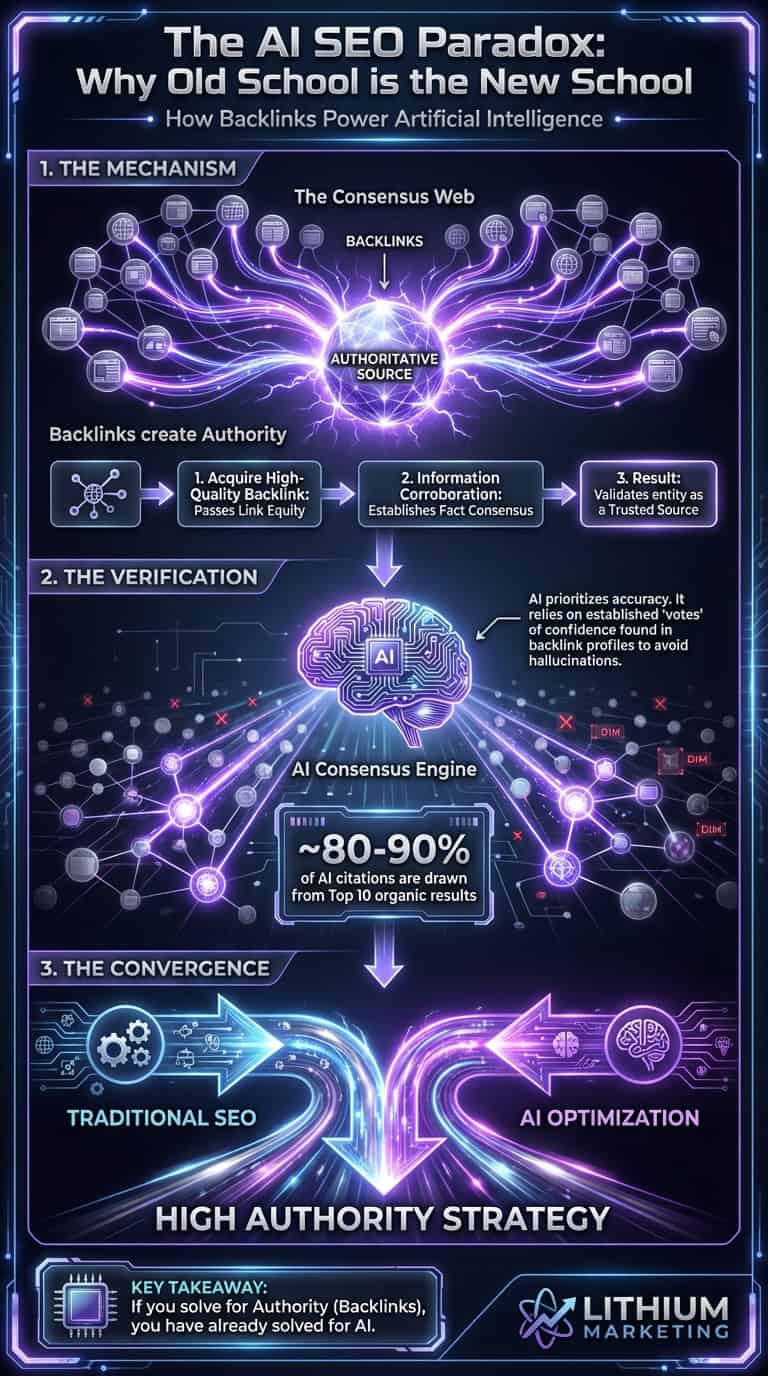
The short answer is no. In fact, the principles of foundational, human-first SEO are more critical than ever. AI search models don’t create facts from thin air; they synthesize information from the most credible sources on the existing web. As Google itself states, these AI features are designed to be a “jumping-off point” to explore web content, not replace it.
This article will demystify how AI search works and demonstrate how your existing investment in quality SEO is the best preparation for this new era. We’ll break down the core pillars that make your website a trusted source for AI and show why doubling down on quality is the key to future success.
The Engine Behind the Answers: Understanding AI Search
Before we connect AI to SEO, it’s crucial to understand that AI search isn’t magic—it’s a system that relies entirely on high-quality content from the web. This technology is dependent on the very work that great SEOs do.
So, how does it work?
- It’s Not Just a Language Model: AI search doesn’t simply rely on a pre-trained Large Language Model (LLM). If it did, the information could be outdated and prone to factual errors, or “hallucinations.”
- The Role of Retrieval-Augmented Generation (RAG): To provide current, accurate answers, these systems use a process called Retrieval-Augmented Generation (RAG). Think of it as a two-step process. First, the AI performs a traditional web search to find the best, most relevant pages on the topic. Then, it uses the content from those top-ranking pages as its source material to generate a summarized answer. The quality of the AI’s response is directly tied to the quality of the pages it finds.
- The Web is the Knowledge Base: The AI’s knowledge base is the entire indexable web. It uses semantic understanding and advanced concepts like vector embeddings to find content that is contextually relevant to a query, not just a match for specific keywords.
Actionable Tip: For your business to be mentioned in an AI Overview, your website must first be discoverable, authoritative, and relevant enough to rank at the top of that initial retrieval search. AI doesn’t replace the need to rank; it heightens it.
Creating Citable Content: Why AI Prioritizes Quality and Originality
Google’s long-term shift toward rewarding “helpful content” created for humans wasn’t just for traditional search; it was the perfect groundwork for the AI era. Unique, high-quality content is the primary signal AI models look for when choosing sources to cite.
- Aligning with the Helpful Content System: Google’s core algorithm now prioritizes content that provides a satisfying user experience and penalizes content created just for search engines. AI models are designed to tap into this same system to find reliable information. If your content is genuinely helpful to a human, it’s likely to be seen as a valuable source for an AI.
- Originality is a Premium: In an age of easy AI-generated content, unique insights are more valuable than ever. To be a cited source, your content must offer something other pages don’t, like original research, expert analysis, or unique case studies. This is why 46% of consumers trust content written by a subject matter expert above all else.
- Clarity and Structure: AI models parse well-structured content more effectively. Using clear headings (H2s, H3s), lists, and a logical flow helps the AI identify and synthesize key points for its answers, making your content easier to “read” and reference.
- Fact-Checking Against the Index: To combat hallucinations, AI systems cross-reference information against multiple trusted web sources. Websites known for factual accuracy and in-depth research are far more likely to be used as a foundational source, as their information can be corroborated by other high-quality pages.
E-E-A-T: Proving Your Expertise to Users and AI Alike
E-E-A-T (Experience, Expertise, Authoritativeness, Trustworthiness) is Google’s framework for identifying reliable content, and for an AI tasked with delivering accurate information, these signals are non-negotiable. An AI model must weigh the credibility of its sources to avoid spreading misinformation, and E-E-A-T provides the exact signals it needs.
Here’s how each component prepares you for AI search:
- Experience: The “Experience” component is vital. Content that shows first-hand product use, site visits, or personal expertise is difficult for AI to replicate and serves as a powerful, citable source. This is why Wirecutter, a New York Times company, is frequently cited in product-related AI Overviews. Its writers rigorously test and use the products they review, creating a level of detail and authenticity that AI values.
- Expertise and Authority: Author bios, credentials, and links to reputable profiles (like LinkedIn) signal expertise. Being cited by other authoritative websites builds authority. A prime example is the Mayo Clinic, which is a top source for medical queries because its content is written and reviewed by certified doctors. This establishes immense expertise and authority that an AI can trust, especially for high-stakes topics.
- Trust: Trustworthiness is the foundation. A secure site (HTTPS), clear contact information, and transparent privacy policies are critical. Ultimately, user trust in AI is heavily tied to the perceived reliability of its sources. By building a trustworthy website, you make your content a safe and credible choice for AI citation.
Topical Authority and Technical SEO: Making Your Content Easy for AI to Find and Understand
Having great content isn’t enough; AI needs to be able to access it efficiently and understand its context. This is where topical authority and technical SEO become essential pillars of your strategy.
- Becoming a Topical Authority: A website that covers a topic comprehensively from multiple angles becomes a reliable, one-stop knowledge base. When an AI needs to answer a complex query, it’s more likely to trust a site that demonstrates deep expertise across a whole subject area. This is why sites like Forbes Advisor are often cited for B2B queries—they have established deep topical authority in business technology and software comparisons.
- Leveraging Semantic Search: Modern SEO is about concepts, not just keywords. Using natural language and organizing content logically helps machines understand the context of your information. Gartner predicts that by 2025, organizations leveraging these semantic techniques will see a 30% increase in their ability to connect with their audience.
- Technical SEO as the On-Ramp: A site must be crawlable and indexable for its content to even be considered. Clean architecture, fast page speed (Core Web Vitals), and a mobile-friendly design are the non-negotiable prerequisites for your content to enter the AI’s retrieval system.
- Structured Data (Schema) is an AI “Cheat Sheet”: Schema markup explicitly defines content for search engines, labeling things like product prices, review ratings, or event dates. This provides a perfectly structured, machine-readable format that is ideal for an AI to accurately extract and include in its summaries.
Tying It All Together: Your AI-Ready SEO Checklist
The core argument is clear: the foundational SEO work you’ve been doing directly prepares your website for the age of AI search. This table breaks down how each pillar serves both traditional and generative search, making you ready for the future.
| Foundational SEO Pillar | How It Helps Traditional SEO | How It Prepares for AI Search |
|---|---|---|
| High-Quality Content | Engages users, earns backlinks, satisfies intent. | Provides a clear, reliable, and synthesizable source for AI answers. Differentiates from generic AI content. |
| E-E-A-T | Builds trust with users and Google, crucial for YMYL topics. | Acts as a critical trust and credibility filter for AI to avoid misinformation and hallucinations. |
| Topical Authority | Dominates SERPs for a niche, builds brand recognition. | Positions the site as a definitive, comprehensive knowledge base for AI to reference with high confidence. |
| Technical SEO | Ensures site is crawlable, indexable, and user-friendly. | Allows AI crawlers to efficiently access and parse content without errors, ensuring inclusion in the knowledge base. |
| Structured Data | Enables rich snippets, improves SERP visibility. | Provides explicit, machine-readable context for accurate data extraction and inclusion in AI-generated summaries. |
Final Thoughts
The integration of AI into search isn’t the end of SEO—it’s the ultimate validation of a quality-first strategy. AI models are curators, not creators, and they are programmed to seek out the most helpful, reliable, and authoritative content on the web. The job of a marketer hasn’t changed: it’s to be that best source.
While user behavior may shift, the fundamental need for trustworthy information remains. Early data already shows that users still value and click on traditional organic links below AI Overviews. By focusing on human-first content, demonstrating E-E-A-T, building topical authority, and maintaining a technically sound website, you are not just optimizing for yesterday’s algorithms; you are positioning your business for sustained success in the age of AI.
Your strategy is already 90% there. Now is the time to perfect the final 10%.
Ready to Future-Proof Your SEO?
Ensure your strategy is ready for the age of AI. Contact the experts at Lithium Marketing today to audit your AI readiness and build a plan for sustained growth.
References:
- Lewis, P., et al. (2020). Retrieval-Augmented Generation for Knowledge-Intensive NLP Tasks. arXiv.org, Cornell University.
- Google. (2023). Supercharging Search with generative AI. The Keyword Blog.
- Google. (2024). Google Search’s helpful content system and your website. Google Search Central Documentation.
- Semrush. (2023). State of Content Marketing 2023 Global Report.
- Google. (2022). Search Quality Rater Guidelines.
- Glikson, E., & Woolley, A. W. (2020). Human Trust in Artificial Intelligence: A Multidimensional Approach. MIT Sloan Management Review.
- Gartner, Inc. (2022). Predicts 2023: Artificial Intelligence Core Technologies.
- Schema.org. (n.d.). Schema.org Documentation.
- Gartner, Inc. (2024). Gartner Predicts Search Engine Volume Will Drop 25% by 2026, Due to AI Chatbots and Other Virtual Agents.
- Authoritas. (2023). SGE & The Future of SEO – Analysis of 200k+ keywords.
- BrightEdge. (2023). The Enduring Power of Organic Search.
- National Institutes of Health (NIH). (n.d.). Health Information.
- The New York Times. (n.d.). About Wirecutter.
- Google AI. (2020). Advancing Search with Deep Learning: The Power of Vector Embeddings.
- Google. (2023). How AI Overviews work. Google Search Help.
- Newman, N., et al. (2023). Digital News Report 2023. Reuters Institute for the Study of Journalism, University of Oxford.
- Forbes. (n.d.). About Forbes Advisor.