

Table of Contents
For HVAC technicians, landscapers, and painting contractors, revenue rarely moves in a straight line. It is a biological and meteorological reality that business spikes with heatwaves and spring blooms, and dips when the leaves fall or the weather turns mild. This is the “feast or famine” cycle of the home service industry. Yet, despite this predictable volatility, many business owners make a critical error in their Pay-Per-Click (PPC) management: Static Budgeting. Spending the exact same amount on ads every month—regardless of external demand—is a recipe for capital inefficiency. It means you are likely overspending during low-intent months, inflating your Cost Per Acquisition (CPA), while simultaneously capping your revenue potential during high-demand windows because your budget runs out by 2:00 PM. The solution isn’t necessarily spending more money over the course of a year; it is about spending smarter. At Lithium Marketing, we specialize in navigating these fiscal cycles. This post breaks down “Dynamic Seasonal Budgeting,” a strategy designed to protect algorithmic learning during the lulls and allow you to dominate impression share during the peaks.
The Economics of Seasonality in Home Services
Understanding the “Feast or Famine” Cycle
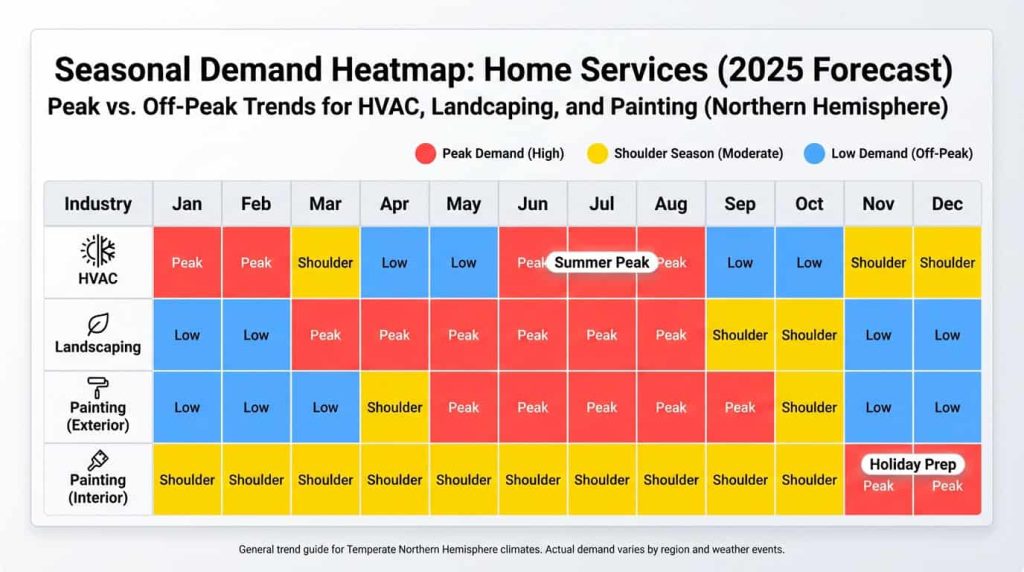
To master your budget, you first need to understand the specific economic triggers of your trade. Seasonality in home services is dictated by the difference between immediate necessity (transactional intent) and discretionary planning (research intent).
- HVAC Volatility: This industry is driven almost entirely by extreme temperatures. The “Peak” occurs during summer heatwaves and winter freezes where search intent is urgent. However, the “Shoulder Seasons” (Spring and Fall) represent the troughs. Here, the urgent repair queries drop significantly, replaced by lower-volume searches for preventative maintenance or system replacements.
- Landscaping Cycles: This trade follows a biological clock. March and April see a massive surge for installation and cleanup. Conversely, winter is often viewed as a dead zone, yet it offers a hidden opportunity for “hardscaping” design projects and snow removal contracts.
- Painting Trends: Painting is segmented by the interior versus exterior feasibility. Exterior work is strictly weather-dependent, but interior demand often spikes before the holiday hosting season in November and December.
The Cost Reality
Market dynamics obey the laws of supply and demand. During peak seasons, as consumer intent rises, more advertisers enter the auction. This increases competition. Data indicates that Cost Per Click (CPC) often inflates by 20-30% during peak months due to this auction pressure. However, business owners shouldn’t shy away from these higher costs. While the clicks are more expensive, the conversion rates often double during these times because the consumer’s “time-to-decision” is drastically shortened by urgency. A homeowner with a broken AC unit in July isn’t browsing; they are buying.
The Hidden Dangers of “Going Dark”
Why Pausing Ads Kills Your ROI
When the phone stops ringing in the off-season, the knee-jerk reaction for many business owners is to “go dark”—to pause their PPC campaigns entirely to save money. From a technical SEO and PPC perspective, this is one of the most damaging actions you can take.
Algorithmic Amnesia
Modern bidding strategies, such as Target CPA (Cost Per Acquisition) and Target ROAS (Return on Ad Spend), rely heavily on machine learning. These algorithms need a steady stream of data to predict which users are likely to convert. When you pause a campaign for longer than two weeks, you effectively delete the recent data signals the algorithm relies on. This causes “Algorithmic Amnesia.” Upon reactivation, your account is forced back into a volatile “learning phase,” resulting in erratic performance and inefficient spend for weeks while the system relearns your audience.
Quality Score Erosion
Furthermore, “going dark” can erode your Quality Score. This metric, which influences how much you pay per click, depends partly on your account history and expected click-through rate (CTR). Gaps in your account history can lower your Ad Rank, forcing you to bid significantly higher just to regain the same position you held before you paused. The Strategic Takeaway: Instead of pausing, the goal should be budget reduction and reallocation. You must keep the data pipeline open to maintain account health.
Winning the Peak Season
Aggression is Key: Maximizing Share During High Demand
During peak months—whether it’s a July heatwave or the Spring planting rush—the goal is not to generate demand, but to capture it. The demand already exists; your job is to ensure you get the lead rather than your competitor.
Search Impression Share (SIS)
Search Impression Share is the percentage of impressions your ads receive compared to the total number they could get. During peak times, your budgets should be uncapped or raised significantly to push SIS above 80-90%. If you cap your daily budget at $100 during a heatwave, and that budget is exhausted by 2:00 PM, you are invisible for the rest of the day. You are effectively handing high-intent, cash-in-hand customers to your competitors for the entire afternoon and evening.
Top of Page Dominance and Negative Keywords
Urgency-driven customers rarely scroll past the first two results. Bidding strategies should pivot toward “Target Impression Share” to dominate the top of the page. However, high volume brings high noise. Aggressive negative keyword lists are essential during peaks. You must filter out queries like “DIY,” “parts,” or “how to” to ensure your inflated peak-season budget is spent strictly on transactional leads, not researchers.
The Off-Season Pivot
Turning “Slow Months” into Pipeline Builders
Just because the immediate urgency is gone doesn’t mean marketing stops. The off-season is the prime window for nurturing leads and lowering your average Cost Per Lead (CPL).
The Power of Retargeting
Marketing theory suggests a prospect needs an average of seven interactions with a brand before purchasing (The Rule of 7). The off-season allows you to rack up these touchpoints at a discount. Users retargeted with display ads are 70% more likely to convert. You can use the off-season to retarget the “window shoppers” who visited your site during the peak season but didn’t buy.
Pivoting the Offer
Success in the off-season requires changing your “hook” to match the consumer’s mindset:
- HVAC: Switch from “Emergency Repair” to “Pre-Season Tune-Ups” or “System Replacement Financing”.
- Landscaping: Target the “Messy Middle.” Google Trends data shows that queries for “Landscaping ideas” often peak in January and February. This is the exploration phase. Promote design ideas and planning services to build a list of prospects ready to book in Spring.
Technical Tools
You can also utilize Google’s “Seasonality Adjustments” tool. This feature informs Smart Bidding algorithms of expected changes, preventing the system from overreacting to a temporary dip in conversion rates during slow months.
The Dynamic Budgeting Framework
Static vs. Dynamic Budgeting: A Comparative Look
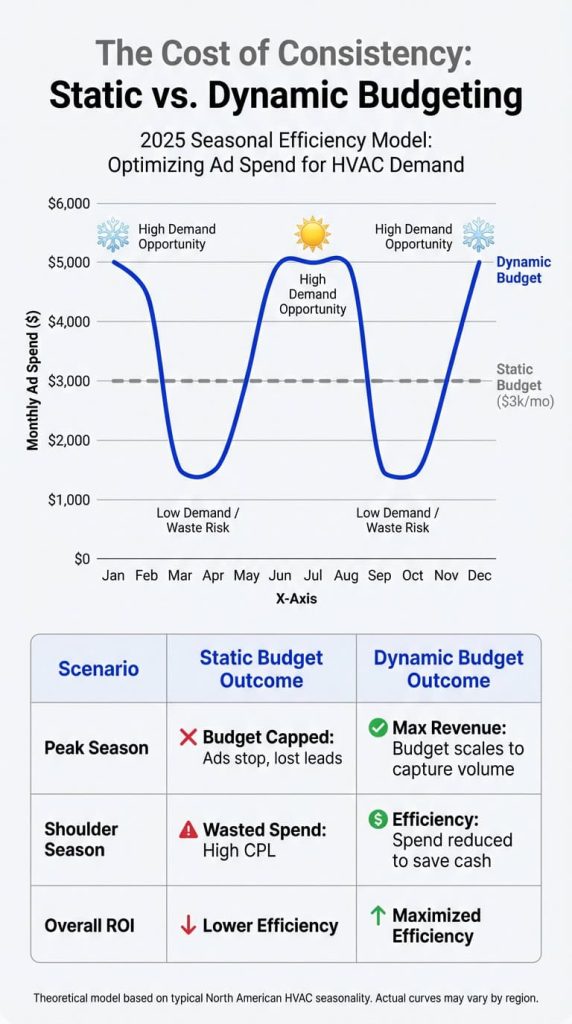
To maximize profitability, business owners must move away from flat monthly budgets. At Lithium Marketing, we recommend a Dynamic Seasonal Budgeting framework.
The 60/40 Rule
A balanced approach often involves allocating 60-70% of your annual ad budget to peak months and 30-40% to off-peak months. This ensures you have the fuel to capture maximum revenue when demand is high, while keeping the lights on for retargeting when demand is low.
Case Study Insight
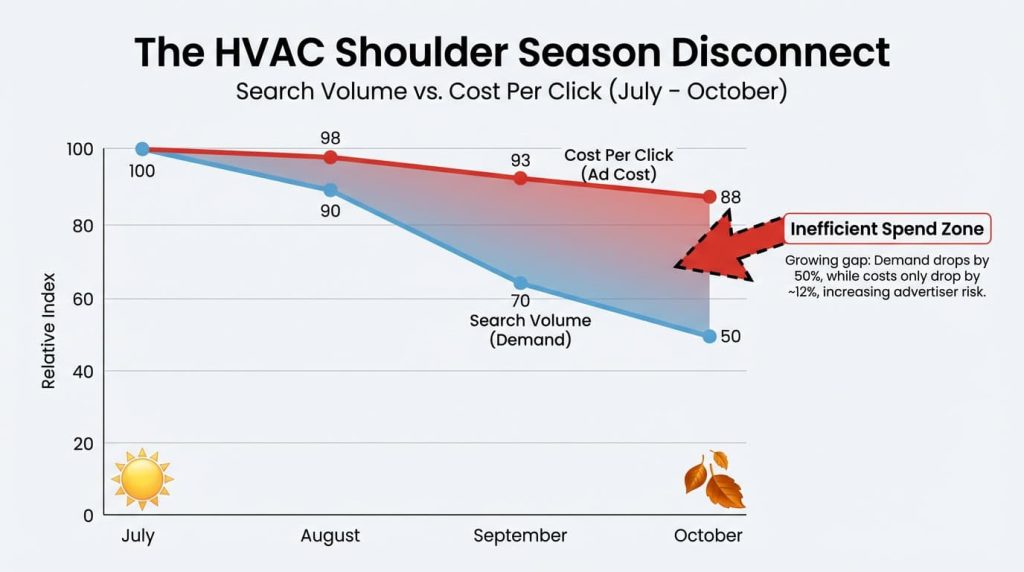
Consider the HVAC shoulder season. Search volume for “AC repair” may drop by 50% in October, but bid costs often only drop by 10-15% because competitors with static budgets are still bidding aggressively on low-volume terms. Smart budgeting avoids this trap by shifting focus to maintenance offers, where conversion rates are higher among existing homeowners.
In Closing
The “set it and forget it” methodology is a relic of print advertising. In a live digital auction, fluidity is the key to profitability. By adopting Dynamic Seasonal Budgeting, home service businesses can mitigate the “famine” by building pipelines in the off-season and maximize the “feast” by dominating impression share in the peak season.
Ready to Optimize Your Seasonal Budget?
Stop guessing with your annual spend. Align your marketing budget with the reality of your industry.
References
- ACHR News. (2023). HVAC Seasonality: Managing the Shoulder Seasons. Retrieved from https://www.achrnews.com/articles/147500-managing-hvac-business-during-shoulder-seasons
- Ahrefs. (2023). The Importance of Search Impression Share. Retrieved from https://ahrefs.com/blog/google-ads-metrics/
- Google Ads Help. (2024). About Quality Score. Retrieved from https://support.google.com/google-ads/answer/6167118
- Google Ads Help. (2024). About Seasonality Adjustments. Retrieved from https://support.google.com/google-ads/answer/9363026
- Google Trends. (2024). Explore Search Terms: Landscaping. Retrieved from https://trends.google.com/trends/explore?date=today%205-y&geo=US&q=landscaping
- LocaliQ. (2024). Search Ad Benchmarks for Home Services. Retrieved from https://localiq.com/blog/search-advertising-benchmarks/
- National Association of Landscape Professionals (NALP). (2023). Industry Growth and Seasonal Trends. Retrieved from https://www.landscapeprofessionals.org/LP/About/Industry_Statistics/LP/Media/Industry_Statistics.aspx
- Painting Contractors Association (PCA). (2023). Market Analysis for Residential Painting. Retrieved from https://www.pcapainted.org/industry-news/
- Search Engine Journal. (2023). Why You Should Never Pause Your Google Ads Campaigns. Retrieved from https://www.searchenginejournal.com/why-you-should-never-pause-google-ads/
- ServiceTitan. (2023). HVAC Marketing Strategies for Slow Seasons. Retrieved from https://www.servicetitan.com/blog/hvac-marketing-slow-season
- Spiralytics. (2024). The Science of Retargeting: Statistics and Trends. Retrieved from https://www.spiralytics.com/blog/retargeting-statistics/
- WordStream. (2024). Google Ads Benchmarks for Your Industry. Retrieved from https://www.wordstream.com/blog/ws/2016/02/29/google-adwords-industry-benchmarks