
Table of Contents
- Why Great Marketing Fails Without Operational Excellence
- Stop Hemorrhaging Leads: AI-Powered Call Recovery Systems
- Kill the Paperwork: How AI Turns Voice Notes Into Billable Invoices
- End Mid-Job Parts Runs: AI That Knows What You’ll Need Before You Do
- Smart Dispatching: AI That Routes Technicians Like a Chess Grandmaster
- Turn Every Job Into a Google Review (And a Future Sale)
- Final Thoughts
The home service industry is at a crossroads. Your digital marketing is working—your SEO brings in high-intent leads, your Google Ads are converting, and the phone is ringing. But here’s the brutal truth: if your operations can’t handle the volume, you’re throwing money down the drain. By 2026, artificial intelligence won’t be a “nice-to-have” for plumbers, HVAC techs, electricians, and roofers—it will be the difference between businesses that scale profitably and those that collapse under administrative weight. According to the U.S. Chamber of Commerce, 88% of small businesses using AI report significant time savings, while 70% have seen direct profitability increases. This isn’t about robots replacing your technicians. It’s about eliminating the operational bottlenecks that prevent you from capitalizing on every marketing dollar spent. From missed calls that cost you thousands monthly to technicians buried in paperwork instead of billable work, AI automation solves the hidden profit killers in your business. In this post, we’ll break down five highly specific, ROI-driven AI automations that home service businesses must implement by 2026—not because they’re trendy, but because your competitors already are.
Why Great Marketing Fails Without Operational Excellence
Even the best SEO strategy falls flat if your business can’t handle the lead volume. This is the core problem plaguing the home service industry: the disconnect between digital marketing success and backend operational capacity.
The Marketing-Operations Disconnect
Agencies like Lithium Marketing excel at driving traffic and generating leads through strategic SEO, web design, and local visibility campaigns. But if your phones go unanswered or estimates take days to deliver, conversion rates plummet. You’re paying to generate leads that simply vanish into the void because your operations can’t keep pace.
The Labor Shortage Crisis
The challenge is compounded by a brutal reality: the home service industry faces an 88% skilled labor shortage. With fewer technicians available, operational efficiency isn’t just important—it’s non-negotiable. Every minute your existing team spends on administrative tasks instead of billable work is a minute you can’t afford to lose.
The Cost of Inaction
The competitive landscape is shifting rapidly. Salesforce projects 43% year-over-year growth in AI adoption for field service operations. This means businesses that delay implementation will face a compounding competitive disadvantage. While you’re manually scheduling jobs and chasing paperwork, your competitors are completing more jobs per day with the same headcount.
The AI Opportunity
Here’s the silver lining: McKinsey estimates that generative AI can absorb up to 30% of administrative work hours. This isn’t theoretical—it’s happening right now. Forward-thinking contractors are freeing their technicians to focus entirely on revenue-generating activities while AI handles the rest. The question isn’t whether you need operational efficiency. It’s whether you’ll achieve it through AI automation or by burning out your team trying to do it manually.
Stop Hemorrhaging Leads: AI-Powered Call Recovery Systems
When a homeowner with a burst pipe calls and you don’t answer, they’re not leaving a voicemail—they’re calling your competitor. This single operational failure is costing home service businesses thousands of dollars monthly in lost revenue.
The Problem
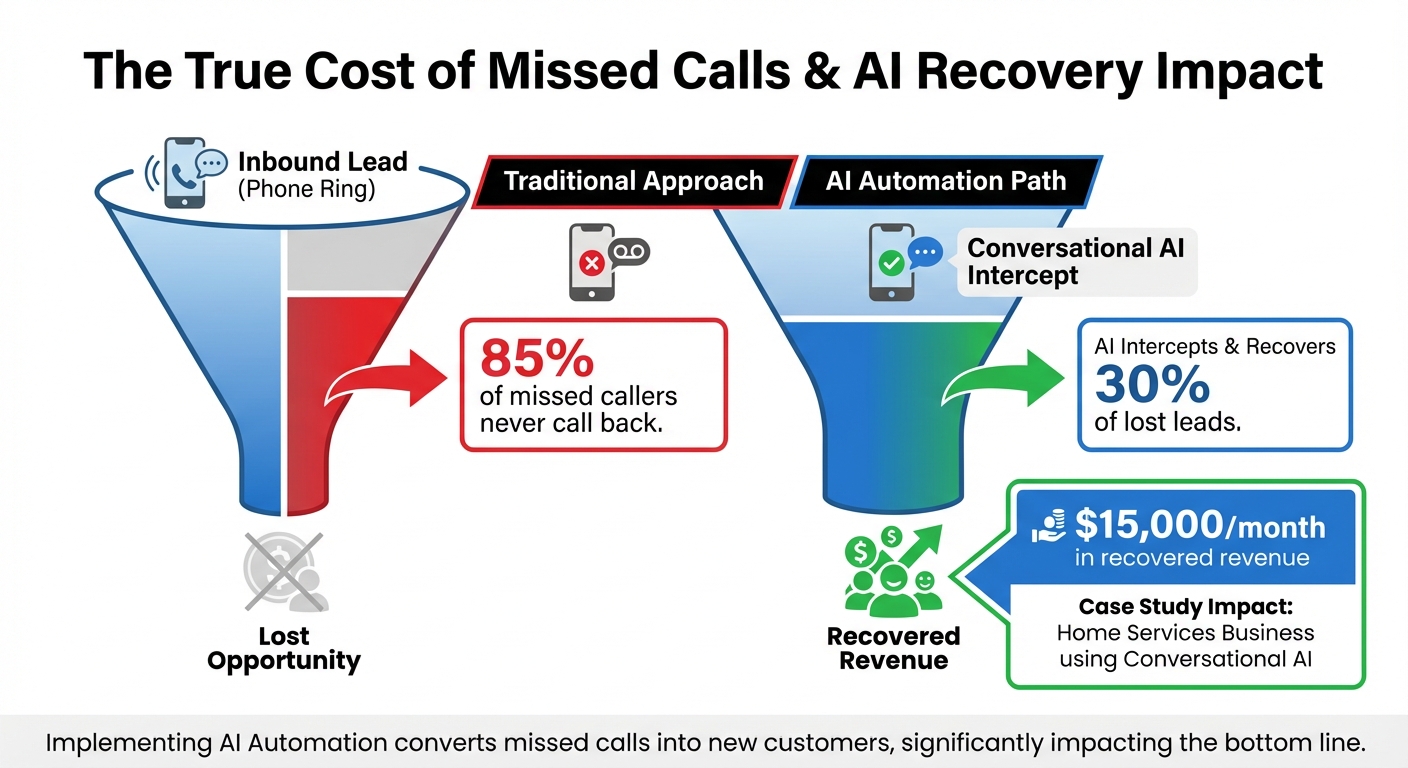
The statistics are sobering: 85% of consumers whose calls are missed will not call back. Think about that for a moment. Your SEO is working, your ads are converting, and someone with an urgent need is actively trying to give you money. But because you’re on another job or it’s after hours, that lead evaporates instantly. For a business generating 50 inbound calls weekly, missing just 20% means losing 10 potential customers. At an average job value of $500, that’s $5,000 in weekly lost revenue—over $20,000 monthly—simply because you couldn’t answer the phone.
The Solution
Conversational AI systems intercept missed calls with instant, context-aware SMS messages. Within seconds of a missed call, the customer receives a text like: “Hi, this is Mike’s Plumbing. We’re on a job, but how can we help you today?” This isn’t a generic autoresponder. The system recognizes it’s a missed call, acknowledges the customer’s need, and opens a conversation channel immediately.
Advanced Capabilities by 2026
The technology evolves rapidly. By 2026, Natural Language Processing will parse customer text responses, check real-time technician availability in your CRM, and autonomously book appointments without human intervention. The customer texts “water heater leaking,” and the AI responds with available time slots, confirms the booking, and adds it to your schedule—all while you’re finishing another job.
ROI Impact
Businesses implementing automated text-back systems recover up to 30% of otherwise lost revenue. For that same business losing $20,000 monthly to missed calls, AI call recovery captures an additional $6,000 in revenue—every single month.
When we talk about AI automation, this is the low-hanging fruit. You’re already generating the leads. You’re just not capturing all of them.
Kill the Paperwork: How AI Turns Voice Notes Into Billable Invoices
Technicians spending hours on post-job documentation is unbillable time that kills profitability. Every minute your team spends writing up invoices, filling out service forms, or updating your CRM is a minute they’re not generating revenue.
The Unbillable Time Problem
Field technicians often spend 1-2 hours daily on paperwork, invoicing, and CRM updates. For a team of five technicians, that’s 5-10 hours of lost productivity every single day. At $100 per billable hour, you’re losing $500-$1,000 daily to administrative tasks. Worse, this paperwork typically happens at the end of long workdays when accuracy suffers. Rushed documentation leads to invoice errors, missing line items, and customer disputes that delay payment cycles.
How It Works
Large Language Models trained on industry terminology allow technicians to dictate field notes immediately after job completion. The technician simply speaks into their phone: “Replaced a 40-gallon Bradford White water heater with a Honeywell expansion tank. Used two copper fittings and six feet of PEX. Took 2.5 hours. Customer requested quote for bathroom remodel.” The AI structures this voice data into a formatted invoice, logs the parts used against inventory, updates the customer’s CRM profile with the remodel quote opportunity, and sends the invoice for immediate payment—all while the technician is already driving to their next job.
Technical Accuracy
Modern AI systems learn industry-specific jargon and technical terminology. They understand the difference between a “Bradford White water heater” and a “water softener,” between a “Honeywell expansion tank” and a “pressure relief valve.” The system translates conversational speech into structured, professional documentation that requires minimal human review.
Profitability Impact
Eliminating 1-2 hours of daily admin work per technician allows businesses to schedule an additional 0.5-1 jobs daily. For a five-technician team, that’s 2-5 additional jobs per day. At an average job value of $400, that’s $800-$2,000 in additional daily revenue—$20,000-$50,000 monthly—without adding headcount.
The message is clear: administrative work is a profit killer. Voice-to-invoice AI eliminates it entirely, freeing your team to do what they do best—fix problems and generate revenue.
End Mid-Job Parts Runs: AI That Knows What You’ll Need Before You Do
Parts shortages force technicians to make supply runs mid-job, killing productivity and frustrating customers. This seemingly small inefficiency cascades into massive revenue loss across your fleet.
The Parts Run Problem
Mid-job supply runs cost 30-45 minutes per occurrence. The technician leaves the job site, drives to a supplier, locates the part, waits in line, drives back, and resumes work. During this time, the customer is waiting, your technician isn’t generating revenue, and your schedule is falling behind. Multiply this across a fleet of five technicians, each making two parts runs weekly, and you’re losing 5-7.5 hours of productivity weekly—20-30 hours monthly. At $100 per billable hour, that’s $2,000-$3,000 in lost revenue, not including the fuel costs and customer frustration.
How Predictive Inventory Works
AI algorithms analyze historical sales data, upcoming scheduled maintenance appointments, and even local weather forecasts to automate inventory management. The system learns patterns: capacitors fail at higher rates during heatwaves, water heaters are replaced more frequently in winter, HVAC filters need replacing every 90 days. When a heatwave is forecast for your service area, the AI predicts increased HVAC capacitor failures and automatically flags inventory levels. When you have 15 annual maintenance appointments scheduled for next week, it ensures you have adequate filter stock.
Automated Ordering
The system drafts purchase orders for fast-moving parts before stockouts occur. You receive a notification: “Based on historical usage and upcoming appointments, you’ll need 12 HVAC capacitors by Friday. Approve order?” One click, and the parts are ordered and scheduled for delivery. This isn’t reactive ordering when you run out—it’s proactive management that ensures technicians always have what they need.
Supply Chain Resilience
With ongoing supply chain volatility, predictive ordering prevents emergency expedited shipping costs. Instead of paying 2-3x normal pricing for overnight delivery when you unexpectedly run out of a critical part, you maintain optimal stock levels through intelligent forecasting.
ROI Impact
Gartner research shows that supply chain organizations using AI-driven predictive analytics reduce inventory carrying costs by up to 20% while improving part-availability rates to 95%+. You’re stocking less capital in slow-moving inventory while ensuring fast-moving parts are always available.
Smart inventory isn’t about having everything. It’s about having exactly what you need, exactly when you need it.
Smart Dispatching: AI That Routes Technicians Like a Chess Grandmaster
Traditional zone-based dispatching breaks down during traffic anomalies and emergency calls. Static schedules can’t adapt to the dynamic reality of field service work, costing you completed jobs and frustrated customers.
The Static Schedule Problem
Traditional dispatching assigns jobs based on geography and human estimation. Your dispatcher looks at the day’s jobs, divides them into zones, and assigns technicians based on who’s closest. It’s simple, intuitive, and increasingly obsolete. This approach fails to account for real-time traffic conditions, varying job durations based on technician skill levels, or the cascade effect when one job runs long. When your 1:00 PM appointment turns into a 3:00 PM start because the morning job took longer than expected, customer complaints roll in and your evening schedule collapses.
How Dynamic Routing Works
AI continuously calculates optimal routes using real-time traffic data, historical job-duration metrics, and skill-matching algorithms. The system knows that Technician A completes AC tune-ups 15 minutes faster than Technician B. It knows that the route to your 2:00 PM appointment has a 25-minute traffic delay right now. It knows which technician is closest to the new emergency call that just came in. The AI makes routing decisions that human dispatchers simply can’t process fast enough. It’s running thousands of scenario calculations per minute, continuously optimizing the day’s schedule.
Real-Time Adaptability
When a job runs long, the AI automatically reshuffles the day’s schedule and sends proactive SMS updates to waiting customers: “Hi John, Mike is running 30 minutes behind on his previous job. Your new arrival window is 2:30-3:00 PM. Reply CANCEL if this doesn’t work for you.” This proactive communication prevents angry phone calls and no-shows. Customers appreciate the transparency, and your team isn’t constantly firefighting scheduling conflicts.
Fuel Cost Reduction
Dynamic routing algorithms reduce fleet mileage by 10-15% by continuously optimizing routes rather than following predetermined paths. With fuel costs representing a significant operating expense, a 15% reduction directly improves your bottom line. For a fleet covering 500 miles daily, a 15% reduction saves 75 miles—approximately 3 gallons of fuel at current commercial vehicle efficiency. At $4 per gallon, that’s $12 daily savings, $300 monthly, $3,600 annually. Scale that across a larger fleet, and the savings compound significantly.
Revenue Multiplication
The real win is increased job completion. Increasing daily job completion from 4.2 to 4.8 jobs per technician represents a 14% revenue increase without adding headcount.
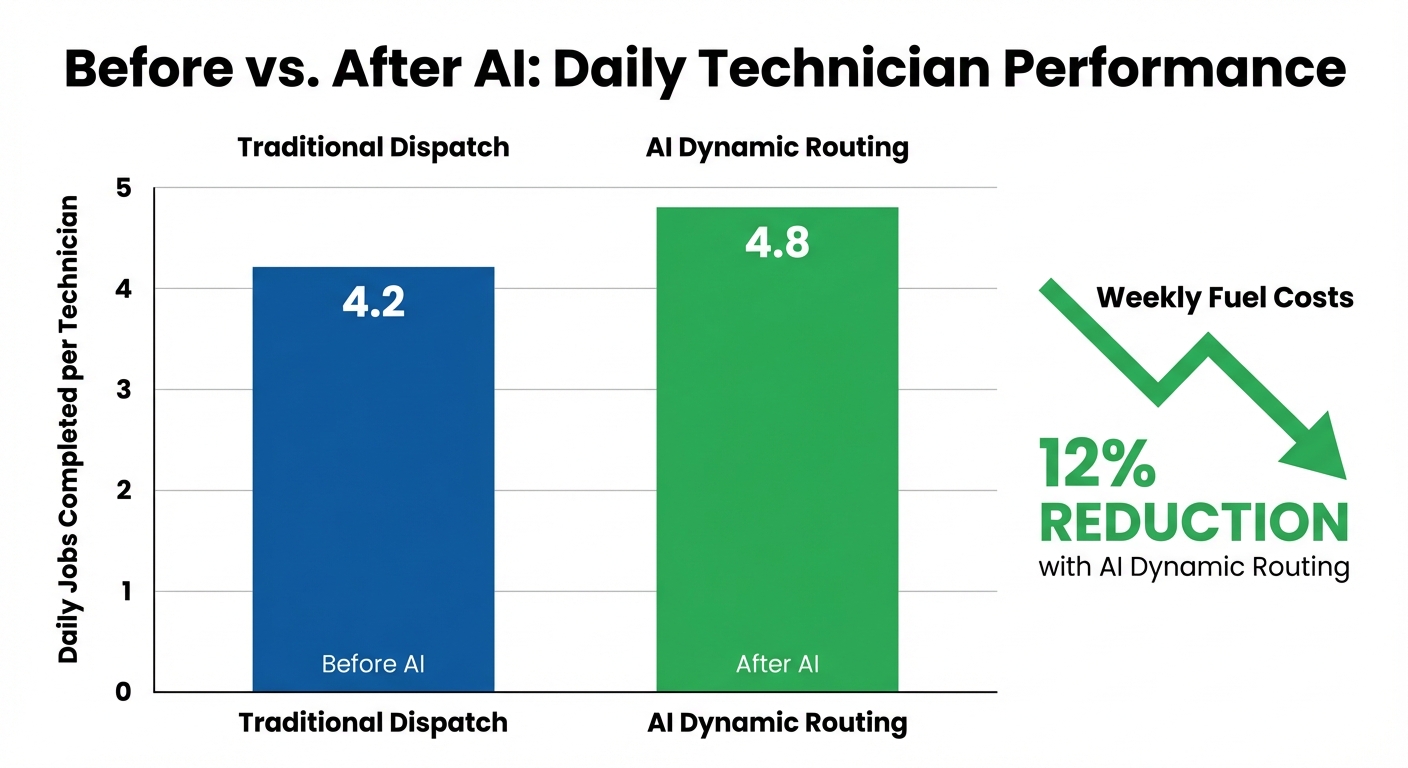
Dynamic AI routing turns your dispatch operation from a reactive firefight into a proactive optimization engine.
Turn Every Job Into a Google Review (And a Future Sale)
Google reviews are SEO currency, but manually chasing them is inconsistent. For agencies like Lithium Marketing, consistent review flow is critical for maintaining and improving local pack rankings. AI automation ensures you never miss an opportunity to capture reviews and future sales.
The Review Gap
Most home service businesses complete excellent work but fail to capture reviews consistently. Technicians forget to ask, customers forget to leave them, and the moment passes. You’re doing five-star work but have a three-star online reputation because your review generation is inconsistent. This directly impacts your SEO performance. Google’s local pack algorithm heavily weights review quantity, recency, and rating. Without a steady stream of fresh reviews, your rankings stagnate while competitors who automate review generation climb above you.
Automated Review Requests
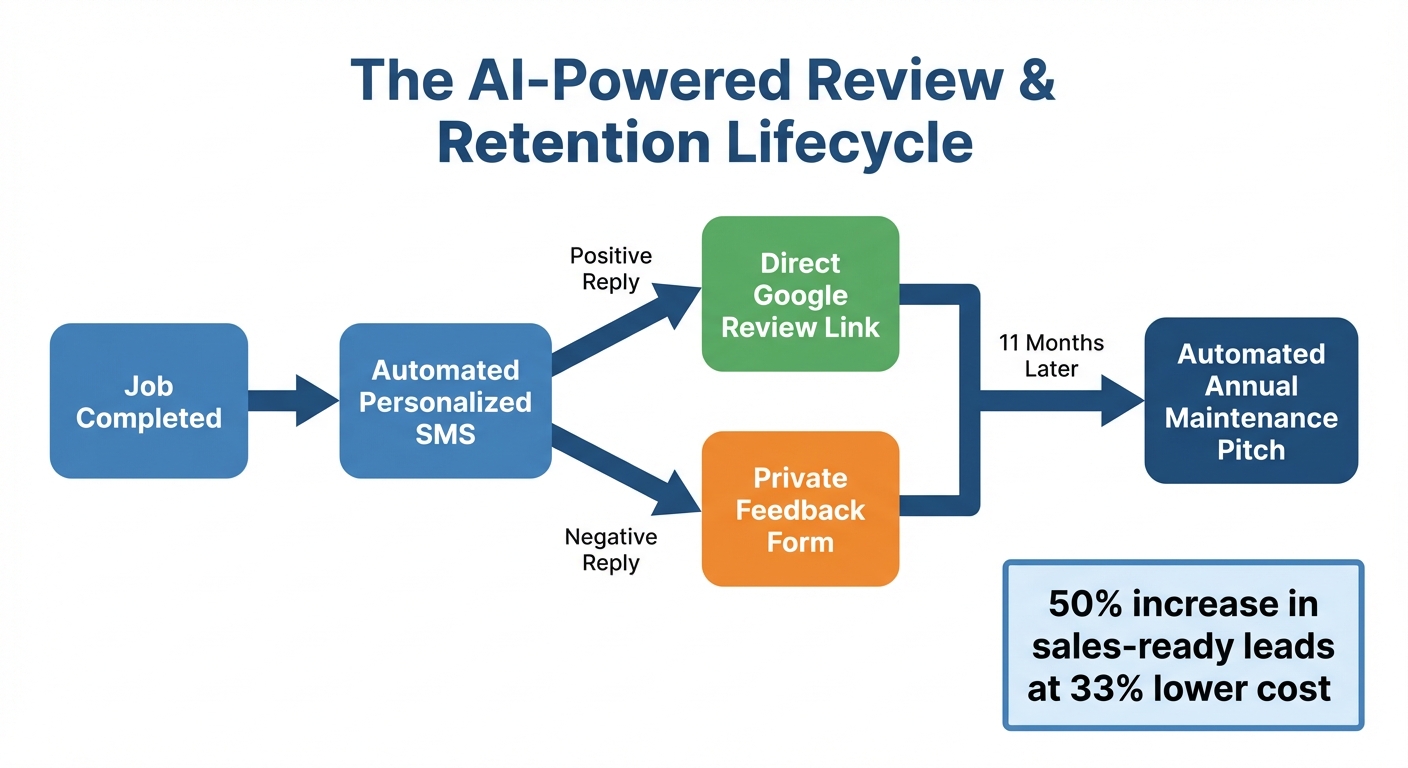
Post-job, AI workflows dispatch personalized follow-up messages based on the specific service provided: “Hi John, Mike here from ABC Plumbing. How’s the new water heater working out? Any issues with the installation?” This isn’t a generic “please leave us a review” message. It’s a personalized check-in that demonstrates you care about the customer’s experience. When John responds positively—“Works great, thanks!”—the AI triggers a second message with a direct Google Review link: “That’s great to hear! If you have 60 seconds, we’d really appreciate a Google review. It helps other homeowners find us.”
Negative Feedback Interception
When a customer responds negatively, the AI routes them to a private feedback form instead of Google. This prevents public damage while capturing improvement opportunities: “We’re sorry to hear that. Can you tell us what went wrong? [Private Feedback Link]” Your team receives an immediate alert to address the issue personally, often converting a potential negative review into a resolved complaint and eventual positive review.
Predictive Lifecycle Marketing
The AI logs future service dates based on equipment lifecycles. When you install a water heater with an expected 10-year lifespan, the system automatically schedules a check-in at the 9-year mark. For annual maintenance contracts, it triggers outreach 11 months after installation. These aren’t cold sales calls—they’re timely, relevant offers based on predictable service needs: “Hi John, it’s been almost a year since we installed your water heater. Time for your annual maintenance check? Reply YES for scheduling options.”
ROI Impact
Harvard Business Review found that companies automating customer nurturing see a 50% increase in sales-ready leads at 33% lower cost. You’re converting one-time customers into lifetime relationships through systematic, automated follow-up.
SEO Connection
For agencies like Lithium Marketing driving traffic to your website, consistent review generation creates a positive feedback loop. More reviews improve your local pack rankings, which drives more traffic, which generates more leads, which creates more review opportunities. AI automation ensures this cycle runs continuously without manual intervention. When you automate review generation and lifecycle follow-ups, you’re not just collecting testimonials—you’re building a systematic revenue engine that compounds over time.
Final Thoughts
The home service businesses that dominate 2026 won’t just have better marketing—they’ll have eliminated the operational friction that prevents scaling. While your competitors drown in missed calls, paperwork, and inefficient routing, you’ll be capturing every lead, completing more jobs per day, and building a Google review machine that feeds your SEO rankings. These five AI automations—automated call recovery, voice invoicing, predictive inventory, dynamic routing, and intelligent follow-ups—aren’t futuristic fantasies. They’re practical, ROI-driven tools already being deployed by forward-thinking contractors. The question isn’t whether AI will reshape your industry—it’s whether you’ll lead the transformation or get left behind. If your digital marketing agency is delivering high-intent leads but your operations can’t convert them efficiently, you’re leaking profit at every stage. AI doesn’t replace the human touch that makes your service business great. It eliminates the administrative burden that prevents you from delivering it consistently.
Your marketing is bringing customers to your door. Make sure your operations can handle them when they arrive.
Ready to Maximize Your Marketing ROI?
Align your digital marketing with operational excellence to capture every lead and maximize conversion rates.
Discover how AI-powered operations maximize the ROI of your SEO and advertising investments.
References:
- U.S. Chamber of Commerce. (2023). Empowering Small Business: The Impact of Technology on U.S. Small Business. Retrieved from https://www.uschamber.com/small-business/empowering-small-business-the-impact-of-technology-on-u-s-small-business
- Salesforce. (2024). State of Service Report: AI Adoption in Customer Operations. Retrieved from https://www.salesforce.com/resources/research-reports/state-of-service/
- Forbes. (2023). The Cost Of Poor Customer Service And How To Fix It. Retrieved from https://www.forbes.com/advisor/business/cost-of-poor-customer-service/
- McKinsey & Company. (2023). The economic potential of generative AI: The next productivity frontier. Retrieved from https://www.mckinsey.com/capabilities/mckinsey-digital/our-insights/the-economic-potential-of-generative-ai-the-next-productivity-frontier
- Gartner. (2023). Magic Quadrant for Field Service Management. Retrieved from https://www.gartner.com/en/documents/4021204
- MIT Center for Transportation & Logistics. (2022). AI-Driven Routing for Last-Mile Operations. Retrieved from https://ctl.mit.edu/research/current-projects/last-mile-logistics
- Harvard Business Review. (2022). How AI Is Changing Sales. Retrieved from https://hbr.org/2018/07/how-ai-is-changing-sales