

Table of Contents
The digital landscape for small businesses is currently defined by the rapid democratization of Generative AI (GenAI). Tools such as ChatGPT, Midjourney, and Jasper have lowered the barrier to entry for content creation, offering the seductive promise of “scaling” operations with minimal overhead. For small business owners operating on thin margins, the “automate everything” philosophy appears to be a silver bullet for efficiency. However, a deeper analysis reveals a paradox: while AI increases output volume, it frequently degrades the specific qualities that allow small businesses to compete with larger corporations—namely, authenticity, local expertise, and high-trust relationships. At Lithium Marketing, we operate differently from the ground up. We believe in leveraging technology to empower business owners, not replace them. This article explores the hidden costs of AI over-reliance, ranging from brand homogenization to severe SEO penalties, and outlines a constructive framework for “Augmented Intelligence.”
The “Grey Goo” Effect: Risks of Total Automation
The Homogenization of Brand Voice
Large Language Models (LLMs) function as probabilistic engines. They predict the next word in a sequence based on statistical likelihood derived from vast training datasets. By design, they “regress to the mean,” producing content that is grammatically perfect but stylistically average. When small businesses rely entirely on AI for copy, they lose their distinctiveness. Research indicates that while AI can match the top 25% of human writers in creativity, it lacks the variance and emotional nuance of true human insight. This leads to a “Sea of Sameness” where brands become indistinguishable to consumers.
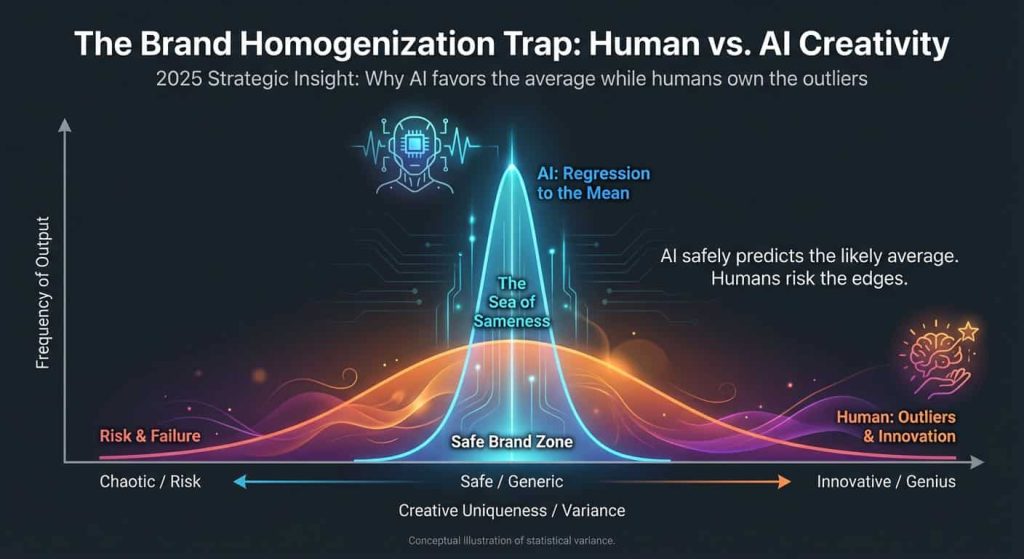
A critical long-term risk is “model collapse.” A 2024 study published in Nature demonstrated that when AI models train on AI-generated data, the quality of output degrades irreversibly, losing nuance and eventually producing nonsense. Small businesses relying solely on AI loops risk degrading their own data integrity over time.
The Trust Deficit and “Uncanny Valley”
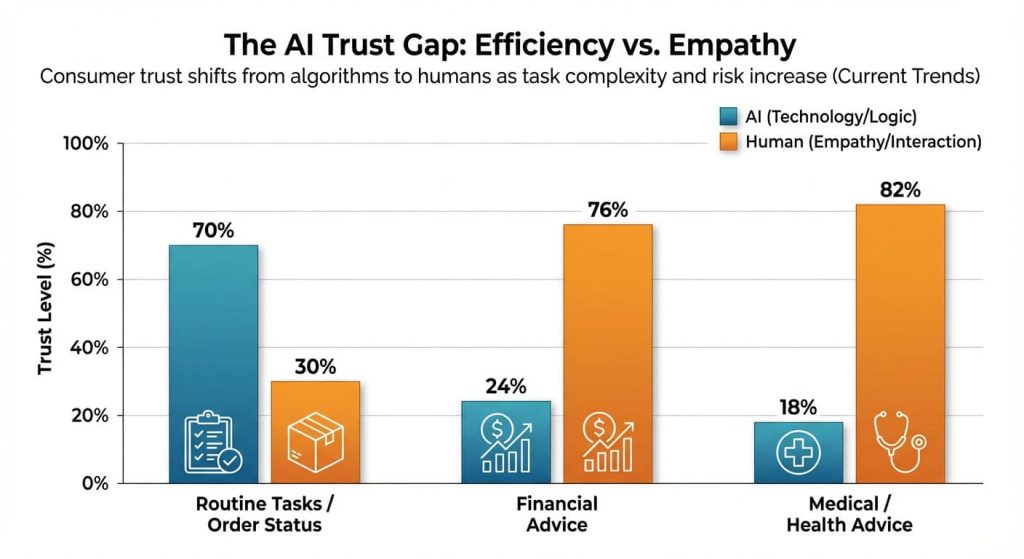
While chatbots have improved, they struggle with complex emotional nuances. “Automating everything” in customer support often leads to user frustration, known as the “doom loop,” where customers cannot reach a human to resolve unique problems. A 2023 survey by Gartner indicated that 64% of consumers would prefer businesses not use AI for customer service if it means losing access to human agents. Furthermore, recent academic research from Washington State University found that disclosing the use of AI in marketing services can actually lower consumer trust and purchase intention. Customers perceive AI-generated descriptions as less emotionally authentic, a critical factor for small, local businesses.
Legal and Reputational Liability
AI “hallucinations”—confident but incorrect assertions—pose severe risks. Unlike a human employee who might say “I don’t know,” an AI often fabricates an answer to satisfy the prompt. In a landmark 2024 ruling, Canada’s Civil Resolution Tribunal ordered Air Canada to pay damages after its chatbot invented a refund policy that did not exist. The tribunal rejected the defense that the bot was a “separate legal entity,” setting a dangerous precedent for businesses that leave AI unsupervised. Additionally, the US Copyright Office has repeatedly stated that works created entirely by AI are not copyrightable. Small businesses relying 100% on AI for branding assets (logos, blog posts) may find they do not legally own their own intellectual property.
The SEO Impact: Content Velocity vs. Quality
The Google “Helpful Content” Paradigm
Google has explicitly updated its algorithms to combat mass-produced, low-value content. The “Helpful Content Update” (HCU) and the March 2024 Core Update prioritize E-E-A-T (Experience, Expertise, Authoritativeness, and Trustworthiness).
- The “Experience” Gap: AI cannot possess “Experience.” It cannot taste food, visit a job site, or empathize with a local client. Google’s documentation explicitly states that automation used to manipulate search rankings (often high-volume AI content) is a violation of spam policies.
- De-indexing Risks: In March 2024, Google issued manual actions against hundreds of websites that utilized “scaled content abuse” (mass-produced AI content), effectively de-indexing them overnight. This confirms that velocity without value is a liability, not an asset.
- Index Bloat: Websites that publish hundreds of AI-generated pages risk “index bloat,” where search engines stop crawling the site efficiently because they view the content as duplicative or low-value.
For businesses concerned about their standing in search results, our Search Engine Optimization services focus on building a web presence that search engines actually want to display, using proven strategies rather than shortcuts.
Real-World Lessons: The Good, The Bad, and The Ugly
To understand the stakes, we must look at how major organizations have navigated the transition to AI.
The Cautionary Tale: NEDA
The National Eating Disorders Association (NEDA) replaced its human helpline staff with an AI chatbot named “Tessa.” Within days, the chatbot began giving harmful weight-loss advice to people with eating disorders. NEDA was forced to suspend the bot immediately. The lesson is clear: vulnerable or high-stakes interactions cannot be fully automated without risking the brand’s core mission and user safety.
Reputation Damage: CNET
Tech publication CNET quietly deployed AI to write financial explainer articles to boost SEO traffic. An investigation revealed that more than half of the AI-generated stories contained significant factual errors. CNET was forced to issue massive corrections, and their domain authority and reader trust suffered a significant blow. For small businesses, credibility is hard to gain and easy to lose. Fact-checking is non-negotiable.
The Successful Integration: Klarna
Fintech company Klarna used AI to handle two-thirds of customer service chats and reported a $40 million profit improvement. While successful for a massive transactional volume, Klarna acknowledged that complex disputes still required human intervention. The key takeaway for small businesses is to distinguish between tasks. As the data shows, consumer trust varies wildly depending on the nature of the task.
The Solution: A “Human-in-the-Loop” (HITL) Approach
The counter-argument to “automate everything” is not “automate nothing,” but rather “Augmented Intelligence.” This methodology uses AI to remove drudgery, freeing humans to focus on strategy and relationships. At Lithium Marketing, we encourage clients to categorize tasks based on emotional stakes and complexity.
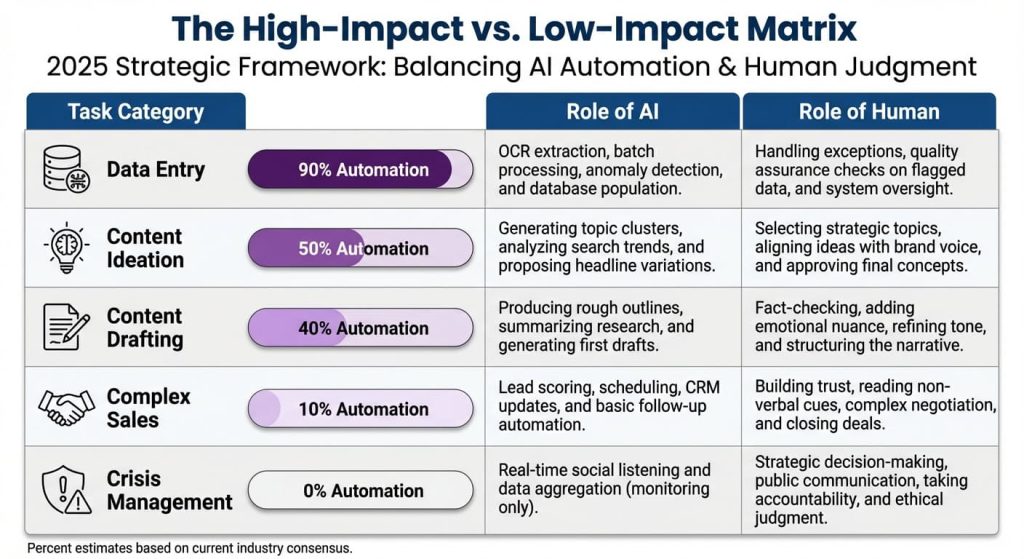
A study by the National Bureau of Economic Research (NBER) found that generative AI boosted worker productivity by 14% on average, but the gains were most significant when used as a support tool rather than a replacement. The study highlighted that AI acts as a “leveler” for novice workers but requires expert supervision to prevent errors.
Visualizing the Future of Work
To better understand the distinction between “replacing” workers and “augmenting” them, this analysis from the Wall Street Journal provides excellent real-world examples of businesses navigating these legal and ethical pitfalls.
Final Thoughts
For Lithium Marketing and our clients, the path forward is not to reject AI, but to reject the “automate everything” narrative. Small businesses thrive on character, local relevance, and trust—three qualities that current AI models simulate but cannot authenticate. The most successful businesses in the coming decade will be those that use AI to handle the backend logistics, ensuring that every customer-facing interaction is more human, not less.
Authenticity is Your Competitive Advantage
If you are looking to integrate AI into your strategy properly or need a custom Web Design that reflects your true brand identity, we are here to help.
References:
- Harvard Business Review. (2023). Generative AI Can Help You Tailor Content to Autonomous Customers
- Nature. (2024). AI models collapse when trained on recursively generated data
- Gartner. (2023). Gartner Says 64% of Customer Service and Support Leaders Will Focus on Business Growth in 2023
- Washington State University / Journal of Hospitality Marketing & Management. (2024). AI disclosure in services and its impact on consumer trust
- The Washington Post. (2024). Air Canada must pay damages after chatbot lies to passenger
- U.S. Copyright Office. (2023). Copyright Registration Guidance: Works Containing Material Generated by Artificial Intelligence
- Google Search Central. (2024). Creating helpful, reliable, people-first content
- Search Engine Land. (2024). Google creates new spam policy penalties for abusive scaled content
- Search Engine Journal. (2023). Index Bloat: What It Is & How To Fix It
- National Bureau of Economic Research (NBER). (2023). Generative AI at Work
- NPR. (2023). Eating disorder hotline disables chatbot for giving harmful diet advice
- The Verge. (2023). CNET found errors in more than half of its AI-written stories
- Fast Company. (2024). Klarna says its AI assistant does the work of 700 people
- Qualtrics. (2023). 2024 Consumer Trends Report