
 Commercial glass
Town & Country Glass
13Xorganic traffic
145 to 1,849 visits a month
- top-3 rankings, up from 1
- 109
- top-3 rankings, up from 1
- Google Ads conversion rate
- 29.9%
- Google Ads conversion rate
Web design in Aloha, Oregon
Aloha contractors and service companies get a WordPress site built for phones, with their own job photos up front and the domain in their name.
 Google PartnerView our Partners listing
5.0on Google · read our reviews
Google PartnerView our Partners listing
5.0on Google · read our reviews
Businesses
we’ve worked with
Businesses we’ve worked with
What the site is for
A service business website has done its job when the visitor picks up the phone or sends a quote request. Lithium Marketing builds every site toward that moment, on WordPress, with the domain and content in your name. In Aloha the houses set the content: the median Aloha home was built in 1984, against 1990 for Washington County as a whole, so repair, upgrade and remodel jobs belong at the front of the site.
Across Washington County, 35.8% of homes were built before 1980; in Aloha the figure is 43.5%. Sites for plumbers, electricians and roofers who work on those houses should show the jobs older homes bring, such as panel upgrades, repipes and reroofs, each with a before-and-after photo.
From search to site
Yelp, HomeAdvisor and MapQuest all showed in Google’s top 10 for “plumber aloha or”. A directory profile gives you a few photos and a short blurb; your own site has room for a gallery per service, a page per city and a quote form, so link every listing to it and keep the business name and phone number identical in both places.
Each service page puts a tap-to-call button and a short quote form on the first screen of a phone. GA4 and call tracking tag every call and form with the page and source behind it, so your first report already splits website calls from Google profile calls.
| Search | Searches a month | Cost per click |
|---|---|---|
| web design aloha or | under 10 | not reported |
| web designer aloha or | under 10 | not reported |
| website design aloha or | under 10 | not reported |
Source: Google Ads keyword data, average monthly U.S. searches. "Under 10" = below Google’s reporting floor.
Source: one Google results page for “plumber aloha or”, as Google showed it to a searcher located in Aloha. Search ad counts exclude sponsored local listings. Results shift by searcher and day.
Aloha homes
New construction is a small slice: 9.7% of Aloha homes were built in 2010 or later, compared with 14.4% countywide. A builder or remodeler selling in Aloha should lead with remodels, additions and upgrades on existing houses, and keep new builds in a second gallery.
The median Aloha home is valued at $484,400, against $588,000 for Washington County. A house at that price is a big thing to hand to a contractor, so each gallery photo gets a line on what was done, and the quote form asks about the project as well as the name and number.
Sources: U.S. Census Bureau 2025 population estimates, ACS 2020–2024 and 2023 County Business Patterns.
Trades and first screens
Three of the bigger groups on the Washington County chart sell projects: 310 new home builders, 307 residential remodelers and 197 painting contractors. Their sites lead with labeled galleries for kitchens, additions, new builds or exteriors, and the estimate form collects the project type, the address and a hoped-for start date.
Urgent work flips the order. For a plumber, electrician or water damage crew, the first thing on a phone screen is a call button with the cities you cover beneath it, and photos and reviews sit further down for the customer who has a minute to compare.
County Business Patterns
Trade and home service businesses in Washington County
Establishments by industry, 2023
Source: U.S. Census Bureau, 2023 County Business Patterns (NAICS establishment counts).
From kickoff to launch
You sign off on each checkpoint before the next one starts.
We start with a call about the work you sell and the places you go, then draft every page ourselves; your part is a folder of finished-job photos.
Before any desktop design, you approve how a service page looks on a phone: where the call button sits, how the gallery scrolls and how short the quote form is.
Pages, galleries and forms are built in WordPress, every call and form is tagged in GA4 and call tracking, and each phone link is tried on real devices.
Old page addresses point to their new pages so existing links keep working, the site launches, and a private Loom video shows your team how to edit text and photos.
What every Lithium website includes
The same eight parts go into every website build, wherever the business is.
A Portland build
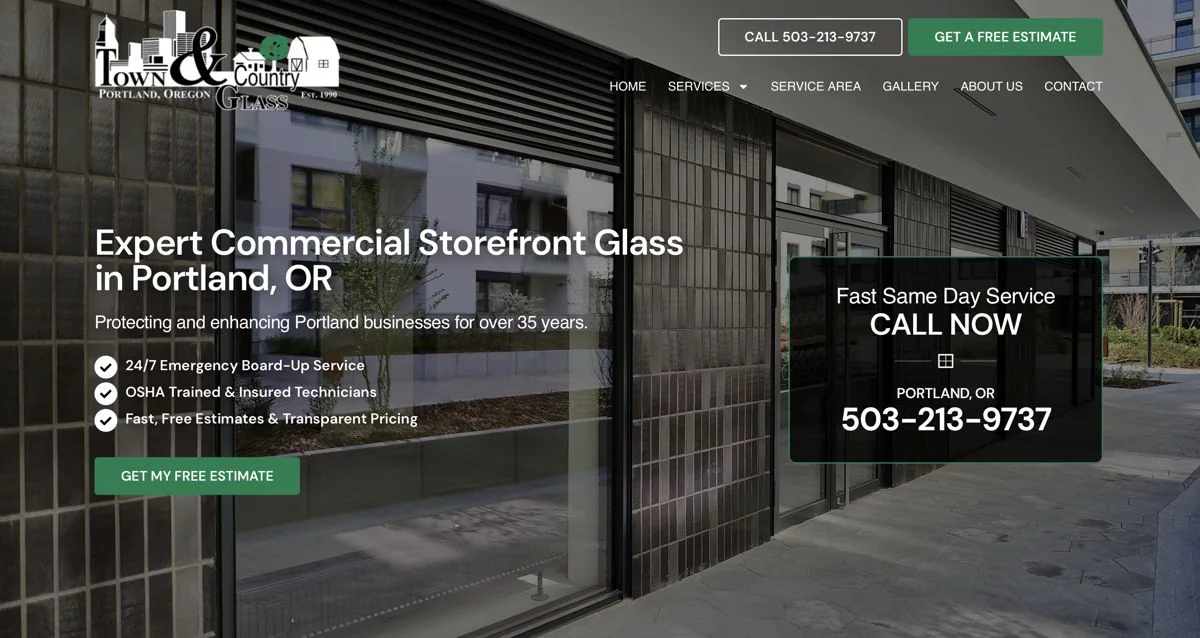
Lithium built a new website for Town & Country Glass, a commercial glass company in Portland, which shares a metro area with Aloha, and ran its SEO and Google Ads on top of it; the results on the card belong to that combined work. Nathan Boos of Hillsview Building, a construction company, has worked with the team for years and says so in his quote.
Commercial glass13Xorganic traffic
145 to 1,849 visits a month
“A lot of options out there for websites and SEO. I’ve worked with this team for years now and would highly recommend them. They know their stuff and deliver results. More importantly to me- they care about service and follow through on what they say they will do. Easy to work with and communicate with. Thank you!”
 Nathan BoosHillsview Building
Nearby cities
Beaverton, Hillsboro, Bethany, Tigard, Tualatin and Sherwood each have a web design page of their own below, built on that place’s housing numbers. Set them beside Aloha’s figures to decide which galleries each of your city pages should lead with; the Oregon link covers everywhere else.
Published price
$5,000
typical project
Larger sites get a fixed proposal after a 30-minute discovery call. Six to nine weeks from kickoff to launch. You own the domain, hosting account, WordPress install and content.
Six to nine weeks from kickoff to launch is typical. The schedule moves fastest when photos, service details and design approvals come back quickly, and we set the checkpoint dates with you at kickoff so you know when each one lands.
Your business does, from launch day. The domain, the WordPress install and every page of content are set up in your name, so moving on from Lithium never means rebuilding the site or buying anything back.
No, hosting is a separate, optional plan at $99 a month. It covers secure private hosting on a high-speed server, daily backups, software and security updates and basic website changes, and most clients choose it to keep the new site updated and running smoothly.
Usually not. Clear phone photos of finished work, taken in good light, are enough; we crop, size and place them, and each one gets a short caption saying what was done. If you have older project shots, send those too.
Yes, one for each city where you want work. Each city page describes the jobs you do there and links to your service pages, so a customer in Tigard lands on a page that names Tigard. The page list is set at kickoff, and a site much larger than typical gets a fixed proposal before work starts.
Free action plan
Tell us which services you sell and which cities you cover, and attach a few job photos if you have them. On a short video call, a co-founder turns that into a page list for your site, a launch date and a price.
What we’ll cover
2000 NE 42nd Ave Ste D Unit 2370, Portland, OR 97213
Prefer to pick a time? Book a 30-minute call with DJ