
Badger PPC Campaigns Built to Turn Clicks Into Customers
More phone calls and booked work from Google search, and now from AI search too.
Google Ads, Microsoft Ads, and Meta campaigns for Badger service businesses, engineered around the only metric that pays back: revenue per booked lead, not click volume.
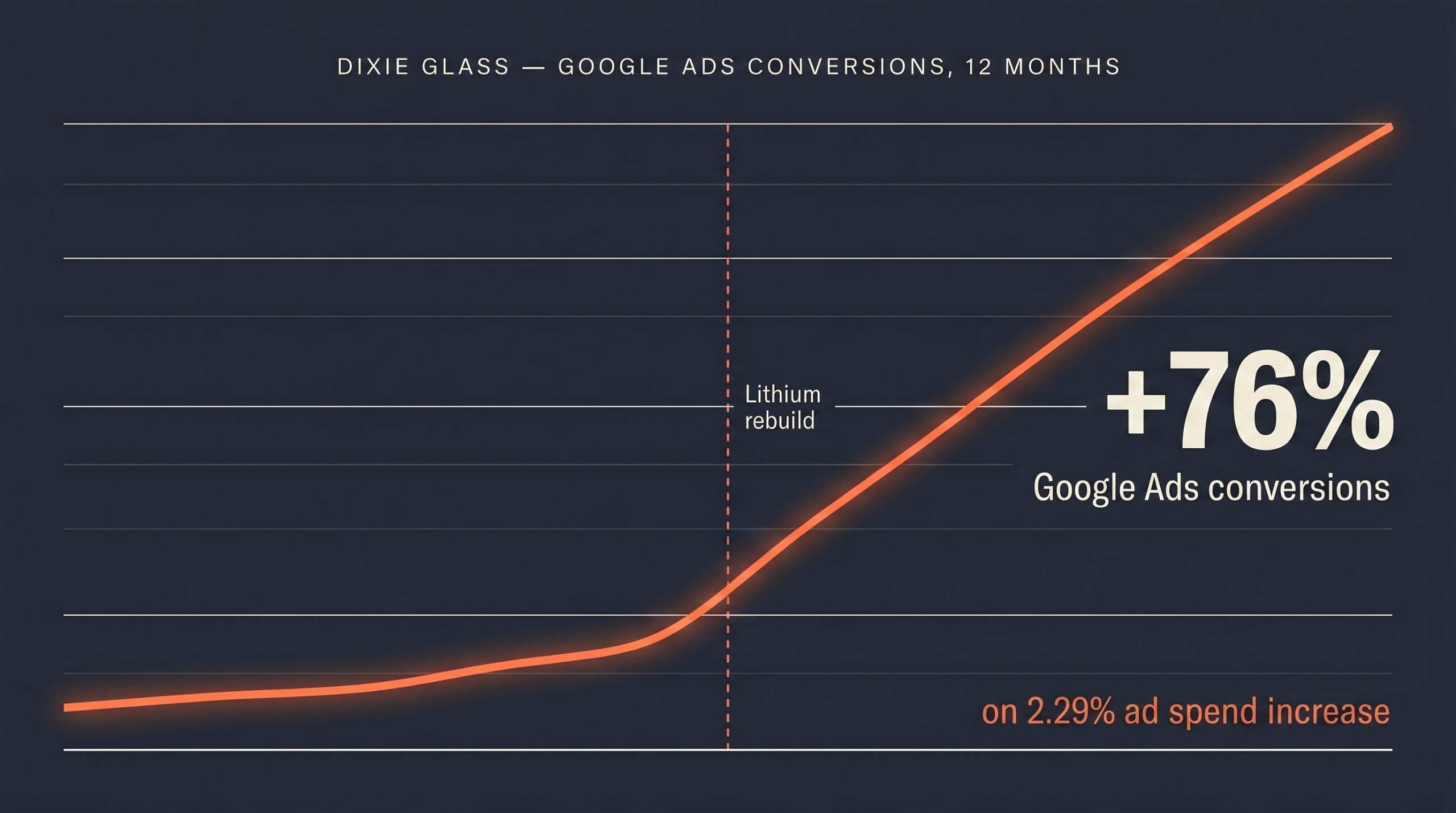
Latest case study below: +76% Google Ads conversions on a 2.29% spend increase.
- Google Ads, Microsoft Ads, Meta, LinkedIn. Every channel where the cost-per-lead math closes
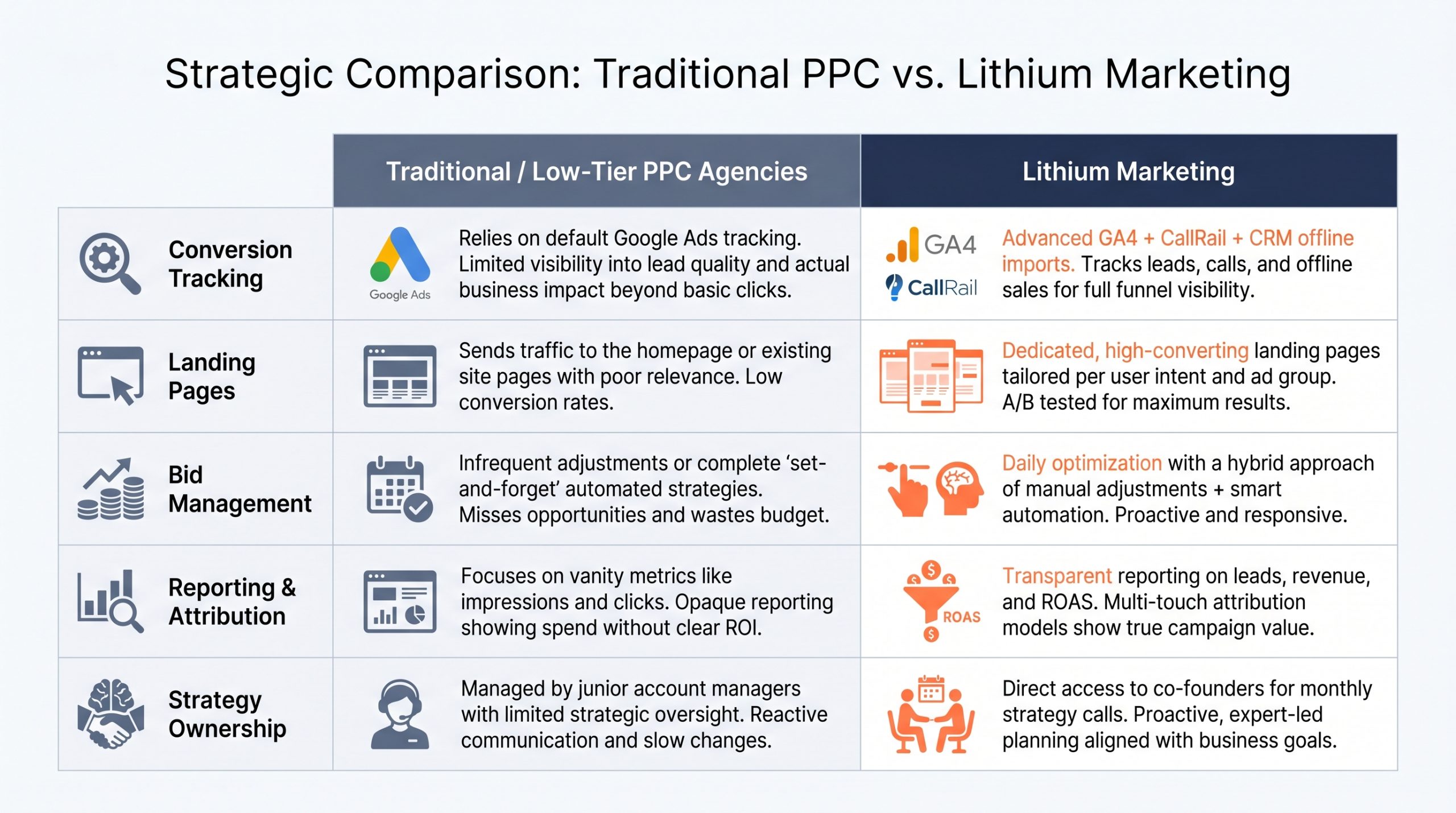
- Conversion tracking wired to your CRM, not just Google Ads (GA4 + CallRail + offline imports)
- Dedicated landing pages per intent. The home page is not a landing page
- Monthly reporting tied to leads and revenue. Google Partner. 5.0 across 30+ Google reviews

Partner
How a 78-year-old Gulf Coast glass company drove 76% more Google Ads conversions on a 2.29% spend increase.
Badger service businesses run in a small Interior Alaska auction, where the Fairbanks-North-Star Borough buyer pool and the military presence at Eielson Air Force Base and Fort Wainwright shape demand differently than any Lower-48 market. The Dixie Glass campaign shows what disciplined PPC management does to that math.
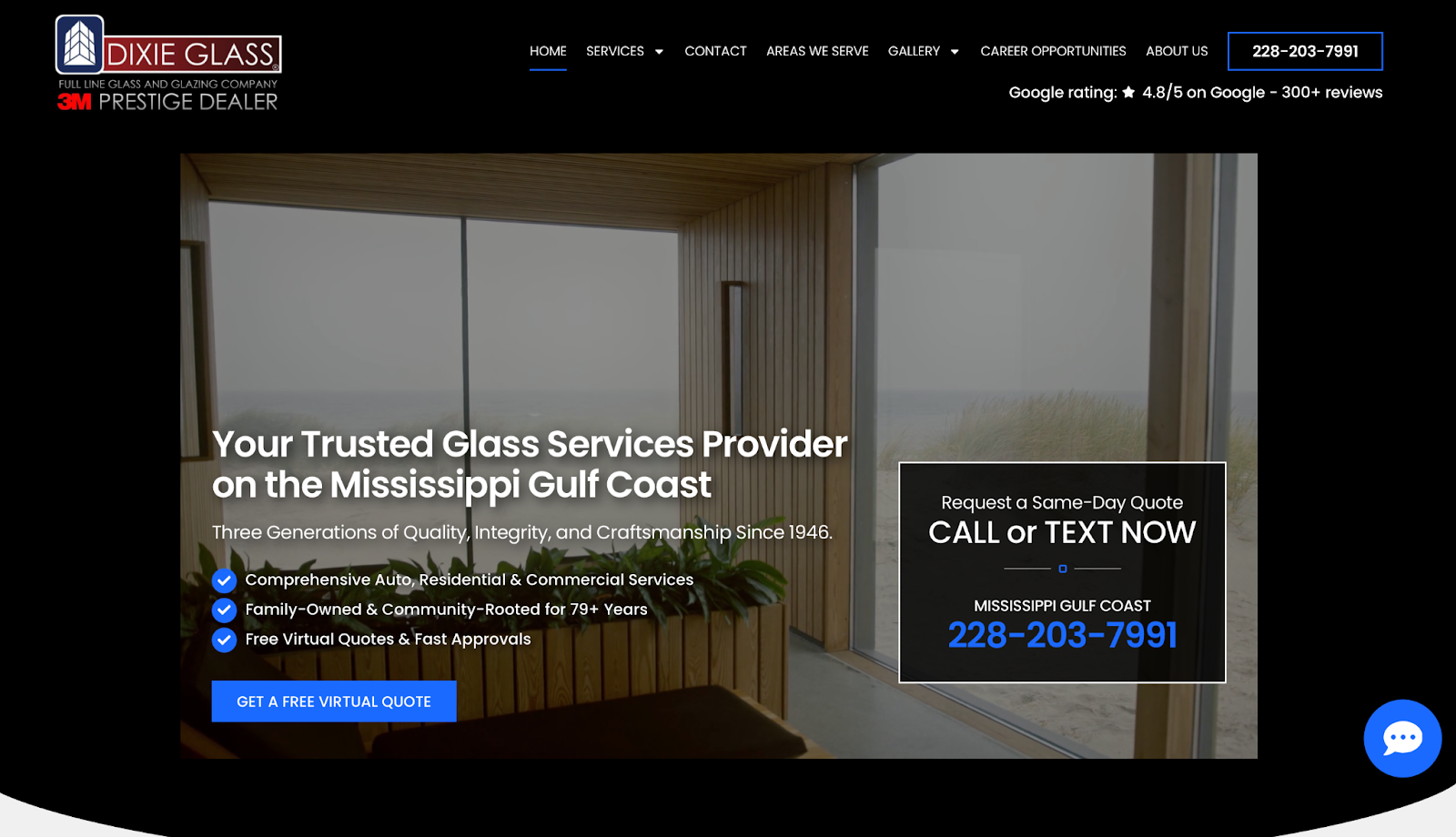
Dixie Glass, a third-generation Mississippi Gulf Coast glass company in business since 1946, came to Lithium with Google Ads campaigns that were spending without producing tracked conversions. We rebuilt the campaigns around proper conversion tracking, tightened the keyword and match-type strategy, deployed dedicated landing pages, and wired CallRail through to GA4. Over twelve months, on only a 2.29 percent ad spend increase, Google Ads conversions climbed 76 percent and the campaign conversion rate landed at 15.57 percent.
DIXIE GLASS — GOOGLE ADS REBUILD

Three things Badger PPC programs miss that we don't.
Badger's tiny auction punishes broad-match guessing.
Search volume in the Badger and broader Fairbanks-North-Star Borough area is a fraction of what runs through Anchorage, so a single broad-match keyword can eat a week of budget on irrelevant Anchorage or out-of-state clicks. We tighten match types early and pair geo-targeting with Interior Alaska radius logic so spend lands on the actual buyer pool.
Interior Alaska buyers respond to local-first ad copy.
The Fairbanks and Badger buyer pool is small enough that residents know local operators by name. Generic Lower-48 Google Ads copy reads as out-of-state and gets skipped. We write ads that name the service, the part of the borough, and a real offer, then point them at landing pages that look like Interior Alaska and load fast on the rural mobile networks you still see in the region.
Badger PPC math closes on cost per booked lead, not impressions.
In a market this size, impression share looks great on paper and means nothing if the phone is not ringing. We report leading indicators weekly during launch, then leads, cost per lead, and revenue every month against your CRM. The strategy call is built around what the CRM recorded, not a vanity dashboard.
Ranking for queries that do not convert
In Badger, where Bay Area business-services CPCs run $7 to $12, every wasted click is a measurable dollar lost. Lithium’s PPC programs are built around the cost-per-lead math first, click volume second.
Technical debt blocking growth
Service-business buyers prefer to tap a phone number rather than navigate a menu to find one. A site missing a click-to-call link in the hero, and a sticky mobile bar that keeps it within thumb reach during scroll, loses the calls you paid to earn through ads.
Generic content that says nothing local
A PPC campaign without proper conversion tracking, dedicated landing pages, and negative-keyword discipline is invisible in your CRM dashboard. The clicks are there, the impressions are there, and the booked work stays flat. That is where most of the Badger ad spend silently leaks.
No measurement tied to revenue
Buyers decide whether to keep scrolling in about five seconds. A site that shows no reviews, no project photos, no service-area clarity, and no trust signal in the hero loses every time to a competitor who placed a single five-star rating in the right spot.
Eight things we ship inside every Badger PPC retainer, not as upsells.
A Badger PPC program needs every line item in this list working together. The Interior Alaska market is small enough that one neglected layer (tracking, negatives, landing-page speed) flips the entire campaign from profitable to wasteful inside a single billing cycle.
Conversion tracking, properly wired
GA4 events on every form and click-to-call. CallRail call tracking with call quality scoring. Server-side conversion imports for Google Ads. Offline-conversion imports from your CRM (HubSpot, Salesforce, GoHighLevel). The algorithm cannot optimize toward leads it cannot see.
Dedicated landing pages per intent
Landing pages built for the buyer behind the keyword, not the home page. Single offer above the fold, tap-to-call thumb-zone-friendly, one form, one CTA, and a load time under 2.5 seconds on a mid-tier Badger mobile network. Every high-intent keyword cluster gets its own page.
Keyword strategy + match-type discipline
Keywords mapped to buyer intent (research, comparison, decision) and tied to estimated revenue per lead. Match-type discipline that prevents broad-match drift from eating budget on the wrong queries. Monthly negative-keyword review from the search-terms report.
Ad copy + Responsive Search Ads
Ad copy that names the actual service, not “quality work.” Responsive Search Ads with the maximum asset count, manual headline pinning where intent demands it, sitelinks tuned to Badger buyer language, and structured asset extensions. Every variant tagged for A/B analysis.
Geo-targeting + audience layering
Geo-targeting at the suburb level, not the metro level. Bid modifiers tuned to your actual conversion data across the neighborhoods you serve. Audience layering with in-market segments, remarketing pools, and customer-match uploads from your CRM. The right click, the right place, the right time, at the right bid.
Bid management + remarketing
Manual control on high-intent keywords, Google’s tCPA and tROAS automation where the data supports it. Remarketing audiences segmented by funnel stage, with display, YouTube, and Discovery campaigns layered on top of search for Badger buyers who clicked but did not convert. The full funnel, not just the first click.
Reporting tied to revenue, not vanity
Looker Studio dashboard updating daily on impressions, clicks, conversions, conversion rate, and ROAS by campaign and ad group. Call quality scored and reviewed monthly. Monthly written report ties everything back to leads delivered, cost per lead, and revenue. The same numbers Lithium uses internally to manage your program.
Optimization cadence that pays back
Daily monitoring during the first 30 days, weekly after that. Bid adjustments, ad copy rotations, and budget reallocations happen on real data: search-terms reports, conversion data by ad group, landing-page conversion rate, device and audience performance. Every change is logged and tied to a measurable outcome.
The verticals where our Badger PPC playbook turns clicks into customers most reliably.
The Badger and surrounding Fairbanks-North-Star Borough economy splits between the military presence at Eielson Air Force Base and Fort Wainwright, the healthcare gravity centered on Fairbanks Memorial Hospital, the resource and logistics sector that runs the Trans-Alaska Pipeline corridor and Interior Alaska transportation, and the home-services and trades work supporting both the established Badger residential base and the rural radius. These are the verticals where our PPC programs deliver the most consistent cost-per-lead math.
HVAC, plumbing, electrical, and roofing trades in Badger run hard against Interior Alaska winters that hit forty below and longer, plus the breakup-season freeze-thaw that punishes drainage and foundation systems. Furnace and heating-system service is not a seasonal vertical here. It is year-round critical infrastructure. We build emergency-intent call-only campaigns, geo-target Badger plus North Pole, the Eielson and Fort Wainwright service radius, and the immediate Fairbanks area, and run tap-to-call landing pages that load fast on Interior Alaska mobile networks. Cost per lead typically lands $60 to $130 once optimized.
The Badger healthcare market orbits Fairbanks Memorial Hospital and the Bassett Army Community Hospital on Fort Wainwright, with the broader Interior Alaska population pulling from a thin tier of specialty practices. We run procedure-specific ad groups, TRICARE-friendly landing pages for the Eielson and Wainwright military beneficiary base, insurance-friendly framing for civilian patients, and conversion tracking through the booking platform. The booked appointment is the lead.
General contractors and builders working the Badger and broader Fairbanks-North-Star Borough handle a mix of cold-climate construction, log and ICF home work, the steady demand for arctic-rated weatherization upgrades, and the occasional new build. We run project-type ad groups, image and YouTube creative with real Interior Alaska project photography, and quote-form landing pages with realistic price-range expectation setting tuned to arctic-construction premium pricing.
Badger and Fairbanks attorneys handle a mix of military-related family law, criminal defense, estate planning, and the maritime, resource-extraction, and aviation law work that runs particularly through Interior Alaska. We run practice-area campaigns tied to real buyer intent, write ad copy that meets Alaska Bar Association advertising rules, and tie consultation-booking landing pages to CallRail so the high-CPC legal click traces to a booked call.
The Badger and Fairbanks restaurant scene is small and tight-knit, with independents along the Richardson Highway corridor and the Fairbanks downtown area. The buyer pool runs strong on Eielson and Wainwright off-base spending plus the year-round resident base. We build local-intent search campaigns, OpenTable conversion tracking where it applies, and geo-fenced ad groups around the military gates and the Fairbanks downtown.
Auto repair, body shops, and diesel service in Badger handle a customer base of military families, oil-field and resource-sector workers, and the rural Interior Alaska driver pool. Vehicle-care intensity runs hard here because Interior Alaska kills vehicles fast. We run emergency-intent call-only campaigns, OEM-targeted ad groups, parts-and-labor landing pages, and dynamic call extensions during shop hours. Geo-targeting covers the Richardson Highway and Steese Highway corridors.
Badger and Fairbanks specialty retail concentrates around the Bentley Mall corridor and the Fairbanks downtown district, with separate independents serving the outdoor, hunting, and arctic-equipment buyer pool that runs on completely different search behavior than Lower-48 retail. We run Google Shopping campaigns with product feeds, local-inventory ads, store-visit conversion tracking, and remarketing audiences segmented by product category. Manual search captures the high-intent buyer.
The Badger and Interior Alaska B2B service economy is heavy on defense contracting orbiting Eielson and Fort Wainwright, oil-and-gas-services vendors supporting the Trans-Alaska Pipeline corridor, logistics and aviation services tied to the Fairbanks International Airport, and the professional services that orbit the borough employer base. Sales cycles run long and relationship-driven. We run LinkedIn-paired Google Ads campaigns, gated-content lead-gen funnels, and long-cycle attribution wired through HubSpot or whatever CRM the business already uses.
From audit to optimized campaigns, with weekly check-ins through the first month.
Profitable PPC is a compounding system, not a one-time launch. The Lithium process starts with an audit and conversion-tracking rebuild, then ships campaign optimizations on a weekly cadence with monthly reporting that ties impressions to booked work.
Audit and strategy
We pull your Google Ads, Microsoft Ads, GA4, CallRail, and CRM data and audit your current campaigns against impression share, conversion rate, quality score, and search-terms waste. We map your service mix, real Badger buyer journeys, and revenue per lead. You receive an audit deliverable in week one with priorities ranked by impact.
Conversion infrastructure
Before we touch ad copy, we wire conversion tracking properly. GA4 events on every form and click-to-call, CallRail through to Google Ads, server-side conversion imports, and offline-conversion imports from your CRM. The algorithm cannot optimize toward leads it cannot see, so this gets done first or everything else compounds slower.
Campaign build
Ad groups structured by buyer intent, ad copy with the maximum Responsive Search Ads asset count, dedicated landing pages built for each high-intent keyword cluster, geo-targeting at the suburb level (tuned to the neighborhoods you actually serve), and a baseline negative-keyword list. Every campaign launches with a 30-day optimization plan already mapped.
Launch and learning phase
We build your Badger campaigns from the ground up: ad groups by intent, ad copy with the maximum Responsive Search Ads asset count, sitelinks tuned to Badger buyer language, geo-targeting at the suburb level, and dedicated landing pages for the highest-intent keywords. Every campaign launches with a baseline negative-keyword list and a 30-day optimization plan already mapped.
Ongoing optimization
Daily monitoring during the first 30 days, weekly after that. We optimize on search-terms reports, conversion data by ad group, landing-page conversion rate, device and audience performance, and quality score drift. Bid adjustments, ad copy rotations, and budget reallocations happen on real data, not gut feel. Every change is logged and tied to a measurable outcome.
Measurement and monthly iteration
Monthly written report tied to leads, cost per lead, and revenue from paid search. Strategy call with DJ Van Zanten to set the next month’s priorities. The strategy adjusts every thirty days based on what is actually moving the phone in Badger. Not what looks good on a vanity chart.
What a Badger service-business owner actually gets, by PPC approach.
Transparent pricing. Management starts at $500/month, separate from your ad spend.
Typical Badger service businesses run $500 to $1,500 per month in management on top of $2,000 to $5,000 in monthly ad spend. Pricing scales with monthly ad spend, channel count (Google, Microsoft, Meta, LinkedIn), and how much landing-page production work the campaign needs. You will see the math on the first call. No haggling, no hidden upsells.
Service businesses Lithium runs PPC for.

Willard Power Vac
“Lithium Marketing has been amazing for our business. They have greatly increased our web traffic and helped us land hundreds of jobs.”
Drake’s 7 Dees
“Cost per lead is down, lead quality is up, and the monthly reports actually mean something. Lithium runs our Google Ads like they own the business.”
Rickabaugh Construction
“Working with Lithium Marketing has been awesome.”
Badger PPC, straight answers.
A properly built Badger campaign starts producing tracked conversions within the first week of launch. The first 30 days are a learning phase where the algorithm calibrates on what is a thin volume of real data in a small Interior Alaska auction. Cost per lead typically stabilizes by month two and improves through month three as negative-keyword lists tighten and the landing pages get conversion-rate-tested. We report weekly during the first month, monthly after that.
Badger CPCs run low compared to a metro market, but the auction is shallow, so a single broad-match mistake can blow through a week of budget on Anchorage or rural-radius clicks. Most service verticals sit in the $2 to $6 range, with legal pushing $8 to $16. PPC works in Badger when the campaign is built tight around the Fairbanks-North-Star Borough and the immediate service radius. Properly run Badger campaigns deliver cost per leads under $90 in trades and under $180 in legal.
Management starts at $500 per month, separate from your ad spend. Typical Badger and Fairbanks-area service businesses run $500 to $1,000 per month in management on top of $1,500 to $3,000 in monthly ad spend. The market does not need Anchorage or Lower-48 budgets to produce real lead flow. The number depends on monthly ad spend, channel count, and how much landing-page production work the campaign needs.
No reputable PPC agency guarantees a specific cost per lead, because both the auction and your offer move it. What we guarantee is the work: conversion tracking shipped properly, dedicated landing pages per intent, monthly negative-keyword review (Badger needs aggressive negatives around Anchorage spillover and the rural Interior Alaska fringe), weekly bid optimization, and reporting tied to revenue per lead.
Quality Score is Google’s estimate of how relevant your ad and landing page are to the keyword. It directly affects your cost per click and ad position. We optimize Quality Score on three vectors: expected click-through rate (better ad copy, headline pinning where intent demands it), ad relevance (tight ad-group themes, one core keyword set per ad group), and landing-page experience (dedicated pages per intent, fast mobile load, message-match with the ad). A 7+ Quality Score on high-volume keywords often saves Badger clients 30 to 50 percent on cost per click compared to a 4 or 5.
Three layers. Leading indicators: impressions, clicks, click-through rate, Quality Score, search impression share in the Badger auction. Mid-funnel: conversion rate by ad group, conversion rate by landing page, call quality scoring (we listen to the calls, because in a market this size every call matters). Revenue: leads delivered, cost per lead, ROAS, revenue attributed to paid via offline conversion imports from your CRM. The dashboard updates daily and the written report ships monthly with a strategy call.
Daily campaign monitoring during the first 30 days (weekly after), bid and budget optimization, ongoing ad copy and creative testing, landing-page conversion-rate optimization, monthly negative-keyword review tuned to the Interior Alaska geo, audience segmentation refinement (military, civilian, resource-sector), call quality scoring, monthly reporting tied to leads and revenue, and a strategy call with DJ Van Zanten.
Yes. PPC is the fastest channel for a new Badger business because it does not depend on review history or earned visibility, which take years to build in a small Interior Alaska market. A new business with a real offer, a clean landing page, and proper conversion tracking can produce tracked leads within the first week. We typically pair an aggressive PPC launch with a measured SEO build over the next six months so the blended cost per lead drops as earned visibility compounds.

Your Badger PPC strategy call is run by DJ Van Zanten, not handed to a junior account manager.
DJ Van Zanten joined Lithium as co-founder in 2018 and leads the strategic side of every client partnership. His approach is real-talk consulting: map out a simple, actionable plan, identify the revenue opportunities that matter most, and translate the technical work into business outcomes you can measure. Behind DJ on every Badger PPC program, co-founder Kurt Schell directs the technical and content execution, drawing on more than twenty years of SEO, PPC, and conversion-rate work. The strategy call you book is the actual call you take, with the person who will be calling the shots on what to prioritize, what to ignore, and how to measure progress.
Get a free 30-minute Badger PPC audit.
On the call we look at your current Badger PPC campaigns against impression share, conversion tracking depth, search-terms waste (Anchorage and rural-borough leakage is the usual culprit), landing-page conversion rate, and the actual cost per lead your CRM is recording. You leave with a specific 30-day plan, whether or not you decide to work with us. There is no slide deck and no sales pitch.
- No-obligation 30-minute call with DJ Van Zanten, not a junior
- Written priority list of the top 5 to 10 changes that will move leads
- Google Partner with a 5.0 rating across 30+ Google reviews