
 Commercial glass
Town & Country Glass
13Xorganic traffic
145 to 1,849 visits a month
- top-3 rankings, up from 1
- 109
- top-3 rankings, up from 1
- Google Ads conversion rate
- 29.9%
- Google Ads conversion rate
Websites for Bethany projects
Bethany service businesses get a WordPress site they own, with a project page for each job, a phone-ready quote form and call tracking.
 Google PartnerView our Partners listing
5.0on Google · read our reviews
Google PartnerView our Partners listing
5.0on Google · read our reviews
Businesses
we’ve worked with
Businesses we’ve worked with
Web design for Bethany
When Lithium Marketing designs a website for a Bethany service business, the first question is what kind of homes you work on, and in Bethany the answer is mostly newer ones. The median year built there is 2004, and only 4.0% of Bethany’s homes were built before 1980, compared with 35.8% across Washington County.
Selling points written for old houses, such as replacing original pipes or rewiring, describe few homes here. Lead with the jobs you do on newer ones: a kitchen update, a backyard on a new lot, a panel or fixture upgrade, a repaint. Each project gets its own photos, a line on what you did and a call button beside it.
Who lands on the site
A Bethany customer can reach your site from a Map Pack listing, an organic result or an ad, and each click lands on a page that has to show straight away that you do the job they searched for. So every service gets its own page, opening with that job, the places you cover and a call button, and each listing or ad links to the matching page.
Every site we build is tested against Google’s Core Web Vitals, which score how fast a page loads, how quickly it responds to a tap and whether the layout jumps while it loads. We test on a phone first, because that is where a customer taps to call.
| Search | Searches a month | Cost per click |
|---|---|---|
| web design bethany or | under 10 | not reported |
| web designer bethany or | under 10 | not reported |
| website design bethany or | under 10 | not reported |
Source: Google Ads keyword data, average monthly U.S. searches. "Under 10" = below Google’s reporting floor.
Source: one Google results page for “plumber bethany or”, as Google showed it to a searcher located in Bethany. Search ad counts exclude sponsored local listings. Results shift by searcher and day.
The Bethany market
Much of Bethany is new: 38.1% of its homes went up in 2010 or later, and Washington County’s share is 14.4%. People in homes that new may not have a contractor they call yet, so your site has to introduce you: who runs the business, the jobs you have finished nearby and how to reach you.
Bethany’s median home value is $751,700, against $588,000 for Washington County. Owners hiring for a house worth that much will want to know who they are letting in, so put the proof above the quote form: reviews, a license number if your trade requires one, and photos of finished jobs with a line on each.
Sources: U.S. Census Bureau 2025 population estimates, ACS 2020–2024 and 2023 County Business Patterns.
Trades in the county
Remodeling and painting are two of the bigger trades on the Washington County chart, with 307 residential remodelers and 197 painting contractors. For both, the work is the pitch: each finished job gets its own page with photos, a short write-up and the community it is in, so a Bethany visitor can find a project close to home.
A plumber’s or electrician’s customer often has a problem today, not a project. Those sites open with a call button that stays on screen as the visitor scrolls, the hours you answer and the places you cover, and the gallery sits lower down.
County Business Patterns
Trade and home service businesses in Washington County
Establishments by industry, 2023
Source: U.S. Census Bureau, 2023 County Business Patterns (NAICS establishment counts).
From photos to launch
Your photos and service list go in first, and each stage needs your sign-off before the next begins.
You send photos of finished jobs and your service list, and we choose the ones that match the homes you work on in Bethany and the places nearby.
Every service gets its own page, with the call button and quote form placed where a visitor on a phone sees them first.
Before anything goes live, we try each form and phone link on a phone, then add GA4 and call tracking so you can see where each call came from.
We point old web addresses to their new pages, launch the site and record a private Loom video showing how to update it.
What every Lithium website includes
The same eight parts go into every website build, wherever the business is.
Proof from the Portland metro
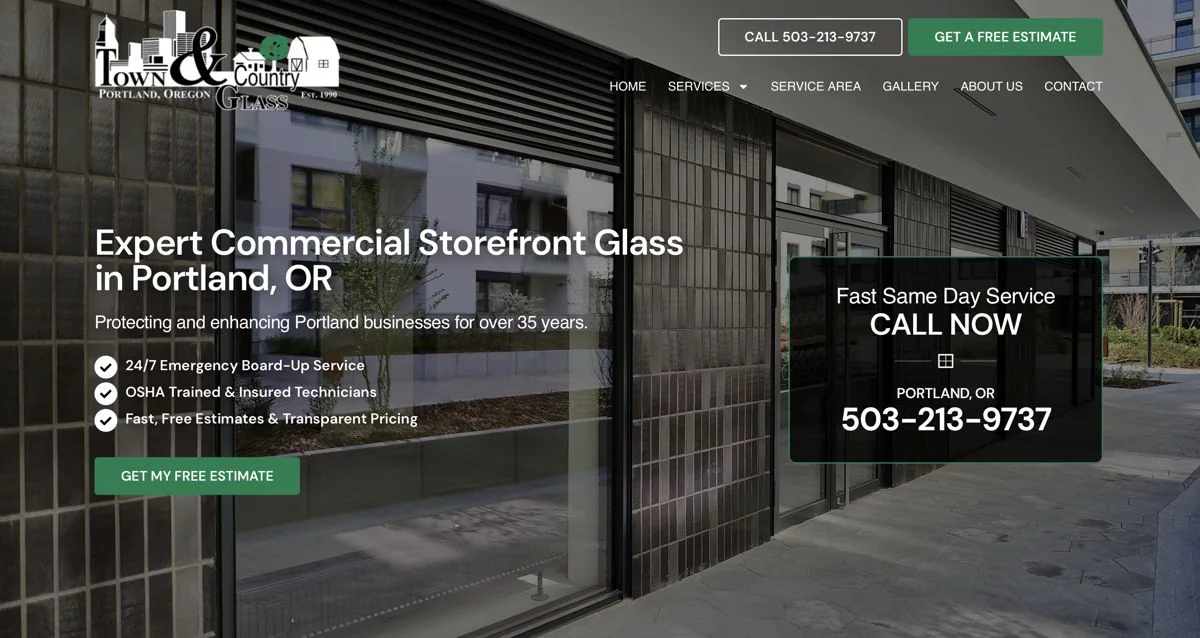
The card comes from Portland, inside the same metro area as Bethany. Town & Country Glass sells commercial glass, and its results came from a new Lithium website working alongside SEO and Google Ads. Marc Rickabaugh of Rickabaugh Construction, who used Lithium Marketing to update his own website and SEO, is quoted next to it.
Commercial glass13Xorganic traffic
145 to 1,849 visits a month
“We used the team at Lithium Marketing to update our website and increase our SEO. We couldn't have been happier with the results! We receive compliments about our updated website on a regular basis!”
 Marc RickabaughRickabaugh Construction
Nearby web design pages
The places your crews go belong in your site’s service-area menu, each with a page written from jobs you did there. To see what a neighbor looks like first, open its web design page: Aloha, Hillsboro, Beaverton, Portland, Tigard and Lake Oswego are all here, and the state link covers the rest of Oregon.
Published price
$5,000
typical project
Larger sites get a fixed proposal after a 30-minute discovery call. Six to nine weeks from kickoff to launch. You own the domain, hosting account, WordPress install and content.
It usually takes six to nine weeks from kickoff to launch, depending on how quickly your photos and service list arrive. You review the design and the pages before anything goes live, and a larger site takes longer.
No. Send what you have, including phone photos of recent jobs, and we choose the best ones. Professional photos help, but a page can launch with the images you have and gain better ones later.
Hosting and maintenance are optional, at $99 a month, and separate from the build. The plan covers secure hosting, daily backups, software and security updates and basic website changes. The site and domain are yours either way.
Yes. Each service gets its own page, and each nearby place you serve can get one too, written from your real jobs there. Pages can be added when you take on new work, and a much larger site is quoted separately before the build starts.
You get a WordPress build with copy and project pages written from your jobs, a private Loom walkthrough and a site and domain that belong to you. Nothing is rented, so leaving Lithium never takes your site with it.
Free action plan
Send your current site, if you have one, and a few photos of finished jobs. On a short video call, a co-founder maps out the pages, the price and the schedule for your Bethany build.
What we’ll cover
2000 NE 42nd Ave Ste D Unit 2370, Portland, OR 97213
Prefer to pick a time? Book a 30-minute call with DJ