

Table of Contents
In the rapidly evolving landscape of digital business, a prevailing anxiety haunts many small-to-medium business (SMB) owners: Is Artificial Intelligence (AI) coming to replace my loyal staff? It is a fair question, given the headlines about automation and efficiency. However, the narrative that AI is a “replacement” is fundamentally flawed. At Lithium Marketing, we believe the future doesn’t belong to AI alone, nor does it belong to humans alone. It belongs to the Augmented Workforce. Rather than dehumanizing business, AI acts as a “force multiplier.” It strips away repetitive drudgery, allowing your team to focus on what humans do best: strategy, empathy, and creative problem-solving. This article explores the economic case for AI, its practical applications in Search Engine Optimization (SEO) and lead generation, and how you can implement a “Human-in-the-Loop” strategy to grow your business without losing your soul.
The Economic Case for the “Augmented” Team
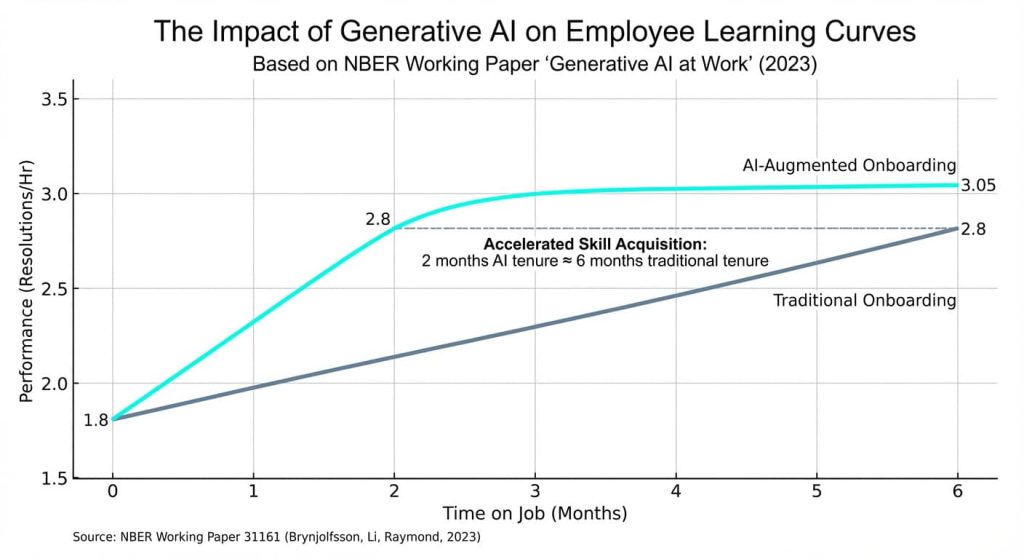
The data regarding AI implementation is no longer theoretical; it is measurable and compelling. The goal is not to cut headcount but to achieve “Augmented Intelligence”—where human capabilities are expanded, not discarded.
The “Jagged Frontier” of Productivity
A landmark study conducted by Harvard Business School in collaboration with the Boston Consulting Group (BCG) introduced the concept of the “jagged frontier.” This research analyzed knowledge workers and found that when they utilized AI for tasks within the technology’s capabilities, the results were staggering. Consultants using AI to support their workflows:
- Completed tasks 12.2% more often.
- Worked 25.1% more quickly.
- Produced results of 40% higher quality compared to a control group without AI access.
Perhaps most interestingly, the study highlighted a “leveling up” effect. AI benefited lower-performing employees the most, raising their baseline performance to near top-tier levels. For a small business owner, this means your junior staff can rapidly acquire the competency of senior employees, accelerating their learning curve and contribution to the company.
Economic Impact on Small Businesses
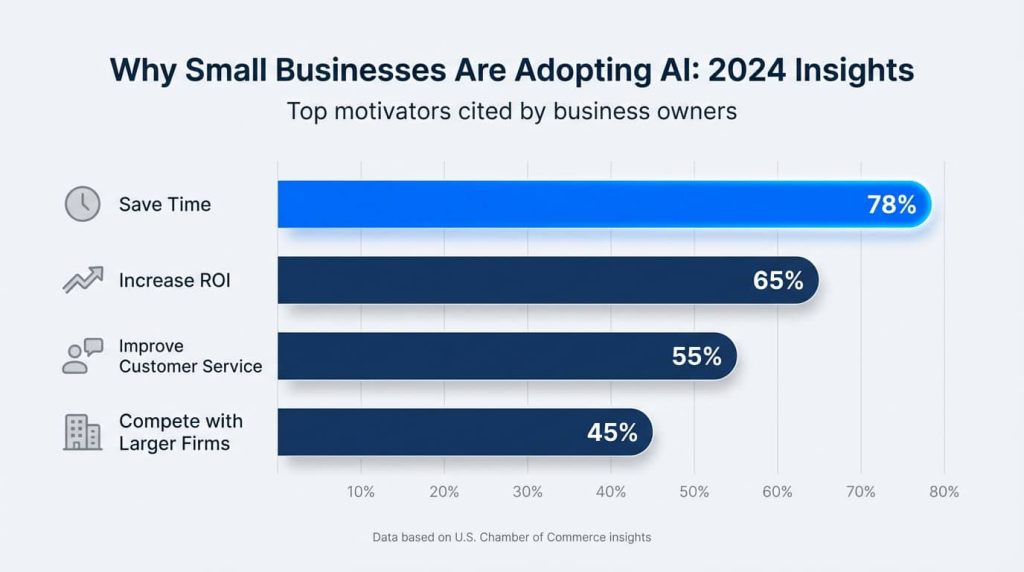
For SMBs, adopting AI is rarely about boosting stock prices through layoffs; it is about survival and scaling in a resource-constrained environment. According to the U.S. Chamber of Commerce, 98% of small businesses using AI platforms report that the technology has been effective in helping their operations. Furthermore, 40% of small business owners believe AI has helped them avoid hiring additional staff for administrative tasks. This allows them to reinvest those funds into growth strategies—like better web design, product development, or employee bonuses. McKinsey & Company estimates that generative AI could add trillions to the global economy, with 75% of this value falling into customer operations, marketing, sales, and software engineering—the very engines of your business growth.
Supercharging SEO and Content Creation
At Lithium Marketing, we specialize in helping businesses dominate search results. We have seen firsthand how AI transforms the SEO landscape from a manual grind to a strategic powerhouse.
Solving the “Blank Page” Syndrome
One of the greatest hurdles in content marketing is simply getting started. Large Language Models (LLMs) solve “blank page syndrome” instantly. A study by the Nielsen Norman Group found that using generative AI improved employee productivity by 66% in drafting and editing tasks. However, the magic isn’t in letting AI write the final product. It is in using AI to identify “semantic gaps”—topics your competitors are covering that you are not. AI tools can analyze top-ranking content and suggest structures that help you build “topical authority,” a key ranking factor for Google.
E-E-A-T: Where Humans Are Essential
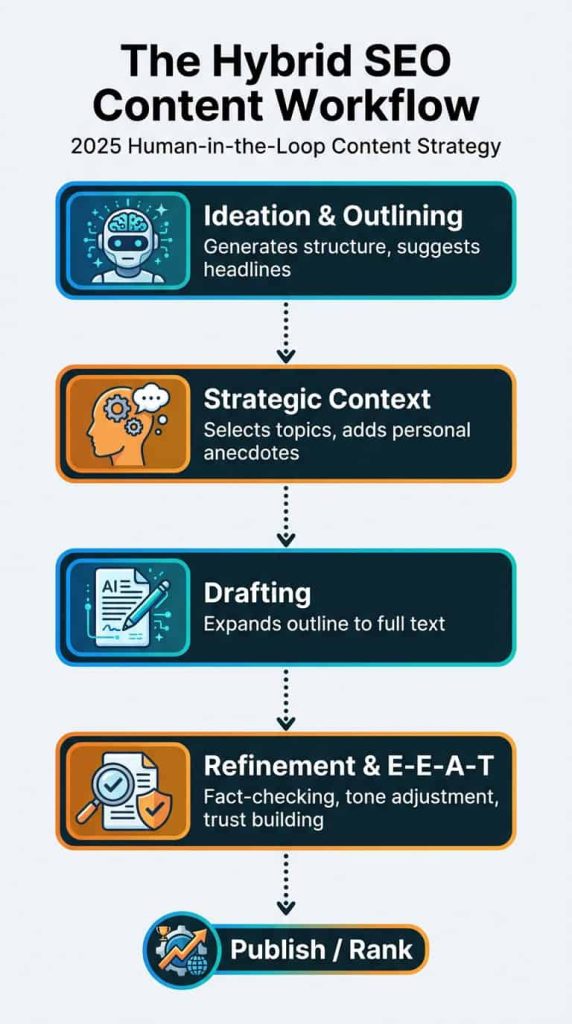
While AI is excellent at structure and drafting, Google’s algorithms prioritize E-E-A-T (Experience, Expertise, Authoritativeness, and Trustworthiness). AI cannot replicate genuine human experience. To rank well, a human expert must review AI-generated drafts, injecting personal anecdotes, verified expertise, and a unique brand voice. This collaborative workflow ensures you get the speed of AI with the quality and trust that only a human can provide.
Customer Insight and Lead Generation
Beyond content, AI serves as an incredible asset for understanding customers and managing leads, ensuring your Pay Per Click (PPC) campaigns yield maximum ROI.
Sentiment Analysis
Small businesses often struggle to process thousands of reviews or emails manually. Natural Language Processing (NLP) tools can digest this qualitative data instantly, extracting themes like “shipping delays” or “confusing checkout.” The National Bureau of Economic Research (NBER) found that customer support agents using AI tools saw a 14% increase in productivity. The AI suggested responses and retrieved technical information instantly, reducing handling time and leaving the customer happier.
The “Speed to Lead”
In sales, time is money. Research indicates that responding to a lead within the first minute increases conversion probability by 391%. Human teams cannot work 24/7, but AI-powered phone systems and chatbots can. These tools serve as a “front line” defense, engaging leads immediately and using predictive scoring to tell your sales team exactly who to call first. This ensures your expensive sales talent spends time closing deals, not chasing “tire kickers.”
The “Human-in-the-Loop” (HITL) Framework
To successfully integrate AI, businesses must adopt a Human-in-the-Loop (HITL) methodology. This concept posits that AI requires human interaction to function ethically and effectively.
- Brand Voice Preservation: AI defaults to a generic, robotic tone. Human editors are essential to infuse the specific personality that distinguishes your small business from a faceless corporation.
- Hallucination Mitigation: Generative AI is prone to “hallucinations” (confident falsehoods). A human expert must always act as the fact-checker.
- Ethical Data Use: Business owners must ensure that proprietary customer data is not fed into public AI models, requiring a human governance policy.
Real-World Implementation Strategy
To visualize the difference between old-school automation and modern augmentation, consider the following comparison:
| Feature | Traditional Automation (Old) | AI Augmentation (New) |
|---|---|---|
| Flexibility | Rigid; follows strict “if/then” rules. | Fluid; adapts to context and natural language. |
| Scope | Best for repetitive, manual tasks (e.g., scheduling). | Best for cognitive tasks (e.g., summarizing, drafting). |
| Human Role | Human monitors the machine for errors. | Human collaborates with the machine (Co-pilot). |
| Outcome | Standardization of output. | Enhancement of creativity and speed. |
The World Economic Forum notes that while 42% of business tasks will be automated by 2027, the primary driver will be augmenting existing roles to make them more efficient rather than eliminating them entirely.
Case Studies in Success
Klarna: Customer Service Augmentation
Klarna launched an AI assistant to handle customer service chats. In its first month, the AI managed 2.3 million conversations (two-thirds of total volume). Crucially, this did not degrade service; repeat inquiries dropped by 25%. Human agents were freed to handle complex, sensitive financial disputes that the AI could not resolve, mirroring the “Assistant” model we advocate for at Lithium Marketing.
Real Estate: Lead Nurturing
Small real estate agencies are using AI chatbots to handle initial inquiries from property portals. The AI engages leads instantly, asking qualifying questions about budget and location. This resulted in agents spending zero time on unqualified leads and 100% of their time on showings for pre-qualified buyers, leading to a 20% increase in closed deals without adding headcount.
Video Resources for Further Learning
To dive deeper into how AI acts as a partner rather than a replacement, we recommend these insightful resources:
- TED Talk: How AI Could Save (Not Destroy) Education – Sal Khan discusses the “super tutor” concept, which parallels the “super assistant” business model. Watch Here
- Microsoft: The Future of Work with AI Copilot – A visualization of how AI sits alongside the worker in everyday apps. Watch Here
- IBM Technology: AI for Business – The Human in the Loop – Explains why human oversight is critical for business AI.
Final Thoughts: The Future is Augmented
The research confirms that AI is most effective when deployed as a “force multiplier.” For Lithium Marketing clients, the message is clear: adopting AI tools for drafting, data analysis, and lead qualification captures the “low-hanging fruit” of productivity. This allows you, the business owner, to redirect your finite energy toward the aspects of business that AI cannot replicate: relationship building, high-level strategy, and closing deals.

Ready to Future-Proof Your Business?
Supercharge your SEO and marketing strategy with the perfect blend of human expertise and cutting-edge technology.
References
- Harvard Business School. (2023). Navigating the Jagged Technological Frontier: Field Experimental Evidence of the Effects of AI on Knowledge Worker Productivity and Quality. View Source.
- U.S. Chamber of Commerce. (2023). Impact of Technology on Small Business. View Source.
- McKinsey & Company. (2023). The Economic Potential of Generative AI: The Next Productivity Frontier. View Source.
- Nielsen Norman Group. (2023). AI Improves Employee Productivity by 66%. View Source.
- Search Engine Journal. (2023). Topical Authority: What It Is & How It Works. View Source.
- Google Search Central. (2024). Creating Helpful, Reliable, People-First Content. View Source.
- National Bureau of Economic Research (NBER). (2023). Generative AI at Work. View Source.
- Harvard Business Review. (2011). The Short Life of Online Sales Leads. View Source.
- MIT Sloan Management Review. (2023). We Need a ‘Human in the Loop’ to Prevent AI Hazards. View Source.
- World Economic Forum. (2023). The Future of Jobs Report 2023. View Source.
- Klarna. (2024). Klarna’s AI assistant handles two-thirds of customer service chats in its first month. View Source.
- Forbes. (2023). How Real Estate Agents Are Using AI To Boost Productivity. View Source.