
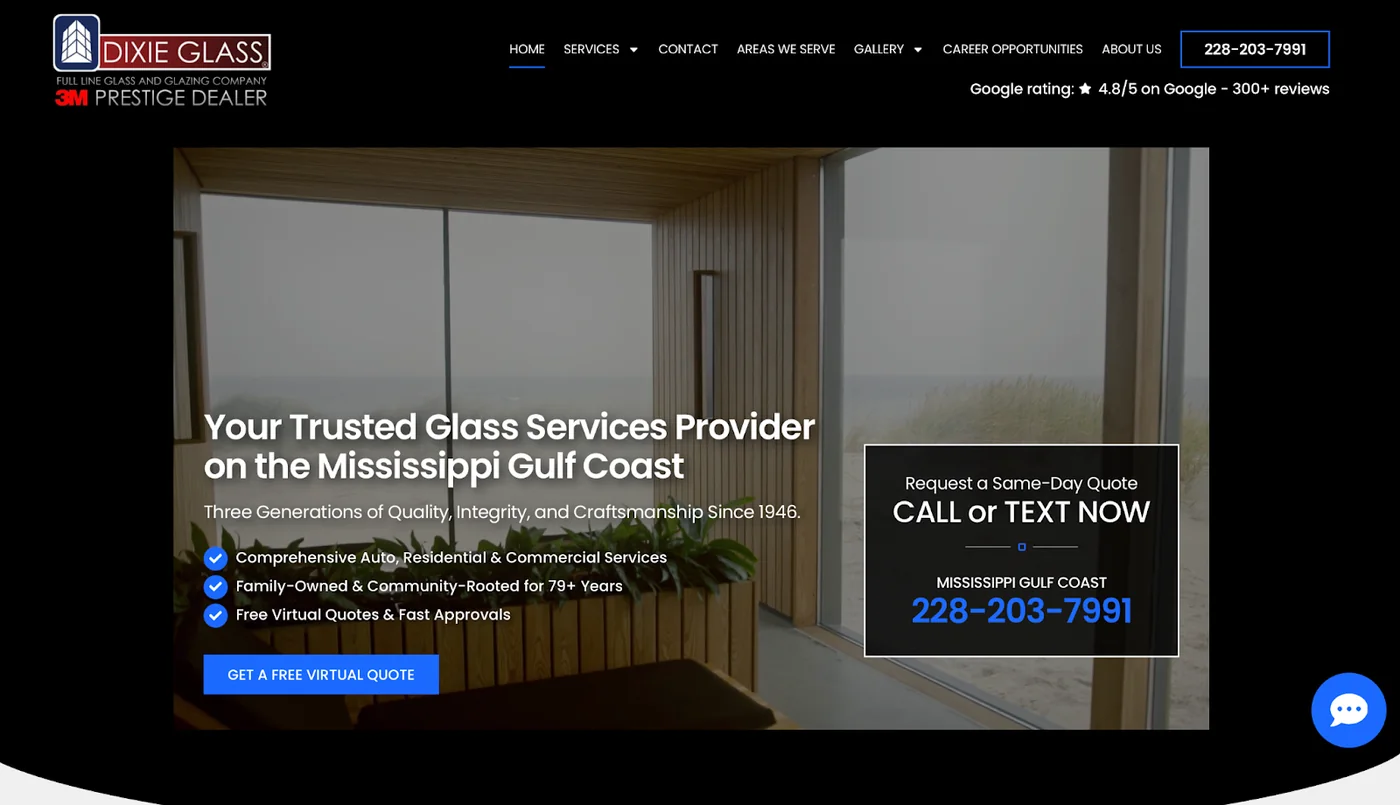
 Glass
GlassDixie Glass
76%more conversions
January vs the January before
- ads conversion rate
- 15.57%
- ads conversion rate
- organic traffic
- +18.2%
- organic traffic
Greensboro, NC website design
Help Greensboro customers compare your work and request an estimate through a WordPress website your business owns from domain to content.
 Google PartnerView our Partners listing
5.0on Google · read our reviews
Google PartnerView our Partners listing
5.0on Google · read our reviews
Businesses
we’ve worked with
Businesses we’ve worked with
A site that helps customers decide
Lithium Marketing builds WordPress websites that help Greensboro service businesses explain their work and earn the call. Greensboro’s median housing construction year is 1985. If your company works on existing properties, show the problem and the finished result, with a short account of what your crew did. Those details give a buyer a reason to ask about a similar job.
A customer should be able to tell what you do, where you travel and how to get an estimate without searching the entire site. We organize those answers around your services and use real project material to support them. The design makes the next step easy on a phone as well as a desktop.
Look past the homepage screenshot
“Website design greensboro” averages about 390 searches a month. When choosing a builder, inspect more than the visual style: open a service page on your phone, find the contact button and try the form. Your own customers need that experience to work smoothly after the design review is over.
About 390 monthly searches use “landscaping greensboro”. A visitor arriving for that service should see the kinds of projects or maintenance the business offers, followed by the appropriate contact option. A plumber’s repair page and a roofer’s estimate page need the same care, with photos and wording matched to the job.
| Search | Searches a month | Cost per click |
|---|---|---|
| web design greensboro | 390 | $13.92 |
| website design greensboro | 390 | $13.92 |
| web designer greensboro | 20 | not reported |
Source: Google Ads keyword data, average monthly U.S. searches. "Under 10" = below Google’s reporting floor.
Source: one Google results page for “plumber greensboro”, as Google showed it to a searcher located in Greensboro. Search ad counts exclude sponsored local listings. Results shift by searcher and day.
Explain who you work for
Owner-occupied homes account for 50.5% of occupied housing in Greensboro. If you serve rental properties as well as homeowners, explain how a tenant or manager should contact you and who needs to authorize the work. A short explanation near the form can save your staff an unnecessary exchange.
The Greensboro-High Point metropolitan area has 805,945 residents. A business covering part of that wider market needs a service-area section that names its coverage precisely. Keep the city pages tied to services and projects you can describe, so the site supports expansion without promising work everywhere in the metro.
Sources: U.S. Census Bureau 2025 population estimates, ACS 2020–2024 and 2023 County Business Patterns.
Make the portfolio informative
Painting contractors account for 72 establishments in Guilford County. Photos of finished rooms are stronger with a caption explaining the preparation, surfaces and work completed. For roofing or remodeling, the same principle helps a buyer distinguish a small repair from a full replacement or renovation.
There are 183 new home-building establishments in Guilford County. If you build homes, your project pages should explain the type of construction and how a prospective customer begins. Other trades can use service-specific galleries too; explain what your crew did before someone requests a quote.
County Business Patterns
Trade and home service businesses in Guilford County
Establishments by industry, 2023
Source: U.S. Census Bureau, 2023 County Business Patterns (NAICS establishment counts).
From content to launch
Your knowledge of the jobs shapes the copy; we handle the writing, design and WordPress build.
We collect service details, project photos and the questions customers ask before hiring. Each planned page has a clear role in helping someone choose your business.
You see mobile and desktop designs and review the wording. We check that the service, proof and contact options make sense together.
The WordPress build includes checks of forms, phone links and tracking. We also plan redirects for old URLs so existing links lead to the correct pages.
At launch you receive access and a private Loom walkthrough of your site. Your team can update project photos and service descriptions as the business changes.
What every Lithium website includes
The same eight parts go into every website build, wherever the business is.
A site within a growth program
On the Mississippi Gulf Coast, Dixie Glass hired Lithium for web design, Google Ads and SEO. Its case connects the website with the wider marketing program. Nathan Boos of Hillsview Building speaks about working with the team in the accompanying owner testimonial.
Glass76%more conversions
January vs the January before
“A lot of options out there for websites and SEO. I’ve worked with this team for years now and would highly recommend them. They know their stuff and deliver results. More importantly to me- they care about service and follow through on what they say they will do. Easy to work with and communicate with. Thank you!”
 Nathan BoosHillsview Building
More city-specific website planning
Website planning pages for High Point, Winston-Salem, Durham, Cary, Concord and Raleigh are available through these links. The North Carolina directory collects the other city pages if your service area extends farther across the state.
Published price
$5,000
typical project
Larger sites get a fixed proposal after a 30-minute discovery call. Six to nine weeks from kickoff to launch. You own the domain, hosting account, WordPress install and content.
FAQ

Still curious?
Call (503) 766-5964 or email [email protected].
A typical website project costs $5,000. The agreed page list and functionality define the build; a larger site receives its own fixed proposal before work begins. Bring the services, areas and project examples you want included so the price reflects a complete plan for your business.
Allow six to nine weeks from kickoff to launch. You will need time to supply photos and service information, then review the copy and designs. Naming one person to gather feedback helps us resolve conflicting requests and keep the project moving through the agreed stages.
Your business owns the domain, hosting, WordPress installation and content. You retain access to the site and can work with another provider later. We explain editing through a private walkthrough so ownership also means your team can keep the service information and photos current.
Optional hosting and maintenance costs $99/month. It includes secure private website hosting on a dedicated high-speed server, daily backups, software and security updates, and basic website changes. Choose it if you want us to handle upkeep, or arrange hosting and maintenance yourself.
Bring the photos and service information you have; finished copy is not required. We write from your knowledge of the work and ask you to check the details. Phone photos can help explain projects, and we will identify which examples best support the pages you need.
Free action plan
Your best project should help sell the next one. Share your website and a job you are proud of; on a short video call with a co-founder, we will map out how to present that work in your free website plan.
What we’ll cover
2000 NE 42nd Ave Ste D Unit 2370, Portland, OR 97213
Prefer to pick a time? Book a 30-minute call with DJ