
 Plumbing
Sarkinen Plumbing
2Xleads
on the same budget
- search visibility
- 3.75X
- search visibility
- ads conversion rate
- 27.37%
- ads conversion rate
SEO in Gresham, Oregon
We build the service pages, listings and review requests that put your business in front of Gresham searchers, and a co-founder runs your first call.

 Google PartnerView our Partners listing
5.0on Google · read our reviews
Google PartnerView our Partners listing
5.0on Google · read our reviews
Businesses
we’ve worked with
Businesses we’ve worked with
Gresham SEO, answered
Lithium Marketing handles local SEO for Gresham service businesses, from the Google Business Profile to the pages and links behind it, so more Gresham searches end in a call to you. When we checked “plumber gresham”, the three businesses in the Map Pack had 399, 66 and 323 Google reviews. One of them made the pack with 66, so a complete profile and a habit of asking for reviews can earn a place without hundreds of them.
Searches name the city: about 210 a month for “electrician gresham” and about 170 for “garage door repair gresham”. A site that talks only about Portland gives Google little reason to show it for those searches, so your pages and profile need to say Gresham plainly.
Search in Gresham
“Pest control gresham” draws about 140 searches a month, enough to justify a page of its own. Every service you want more of deserves the same, whether that is drain cleaning, roof repair or lawn care: one page per service, written for a Gresham customer and answering the questions people ask before they call.
Facebook, HomeAdvisor, Nextdoor and Thumbtack all ranked in the top 10 for “plumber gresham”, below the Map Pack. A customer may find you on any of them before they ever see your website, so your name, phone number and services have to match on every listing and on your site.
| Search | Searches a month | Cost per click |
|---|---|---|
| seo gresham | 10 | not reported |
| seo agency gresham | under 10 | not reported |
| seo company gresham | under 10 | not reported |
| seo services gresham | under 10 | not reported |
Source: Google Ads keyword data, average monthly U.S. searches. "Under 10" = below Google’s reporting floor.
Source: one Google results page for “plumber gresham”, as Google showed it to a searcher located in Gresham. Search ad counts exclude sponsored local listings. Results shift by searcher and day.
The Gresham market
Gresham is divided into 16 recognized neighborhoods, including Rockwood, Centennial, Powell Valley, Pleasant Valley and Kelly Creek. Naming the ones you serve on your service-area pages, with a job you finished in each, tells Google where you work and shows customers you know their part of town.
About 56% of Gresham’s occupied homes are owner-occupied, and the rest are rented. Landlords and property managers hire plumbers, roofers and landscapers too, so a page on how you work with rental properties, from scheduling around tenants to billing the owner, gives Google something to show them.
Sources: U.S. Census Bureau 2025 population estimates, ACS 2020–2024 and 2023 County Business Patterns.
Trades in Gresham
Multnomah County has 436 residential remodelers and 329 new home builders. For them, and for roofers and landscapers who sell larger jobs, we build SEO around project pages: a kitchen remodel, a new roof, a backyard patio, each with photos and the neighborhood it was in, so one page can rank for the job and show the work at the same time.
The county also has 171 plumbing, heating and air-conditioning contractors, yet “hvac repair gresham” draws only about 10 searches a month. Repair trades shouldn’t lean on one city phrase like that: a plumber or heating company does better with a page for each job, such as sewer line repair, water heater replacement or furnace repair, plus pages for the nearby cities it covers.
County Business Patterns
Trade and home service businesses in Multnomah County
Establishments by industry, 2023
Source: U.S. Census Bureau, 2023 County Business Patterns (NAICS establishment counts).
The SEO plan
Month one goes to repairs on the site itself; pages, profile work and links build from there.
We repair whatever stops Google from reading your pages, from broken redirects to pages that load too slowly on a phone.
We set the right categories, list every service, add job photos and mark your service area, then hand you a review-request text to send after each job.
Each service you want more of gets a page, and the Gresham neighborhoods and nearby cities you work in get pages that show jobs there.
Your directory profiles get the same name, phone number and services as your site, and links go to the pages that produce calls.
What every SEO retainer includes
The same eight parts go into every SEO retainer, wherever the business is.
Proof
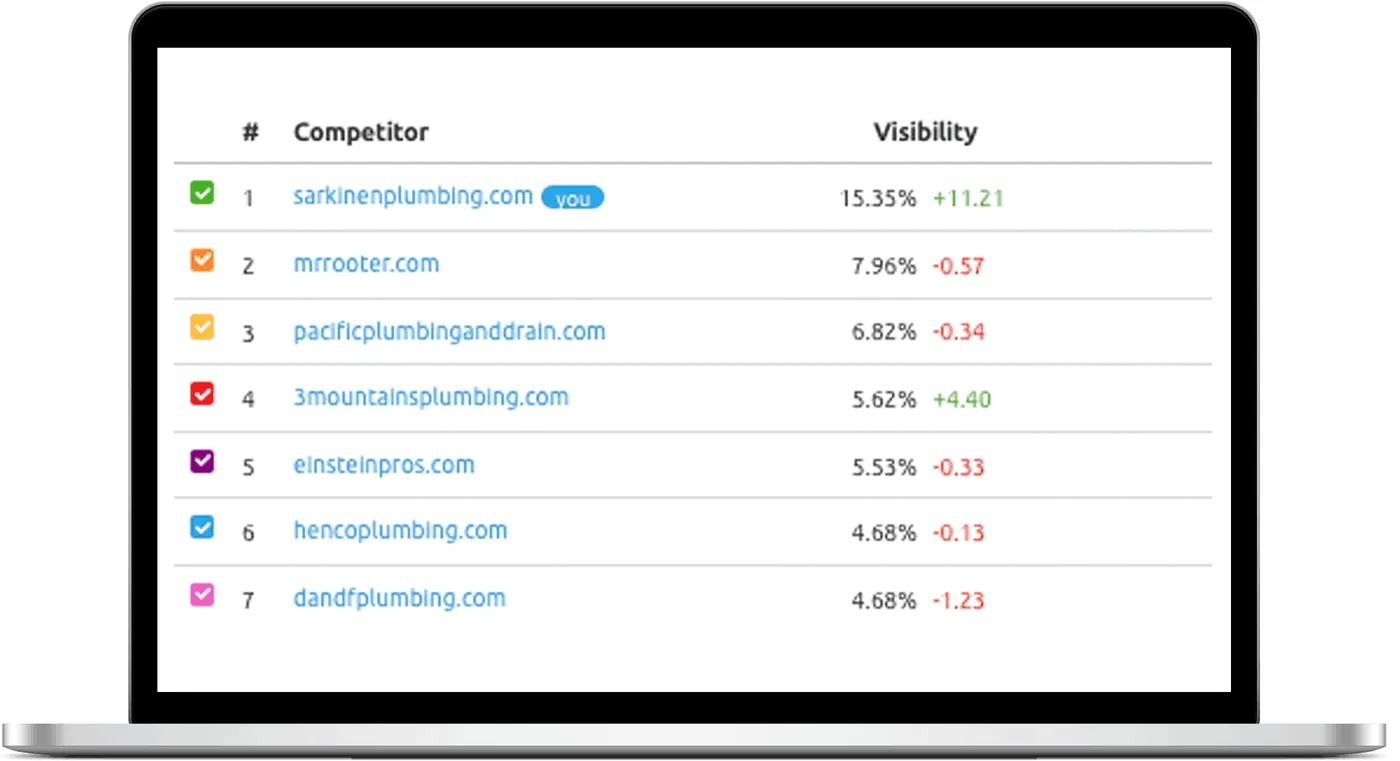
Sarkinen Plumbing is a plumber in the Portland area, the same metro Gresham belongs to. Lithium built its website and ran its SEO and Google Ads, and the card shows what that combined work did. Nathan Boos of Hillsview Building, a construction business, gives his own view of working with Lithium.
Plumbing2Xleads
on the same budget
“A lot of options out there for websites and SEO. I’ve worked with this team for years now and would highly recommend them. They know their stuff and deliver results. More importantly to me- they care about service and follow through on what they say they will do. Easy to work with and communicate with. Thank you!”
 Nathan BoosHillsview Building
Around Gresham
Each nearby city has its own SEO page below: Fairview, Troutdale, Happy Valley, Portland and Sandy in Oregon, plus Vancouver in Washington. Start with the ones where you already take jobs, since those are the first area pages worth adding to your own site. The Oregon page covers everywhere else.
Published price
$1,300–$3,000
per month
Typical local SEO retainer, scoped against what a lead is worth to you, with AI search optimization included.
It can be, if a new customer is worth enough to you. A one-truck electrician or plumber usually needs fewer pages and links than a company with several crews, so the work sits toward the low end of the range. If the numbers don’t add up for your business, we’ll say so on the first call.
Technical fixes usually move within 30 days, and local and long-tail rankings typically take 60 to 90 days. From month four, revenue usually compounds as more of your pages rank. Calls are counted in your report from the first month, so you see the direction well before then.
No. Google alone decides who appears in the Map Pack, so nobody can promise you a position. What we guarantee is the work: the profile, pages, listings, review requests and links, done every month and shown in your report next to the calls they bring.
Access to your website, Google Business Profile and Search Console, plus a list of the services you want more of and the neighborhoods and cities you work. Photos from real jobs help, and so does a quick note each time a lead turns into a job, so the report can follow calls all the way to revenue.
Yes. AI search optimization is part of every SEO retainer at no extra charge. Pages open with a direct answer, carry schema markup and state the same business facts as your listings, which makes your company easier for tools like ChatGPT to read. An AI mention can’t be promised by anyone, which is why calls and leads stay the measure in your report.
Free action plan
Send us your website and your Google Business Profile link. A co-founder will pull up the Gresham Map Pack for your main services, show you where you stand against the businesses in it and lay out the first three months of work, all on a short video call.
What we’ll cover
2000 NE 42nd Ave Ste D Unit 2370, Portland, OR 97213
Prefer to pick a time? Book a 30-minute call with DJ