
 Plumbing
Sarkinen Plumbing
2Xleads
on the same budget
- search visibility
- 3.75X
- search visibility
- ads conversion rate
- 27.37%
- ads conversion rate
SEO in Lake Oswego, Oregon
Getting into the Lake Oswego Map Pack takes a strong Google profile, service pages and reviews, and we work on all three, then report the calls.
 Google PartnerView our Partners listing
5.0on Google · read our reviews
Google PartnerView our Partners listing
5.0on Google · read our reviews
Businesses
we’ve worked with
Businesses we’ve worked with
Lake Oswego SEO, explained
Lithium Marketing works on Google rankings for Lake Oswego service businesses so more of the people who search their trade by city call them first. Of the three businesses in the Map Pack for “plumber lake oswego”, one had only 3 Google reviews, sitting beside rivals with 985 and 705.
So reviews help, but they don’t settle who gets in. Google also weighs your categories, how complete your profile is and whether a page on your site matches the search, and those are the first things we fix. The same results page showed an AI Overview and a People also ask box, so your service pages should answer a buyer’s main questions in their opening lines.
Search in Lake Oswego
“Electrician lake oswego” draws about 140 searches a month, and the Map Pack for a search like that holds only three businesses. Everyone else competes in the organic results below it, where a page for each job you sell, written for Lake Oswego customers, gives Google a direct match.
Better Business Bureau, Facebook and Yelp each held a top 10 organic spot for “plumber lake oswego”. Each of those listings should carry the exact business name, phone number and service list shown on your website, or Google may treat them as two different businesses.
| Search | Searches a month | Cost per click |
|---|---|---|
| seo lake oswego | 10 | not reported |
| seo agency lake oswego | under 10 | not reported |
| seo company lake oswego | under 10 | not reported |
| seo services lake oswego | under 10 | not reported |
Source: Google Ads keyword data, average monthly U.S. searches. "Under 10" = below Google’s reporting floor.
Source: one Google results page for “plumber lake oswego”, as Google showed it to a searcher located in Lake Oswego. Search ad counts exclude sponsored local listings. Results shift by searcher and day.
The Lake Oswego market
Lake Oswego has 25 formally recognized neighborhood associations, and customers use those names when they describe where they live. A service page that names Lake Grove, Mountain Park, Westlake or Palisades tells both the customer and Google exactly where you work.
We don’t write 25 thin pages to get there. We group neighborhoods where your jobs already cluster, so each area page carries project photos and reviews from that part of town and reads as proof, not filler.
Sources: U.S. Census Bureau 2025 population estimates, ACS 2020–2024 and 2023 County Business Patterns.
Trades in Clackamas County
Plumbing and HVAC is the biggest repair trade in Clackamas County, where most of Lake Oswego sits, at 216 contractors; the county also has 122 electrical contractors and 116 painting contractors. With that many in the field, one general services page gives Google nothing specific to match. A separate page for each job you want more of, such as a water heater swap, a panel upgrade or an exterior repaint, does.
Clackamas County counts only 60 roofing contractors, far fewer than the trades above. A roofer with its own pages for repair, replacement and gutters, plus photos from finished jobs around the lake, can climb faster than a plumber or painter in a crowded field.
County Business Patterns
Trade and home service businesses in Clackamas County
Establishments by industry, 2023
Source: U.S. Census Bureau, 2023 County Business Patterns (NAICS establishment counts).
The SEO plan
The first month goes to fixes Google notices quickly; pages, reviews and links build on them.
We check speed, crawl errors and your Google Business Profile categories, then clear whatever blocks rankings, the kind of fix that usually moves within 30 days.
Service pages for the work you want to grow, and area pages naming the Lake Oswego neighborhoods and nearby cities you cover.
You get a short link to text finished customers, and your profile gets fresh photos and posts from recent work.
Links from local and trade sites point at the pages that bring calls, and the monthly report counts calls, forms and ranking moves.
What every SEO retainer includes
The same eight parts go into every SEO retainer, wherever the business is.
Proof
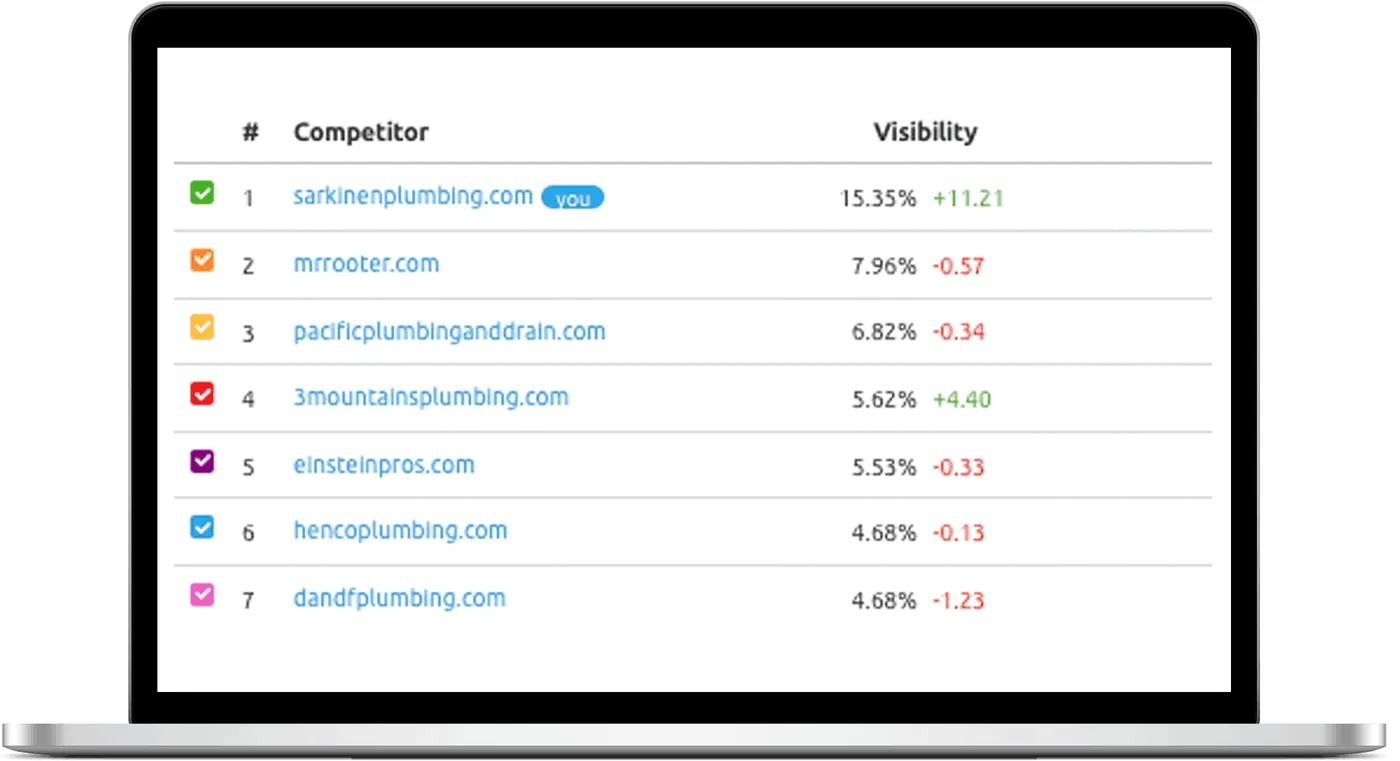
For Sarkinen Plumbing, a plumber in the greater Portland area that takes in Lake Oswego, Lithium did three jobs at once: a new website, SEO and Google Ads. The results card below comes from that combined work. The quote is from Matt Johnson, whose landscaping company was a Lithium client.
Plumbing2Xleads
on the same budget
“Lithium Marketing is awesome to work with and the results you’ll get are outstanding. Once I started working with them I saw increase in my online presence and my sales increased too. I would highly recommend them to anyone looking for help with marketing!”
 Matt JohnsonOn-Target Landscape
Around Lake Oswego
Plenty of Lake Oswego crews also take jobs in the cities below. Open one to see its search numbers before you spend on an area page for it, or use the Oregon link for every other city on our list.
Published price
$1,300–$3,000
per month
Typical local SEO retainer, scoped against what a lead is worth to you, with AI search optimization included.
FAQ

Still curious?
Call (503) 766-5964 or email [email protected].
SEO runs $1,300–$3,000 a month. Where you land depends on how many services and cities you want to rank for, how much your site needs and what one new job is worth to you. A pest control company covering Lake Oswego alone sits lower than a remodeler going after six cities.
Technical fixes usually show up within 30 days, and local and long-tail rankings typically take 60 to 90 days, with revenue compounding from month four. How fast you move depends on where you start: a business that already has a page for each service and recent reviews moves sooner than one with a single services page. Each month’s report lists calls and form leads by source, so the early gains are easy to spot.
In the organic results, yes: a strong Lake Oswego service page can rank wherever your shop sits. The Map Pack is harder, because Google weighs how close a business is to the person searching. Area pages, reviews from Lake Oswego jobs and a service area that lists the city give you the best shot there.
Nobody controls Google’s order, so no honest agency will. What we guarantee is the work. Your profile gets every category and photo it should have, each service gets a page, your listings match, and your monthly report shows where you moved.
It raises the bar for how clearly your pages answer questions. Google builds that summary from pages it can read easily, so we open each service page with a direct answer, add schema and keep your business name, phone and hours identical on every listing. That work comes with every SEO retainer at no extra charge. Google alone picks which sources it quotes, so your monthly report sticks to calls and form leads.
Free action plan
Send your website and a list of the jobs you want more of. A co-founder will take you through it on a short video call: where you appear for Lake Oswego searches now, what’s holding your Google profile back and which pages to build first.
What we’ll cover
2000 NE 42nd Ave Ste D Unit 2370, Portland, OR 97213
Prefer to pick a time? Book a 30-minute call with DJ