
 Commercial glass
Town & Country Glass
13Xorganic traffic
145 to 1,849 visits a month
- top-3 rankings, up from 1
- 109
- top-3 rankings, up from 1
- Google Ads conversion rate
- 29.9%
- Google Ads conversion rate
Websites for Lancaster service businesses
A Lancaster website from Lithium loads fast, shows real job photos and puts a tap-to-call button beside the quote form, on a site you own.
 Google PartnerView our Partners listing
5.0on Google · read our reviews
Google PartnerView our Partners listing
5.0on Google · read our reviews
Businesses
we’ve worked with
Businesses we’ve worked with
The site a Lancaster buyer sees
Lithium Marketing builds Lancaster service websites on WordPress with the phone layout settled before the desktop one, because a customer who taps a map result should not have to pinch and zoom to find the number. Lancaster's median home was built in 1986, so the site needs repair, upgrade and replacement pages for older housing, not only new-build galleries.
Lancaster's median home value is $446,600, so the site has to earn trust before a stranger walks in: photos of finished jobs, a service page that matches the problem and a phone number that works on the first tap. We put those ahead of the form.
Where the website gets tested
The person who searches “web design lancaster ca” is an owner like you, comparing agencies. The visitor who matters came from a trade search and landed on your site from the Map Pack or the organic results. A slow page, a hidden number or a long form gives that visitor a reason to go back to Google.
Facebook and Yelp appeared in the top 10 when we checked “plumber lancaster ca”. A customer who finds you on a directory may look at your site next, and the site has to carry what the directory cannot: job photos, service detail and a quote request that fits a phone screen.
| Search | Searches a month | Cost per click |
|---|---|---|
| web design lancaster ca | 10 | not reported |
| web designer lancaster ca | under 10 | not reported |
| website design lancaster ca | under 10 | not reported |
Source: Google Ads keyword data, average monthly U.S. searches. "Under 10" = below Google’s reporting floor.
Source: one Google results page for “plumber lancaster ca”, as Google showed it to a searcher located in Lancaster. Search ad counts exclude sponsored local listings. Results shift by searcher and day.
The housing behind the work
33.5% of Lancaster's homes went up before 1980. For a plumber, electrician or roofer, that is a page plan. Repair, repipe, panel upgrade and roof replacement each need an explanation, and each one should show a finished local job, not a stock photo of a new house.
Only 6.0% of Lancaster's homes were built in 2010 or later, so new-construction work is a smaller share of the local market. A remodeler or builder still needs those pages, but the everyday demand sits in the older housing. Put the repair and upgrade work where a homeowner sees it first.
Sources: U.S. Census Bureau 2025 population estimates, ACS 2020–2024 and 2023 County Business Patterns.
Trade pages a Lancaster site needs
Los Angeles County lists 1,747 new home builders and 839 painting contractors, two trades that need different websites. A builder sells a completed project and a process; a painter sells a finish and a fast quote. One site can serve both only if each has its own gallery and its own request path.
Los Angeles County's 3,775 residential remodelers are the largest trade group on the chart. A remodeler's site lives on project photos and a clear scope conversation, so the gallery needs captions that name the work and the estimate form needs to ask for the room, the timeline and the budget range your estimator works from.
County Business Patterns
Trade and home service businesses in Los Angeles County
Establishments by industry, 2023
Source: U.S. Census Bureau, 2023 County Business Patterns (NAICS establishment counts).
The build
Each stage gets your sign-off, and nothing goes live until the forms, call links and tracking are tested.
We map the services, cities and proof each page needs before design starts, so the build has a fixed scope and a price.
You see the phone layout first, with the call button and quote form in reach, and you sign off before the desktop view is built.
GA4 and call tracking go in while the site is still local, so the first day of traffic has a source and every form has been tested.
Old links redirect to their replacements, then the new site opens with a Loom recording that shows your team how to make edits.
What every Lithium website includes
The same eight parts go into every website build, wherever the business is.
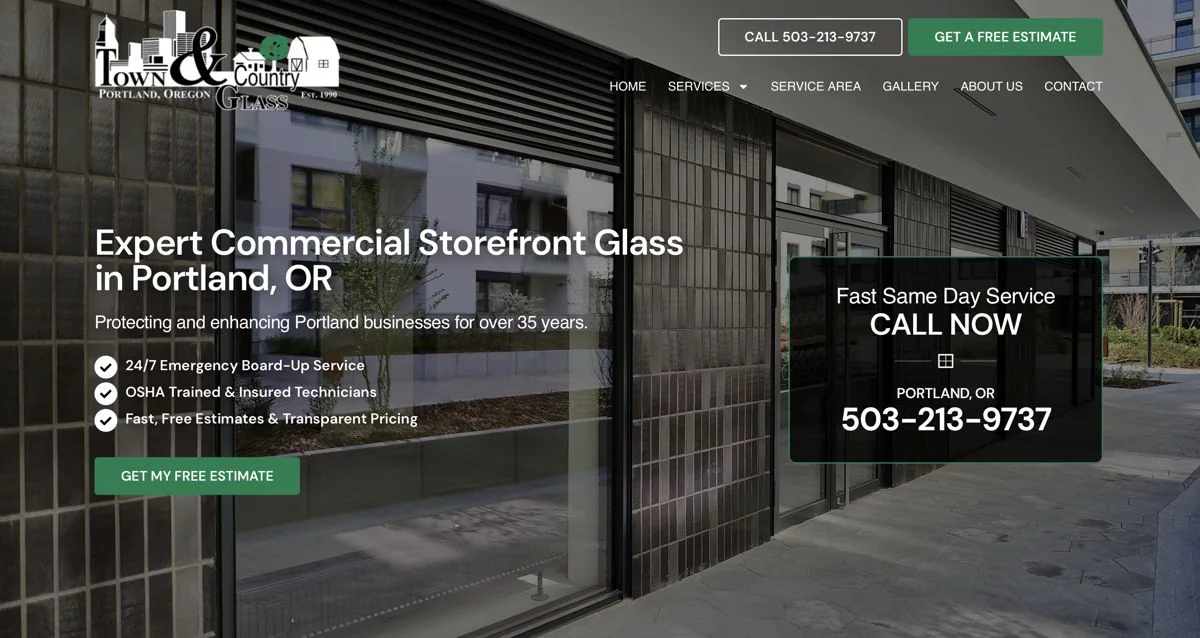
A Portland glass company's site
The card is Town & Country Glass, a Portland commercial glass company that hired Lithium for a website plus SEO and Google Ads. The card's traffic, ranking and conversion figures come from that combined work. Kevin Atiyeh of Atiyeh Bros, a carpet and rug business, is quoted beside the card.
Commercial glass13Xorganic traffic
145 to 1,849 visits a month
“Lithium Marketing has done a good job with understanding our Company and what we specialize in and applying that to our digital marketing.”
 Kevin AtiyehAtiyeh Bros Carpet
Cities near Lancaster
Every city link below opens a web design page with its own housing notes. Those notes tell you whether a town needs repair galleries, new-build galleries or both, which is the decision behind adding a city page to your own site. The California directory lists the rest of the state.
Published price
$5,000
typical project
Larger sites get a fixed proposal after a 30-minute discovery call. Six to nine weeks from kickoff to launch. You own the domain, hosting account, WordPress install and content.
FAQ

Still curious?
Call (503) 766-5964 or email [email protected].
Most Lancaster builds land at $5,000. The number climbs with scope: a page for every city you cover, a gallery of dozens of jobs or a feature your team relies on. You get a fixed proposal after a short discovery call, before the build starts.
Everything does: the site, the domain, the hosting account, the WordPress install and the content. All of it lives in accounts you control, so a new agency can pick up where this one left off.
Old pages that earn visits or links get redirected to the closest new page, and the map is checked in Search Console after launch. Rankings can still move; a redirect protects the address, not the position. A visitor or a crawler that lands on an old link still finds the work.
Text, photos and finished jobs can be changed in WordPress without code, and a private Loom recording walks your team through it. If you would rather hand updates off, the optional $99 a month plan covers hosting, daily backups, software and security updates, and basic changes.
Photos of finished jobs, your service list, the cities you cover and any reviews you want shown. The copy comes from that material, so you do not need a finished brief, and you approve every page before launch.
Free action plan
Photos from finished jobs and a link to the current site give us enough to start. The page plan, the typical $5,000 price and the build timeline all come back to you on a short video call with a co-founder.
What we’ll cover
2000 NE 42nd Ave Ste D Unit 2370, Portland, OR 97213
Prefer to pick a time? Book a 30-minute call with DJ