
 Septic
Byers Septic Service
9Xorganic traffic
91 to 799 visits a month
- more ranking keywords (36 to 395)
- 11X
- more ranking keywords (36 to 395)
- conversion rate
- 23.1%
- conversion rate
Website design for Milwaukee contractors
Give Milwaukee customers a clearer reason to call with a WordPress website built around your work, your services and full ownership.
 Google PartnerView our Partners listing
5.0on Google · read our reviews
Google PartnerView our Partners listing
5.0on Google · read our reviews
Businesses
we’ve worked with
Businesses we’ve worked with
Show the work behind your name
Lithium Marketing builds service-business websites that help Milwaukee customers judge the work and request an estimate. Within Milwaukee city, 84.2% of homes were built before 1980. If you repair, maintain or improve older houses, your website should show that experience through completed jobs, clear descriptions and photos of the work.
Construction from 2010 onward accounts for 4.2% of the city’s housing. A gallery filled only with new builds may miss the work your customers are trying to hire. We help you choose examples that represent your services, then design the pages so a visitor can move from a project to a call or quote request.
Design for the visit you earned
“Roofing company milwaukee” accounts for about 590 searches a month. Visitors arriving from that search should immediately find repairs, replacements and your service area. A customer looking for help with a leak should not have to search a gallery to find out if you offer repairs.
For “landscaping milwaukee”, monthly search volume is about 880. A landscaping website can organize maintenance and installation work separately, with an estimate form that asks which one the visitor needs. We build navigation around those buying decisions, then check it on mobile screens where long menus and oversized photos can get in the way.
| Search | Searches a month | Cost per click |
|---|---|---|
| web design milwaukee | 590 | $11.28 |
| web designer milwaukee | 590 | $11.28 |
| website design milwaukee | 590 | $11.28 |
Source: Google Ads keyword data, average monthly U.S. searches. "Under 10" = below Google’s reporting floor.
Source: one Google results page for “plumber milwaukee”, as Google showed it to a searcher located in Milwaukee. Search ad counts exclude sponsored local listings. Results shift by searcher and day.
Recognizable properties, clearer questions
Milwaukee’s Polish flats have stacked homes with separate entrances. If you work on these properties, include examples and explain how you arrange access to the unit being serviced. A project caption can say what changed and which part of the property was involved, helping a visitor recognize a similar job.
The owner-occupied share of Milwaukee city’s occupied housing is 41.8%. For businesses serving rental properties, a site can explain how an owner or manager requests work and who needs to authorize it. Keep the form short, but ask for the job address and a description so your team can begin with the right details.
Sources: U.S. Census Bureau 2025 population estimates, ACS 2020–2024 and 2023 County Business Patterns.
Photos need an explanation
Painting contractors make up 110 establishments in Milwaukee County. A finished-room photo becomes more persuasive when the caption explains surface preparation, the work completed and what the customer requested. Use your own jobs and make the related service easy to request from the gallery.
Milwaukee County’s residential remodeling category contains 233 establishments. For a remodeler, a project page can explain the starting condition, the agreed changes and the finished space. Plumbing and roofing businesses can use shorter job examples with a prominent call button; the amount of detail should suit the decision the customer faces.
County Business Patterns
Trade and home service businesses in Milwaukee County
Establishments by industry, 2023
Source: U.S. Census Bureau, 2023 County Business Patterns (NAICS establishment counts).
From material to finished website
You bring the knowledge of your work. We turn it into copy, layouts and a tested WordPress website.
We review your service list, job photos and coverage. Together we decide which pages a customer needs before contacting you.
Layouts connect project examples to the service being sold. You review the wording and design before we complete the build.
We test phone links, forms and mobile layouts, then verify the tracking for calls and quote requests. Existing URLs are accounted for before launch.
You receive the site access and a private walkthrough. Your team can add jobs and edit content, or choose optional ongoing maintenance.
What every Lithium website includes
The same eight parts go into every website build, wherever the business is.
A site supported by search and advertising
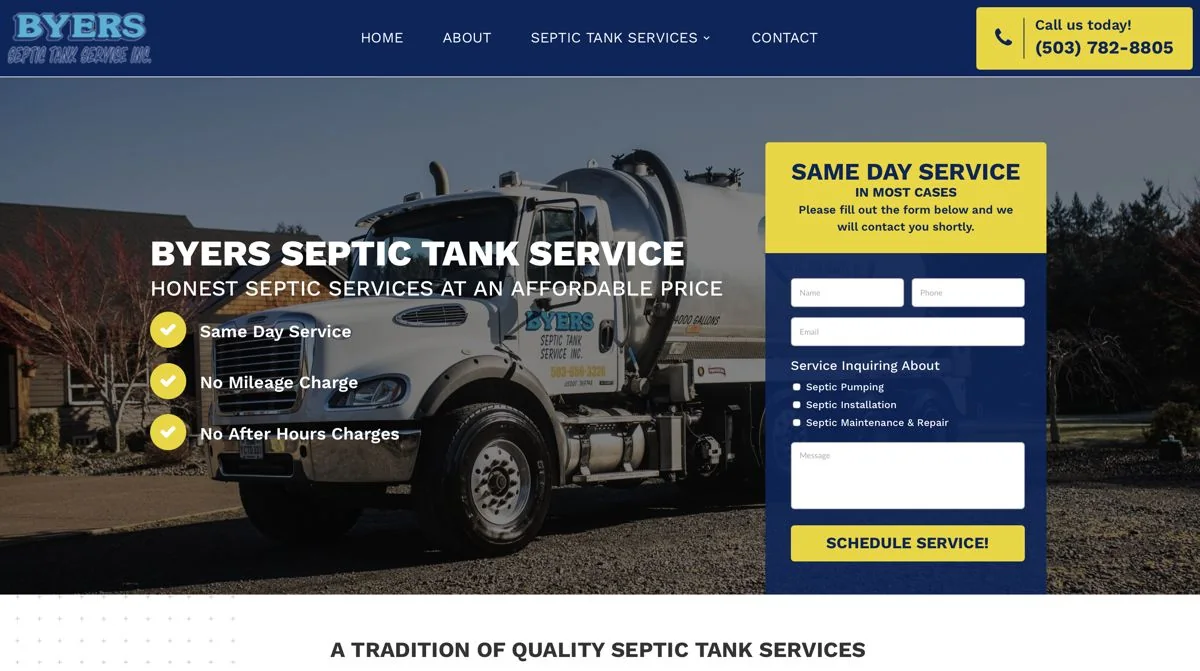
Byers Septic Service hired Lithium for web design, SEO and Google Ads. The case records results across that work. The accompanying testimonial comes from Drake Snodgrass, the owner of garden center Drake’s 7 Dees.
Septic9Xorganic traffic
91 to 799 visits a month
“Lithium has moved us to page 1 in Google search organically. Prior to working with them we spent a huge part of our marketing budget on paid search. Website redesign was a great experience.”
 Drake SnodgrassDrake’s 7 Dees
Design for your full coverage
Planning a site that also sells work outside Milwaukee? Open a web design guide below for another city’s housing and customer context. Wisconsin coverage has its own directory, while Elgin and Rockford are linked as Illinois cities.
Published price
$5,000
typical project
Larger sites get a fixed proposal after a 30-minute discovery call. Six to nine weeks from kickoff to launch. You own the domain, hosting account, WordPress install and content.
FAQ

Still curious?
Call (503) 766-5964 or email [email protected].
A typical service-business website costs $5,000. We define the pages, copy and build work in the proposal; a larger site with more services, project pages or migration work needs its own fixed price. Optional hosting and maintenance is $99/month and is separate from the website purchase.
Plan on six to nine weeks from kickoff to launch. Getting photos, service details and feedback to us promptly helps keep the agreed schedule. We establish what you need to review before work begins, so your team knows when decisions are needed without managing the build itself.
Your business keeps the domain, hosting, WordPress installation and content. Ownership belongs to you, and you have access to the site you paid for. Choosing Lithium’s optional hosting and maintenance does not change that ownership; you can have another provider work on your website.
We plan for existing links before launch by reviewing old URLs and mapping changed pages to suitable replacements. That includes service pages linked from business profiles or material you have already shared. We check the redirects and monitor search performance around launch, though search positions can still change.
Clear photos of your own completed work are a good starting point. Send what you have and explain the job, including what your team handled. We help select images that support the services you sell. A short, accurate project story is more convincing than a large gallery with no context.
Free action plan
Send a link to your site and examples of the work you want customers to see. On a short video call with a co-founder, you’ll review a free plan for the pages, build scope and next steps.
What we’ll cover
2000 NE 42nd Ave Ste D Unit 2370, Portland, OR 97213
Prefer to pick a time? Book a 30-minute call with DJ