
 Glass
GlassDixie Glass
76%more conversions
January vs the January before
- ads conversion rate
- 15.57%
- ads conversion rate
- organic traffic
- +18.2%
- organic traffic
WordPress websites for Stockton service companies
Show Stockton customers the work you do with a WordPress website built for estimate requests and owned entirely by your business.
 Google PartnerView our Partners listing
5.0on Google · read our reviews
Google PartnerView our Partners listing
5.0on Google · read our reviews
Businesses
we’ve worked with
Businesses we’ve worked with
Make your work visible
Lithium Marketing turns your service knowledge and project photos into a Stockton website that helps customers request work. In Stockton, 50.7% of homes were built before 1980. If your crews repair or improve existing properties, the site should show examples of that work and explain what the customer can ask you to do.
We build on WordPress and write the service pages, with contact options that are easy to use on a phone. A homeowner considering a larger project can examine your work; someone with a repair question can reach you quickly. The domain, hosting, WordPress installation and content all belong to you.
After the search comes the decision
“Landscaping stockton” accounts for about 320 searches per month. A visitor may want ongoing care or a garden project, so a company offering both should explain them separately. Give each service photos that match the work and a clear way to ask for an estimate.
The phrase “electrician stockton” has a monthly search volume of 390. A readable list of services helps that visitor move beyond a broad trade name. We put the job description and contact action together, with fast-loading pages and forms tested on mobile.
| Search | Searches a month | Cost per click |
|---|---|---|
| web design stockton | 70 | $10.23 |
| website design stockton | 70 | $10.23 |
| web designer stockton | 10 | not reported |
Source: Google Ads keyword data, average monthly U.S. searches. "Under 10" = below Google’s reporting floor.
Source: one Google results page for “plumber stockton”, as Google showed it to a searcher located in Stockton. Search ad counts exclude sponsored local listings. Results shift by searcher and day.
Choose the right examples
Only 4.3% of Stockton homes were built in 2010 or later. If most of your work is on existing houses, make those projects prominent in the site’s photography. A remodeler can explain what changed in a room; a painter can show the preparation and finish. Use newer construction examples where they match the jobs you sell.
Stockton’s owner-occupied share is 53.9% of occupied homes. When you work for rental owners as well as homeowners, explain how each can arrange an estimate. The form can ask for a service address and a short description without forcing someone to know technical details before contacting you.
Sources: U.S. Census Bureau 2025 population estimates, ACS 2020–2024 and 2023 County Business Patterns.
A website that sounds like your business
Residential remodelers have 183 establishments in San Joaquin County. A generic gallery makes it hard to tell what any particular firm did. We pair your photos with descriptions of the project, the work you performed and the kind of work another customer can request.
San Joaquin County also records 70 painting contractors. For a painting business, show the rooms or exterior surfaces you work on and explain the estimate process. Other trades need different examples, but the goal is the same: enough detail for the visitor to choose a next step.
County Business Patterns
Trade and home service businesses in San Joaquin County
Establishments by industry, 2023
Source: U.S. Census Bureau, 2023 County Business Patterns (NAICS establishment counts).
Your website project
We agree on the pages, develop the designs with your feedback and test how customers contact you.
We review your current site, best projects and service priorities. You provide the business details and photos; we organize them and write the copy.
You see how the pages present your services and estimate options on both screen sizes. We refine the design using your feedback before completing the build.
We create the WordPress pages, connect analytics and call tracking, and test contact forms and phone links. Existing URLs are reviewed for redirects where needed.
After launch checks, we provide a private Loom walkthrough of your website. Your team can update its content, and optional hosting and maintenance is available.
What every Lithium website includes
The same eight parts go into every website build, wherever the business is.
Website work in a wider program
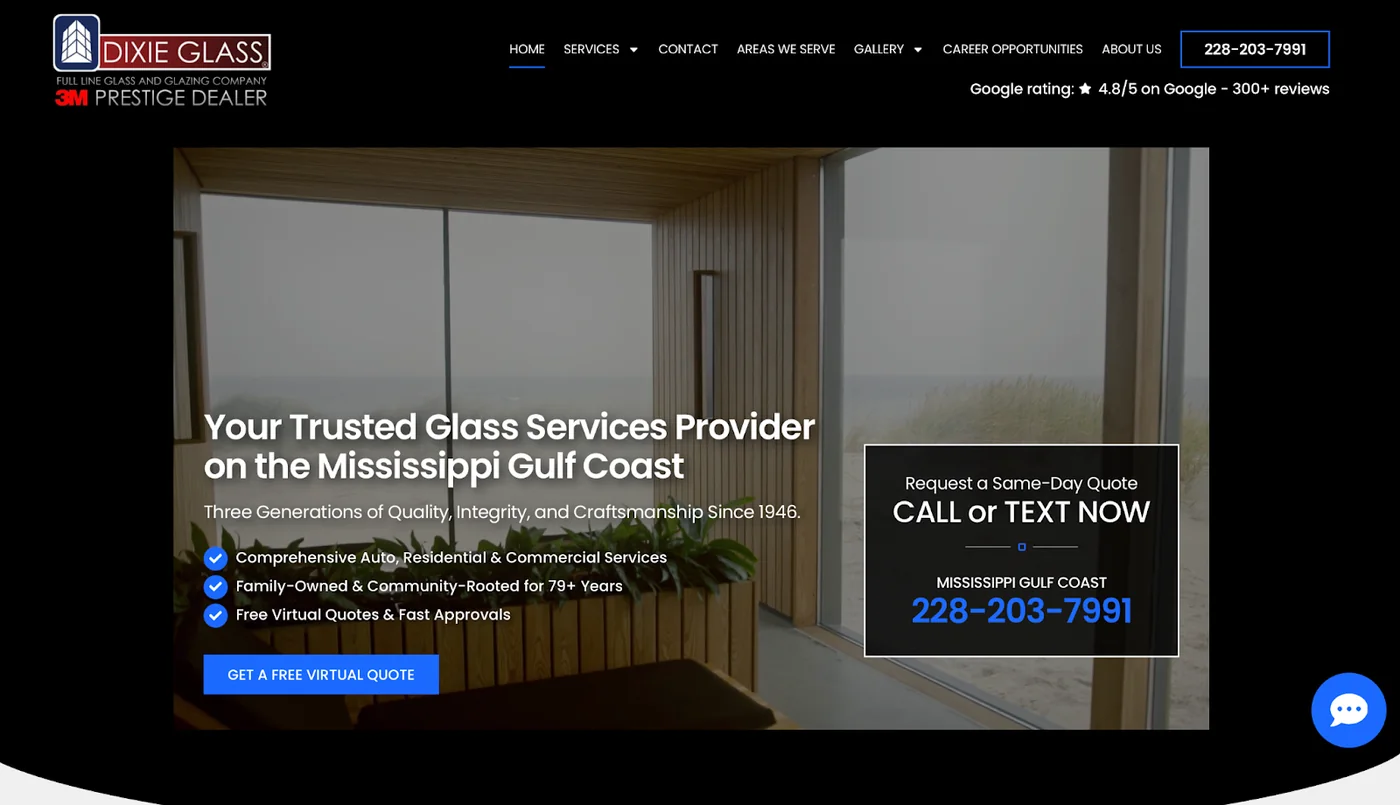
On the Mississippi Gulf Coast, Dixie Glass used Lithium for a new website, SEO and Google Ads. The case reflects that full program. Chris Martin’s accompanying testimonial describes the relationship from the perspective of Mt. Hood Pro Painting.
Glass76%more conversions
January vs the January before
“Ever since we've used Lithium Marketing, our phone has been ringing off the hook and we can hardly keep up with the leads we get from Google, Facebook or through our website. Most of our leads other than referrals are through Google and it's all because of Lithium Marketing.”
 Chris MartinMt. Hood Pro Painting
Planning pages for your service area
If your next website needs to explain work outside Stockton, compare the linked city guides before choosing its page list. They include web design in Tracy and Modesto, plus Antioch, Elk Grove, Concord and Sacramento, with other locations in the California directory.
Published price
$5,000
typical project
Larger sites get a fixed proposal after a 30-minute discovery call. Six to nine weeks from kickoff to launch. You own the domain, hosting account, WordPress install and content.
FAQ

Still curious?
Call (503) 766-5964 or email [email protected].
A typical service business website costs $5,000. A larger page list or more extensive project content can change the scope, so we provide a fixed proposal after the discovery call. Optional hosting and maintenance costs $99/month and is separate from the build price.
Allow six to nine weeks from kickoff to launch for a typical website. We need your service information, photos and feedback as the work progresses. You review desktop and mobile designs, and the schedule includes building the pages and testing the site before customers use it.
You keep full ownership of the domain, hosting, WordPress installation and content. Those assets belong to your business, so another provider can work on the site if you choose. We also provide editing guidance so your team can maintain its service details and project examples.
A redesign is worth considering if referred customers cannot find your services, see examples or contact you easily. We inspect the existing site before proposing a replacement. Sometimes focused improvements are enough; a full build makes sense when the structure or mobile experience prevents the site from doing its job.
We review existing URLs and plan redirects for pages that move, so visitors and search engines can reach the corresponding content. We also check search performance around launch. A redesign cannot guarantee unchanged rankings, but preserving valuable pages and links is part of the migration work.
Free action plan
Bring a few completed projects and a link to the site you use today. During a short video call, a co-founder will discuss the page list, build scope and next steps with you.
What we’ll cover
2000 NE 42nd Ave Ste D Unit 2370, Portland, OR 97213
Prefer to pick a time? Book a 30-minute call with DJ