
Table of Contents

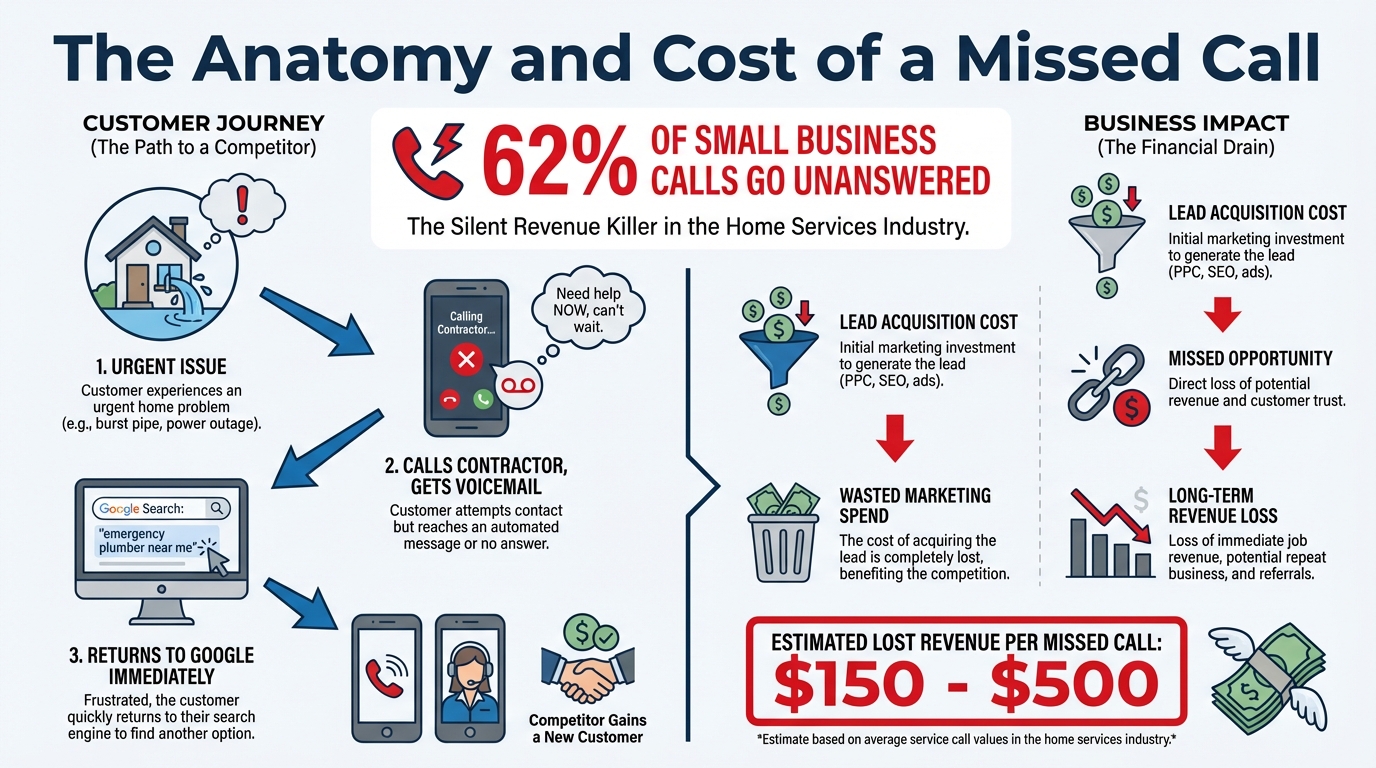
Picture this: It’s 2 AM, and a homeowner’s basement is flooding. They frantically Google “emergency plumber near me,” find your website, and call… only to reach voicemail. By morning, they’ve already hired your competitor who answered on the first ring.
This scenario plays out thousands of times daily across the home service industry. According to recent industry data, a staggering 62% of calls to small businesses go unanswered—and in urgent service industries like plumbing, electrical, and HVAC, every missed call represents lost revenue. With the U.S. Bureau of Labor Statistics projecting 6% employment growth for HVAC technicians alone through 2032, demand is soaring while skilled labor remains scarce.
The solution? AI-powered dispatchers that never sleep, never miss a call, and can instantly schedule appointments directly into your CRM—without any human intervention. This technology is transforming how home service professionals capture leads, manage their schedules, and ultimately, grow their businesses. In this article, we’ll explore how AI dispatchers work, why they’re becoming essential for competitive contractors, and how they solve the age-old problem of being too busy working to answer the phone.
Why Traditional Scheduling Is Killing Your Bottom Line
The home service industry operates on a simple but brutal truth: when a customer needs help, they need it now. And whoever answers first typically wins the job.
The Urgency Factor
When a customer’s AC fails during a heatwave or a pipe bursts in their kitchen, they don’t politely wait for your business hours to start. They contact multiple contractors simultaneously until someone—anyone—answers. In this high-stakes race, being the most skilled technician in town means nothing if you’re unreachable when customers are desperately searching for help.
The financial impact is staggering. The average cost per missed call in the home service industry ranges from $150 to $500 depending on the service type and market. For a busy contractor receiving 20-30 calls per week, even a 62% miss rate translates to thousands of dollars in lost revenue monthly.
The Cost of Human Limitations
Field technicians face an impossible dilemma: they cannot simultaneously fix a furnace and answer scheduling calls. You’re either under a sink diagnosing a leak, or you’re on the phone booking the next appointment—but you can’t do both.
Traditional solutions come with significant drawbacks. Hiring dedicated dispatchers adds $35,000-$50,000 annually in salary and benefits. Answering services provide coverage but often lack the technical knowledge to properly assess job urgency or ask the right diagnostic questions. Neither option scales efficiently during seasonal demand spikes.
The After-Hours Gap
Emergencies don’t respect business hours. In fact, many of the most lucrative service calls occur during evenings, weekends, and holidays when homeowners are actually home to notice problems. A traditional 9-to-5 dispatch model leaves massive revenue opportunities on the table during precisely these high-value windows.
Consider the HVAC contractor who misses a Saturday afternoon call about a failed air conditioning unit. That homeowner won’t wait until Monday—they’ll keep calling competitors until someone responds. The same pattern plays out for Sunday morning water heater failures, holiday weekend electrical issues, and late-night plumbing emergencies.
Double-Booking Disasters
Manual calendar management creates a breeding ground for scheduling conflicts. One plumbing contractor reported losing an average of three billable hours weekly to scheduling errors alone—time wasted driving to appointments that were accidentally double-booked or locations that were outside their service area.
These errors cascade into larger problems: angry customers who took time off work for appointments that get canceled, damaged reputations from unreliable service, and technician frustration from inefficient routing that increases drive time between jobs.
The Skilled Labor Shortage Amplifier
With the Bureau of Labor Statistics forecasting continued growth in HVAC demand, existing contractors face mounting pressure to maximize efficiency from their current workforce rather than compete for scarce new hires. When you can’t simply hire more technicians, you must extract more value from every hour your existing team works.
This means eliminating administrative friction, reducing wasted drive time, and ensuring that every available service slot gets filled with a paying customer. Traditional dispatching models, dependent on human availability and prone to manual errors, simply cannot deliver this level of optimization.
Meet Your New Team Member That Never Takes a Lunch Break
Modern AI dispatchers represent a fundamental leap beyond basic chatbots or those frustrating “press 1 for plumbing” phone trees. These systems use sophisticated Natural Language Processing to understand conversational, complex customer inquiries—not just simple keyword triggers.
Beyond Basic Chatbots
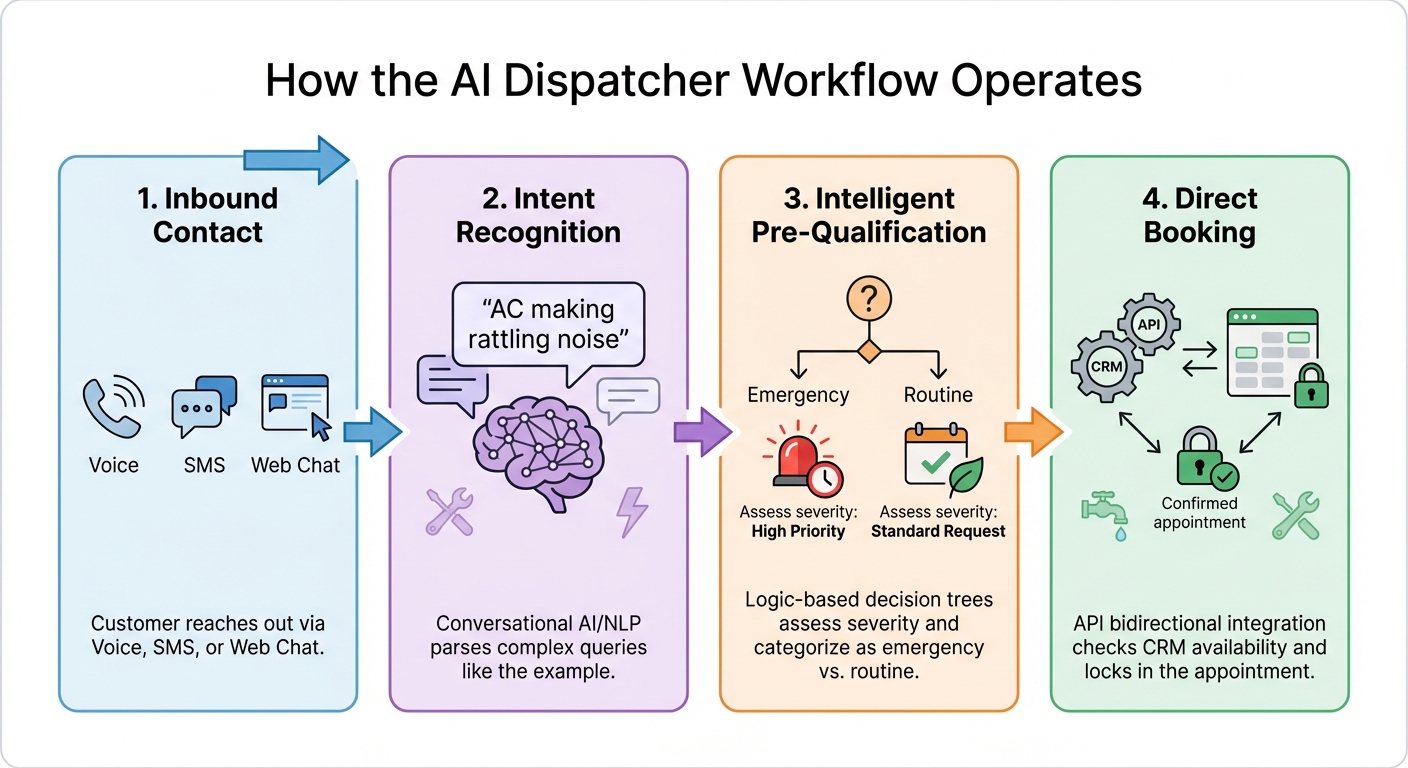
When a customer says “My AC is blowing warm air and making a weird rattling noise,” a modern AI dispatcher comprehends multiple layers of information: the urgency of the situation, the type of expertise required, and the appropriate scheduling priority. It can then ask intelligent follow-up questions: “Is the unit running continuously? When did you first notice the noise? What’s the make and model of your system?”
This conversational intelligence creates a customer experience that feels natural and helpful rather than robotic and frustrating. Customers don’t realize they’re not speaking to a human—they simply appreciate getting immediate assistance.
The Three-Pillar Technology Stack
AI dispatchers operate on three interconnected technologies:
Conversational AI and Natural Language Processing enables the system to understand intent behind customer statements. Unlike legacy systems that require specific keywords, NLP parses the meaning of entire sentences, recognizes synonyms, and adapts to different communication styles.
Logic-based pre-qualification uses decision trees specific to your trade. For electricians, the system might assess panel amperage, the age of wiring, and the presence of GFCIs. For plumbers, it determines if water is currently leaking, what fixture is affected, and the age of the system. This structured information gathering ensures your technicians arrive prepared with the right tools and knowledge.
CRM API integration provides bi-directional communication with field service management platforms like ServiceTitan, Housecall Pro, and Jobber. The AI reads real-time technician availability, factors in drive-time radiuses, and writes appointments directly into your system. This seamless synchronization eliminates the primary cause of double-bookings and scheduling conflicts.
The Intelligence Layer
The most sophisticated AI dispatchers don’t just book appointments—they conduct diagnostic conversations. They can ask questions like “Is water currently leaking?” or “What’s your panel’s amperage?” to properly triage the job severity and assign the right level of technician.
This intelligence extends to understanding customer sentiment. If a caller expresses frustration or mentions a previous bad experience, the system can adjust its approach, offer priority scheduling, or flag the conversation for personal follow-up from a manager.
McKinsey research validates this approach, finding that integrating Generative AI in customer operations increases issue resolution rates by 14% per hour and reduces time handling inquiries by 9%. For home service businesses, this translates directly to faster booking times and higher lead conversion rates.
The Seamless Handoff
While AI handles approximately 80% of routine scheduling autonomously, complex scenarios still benefit from human expertise. Major commercial bids, specialized permit requirements, or jobs requiring detailed site assessments automatically escalate to human managers.
This hybrid approach maximizes efficiency without sacrificing customer service quality. The AI handles high-volume, straightforward bookings while freeing your experienced staff to focus on complex situations that truly require their expertise.
Why Your Competitors Are Switching (And You Should Too)
The operational and financial advantages of AI-powered scheduling become crystal clear when examined side-by-side with traditional methods.
Response Time: Instant vs. Eventually
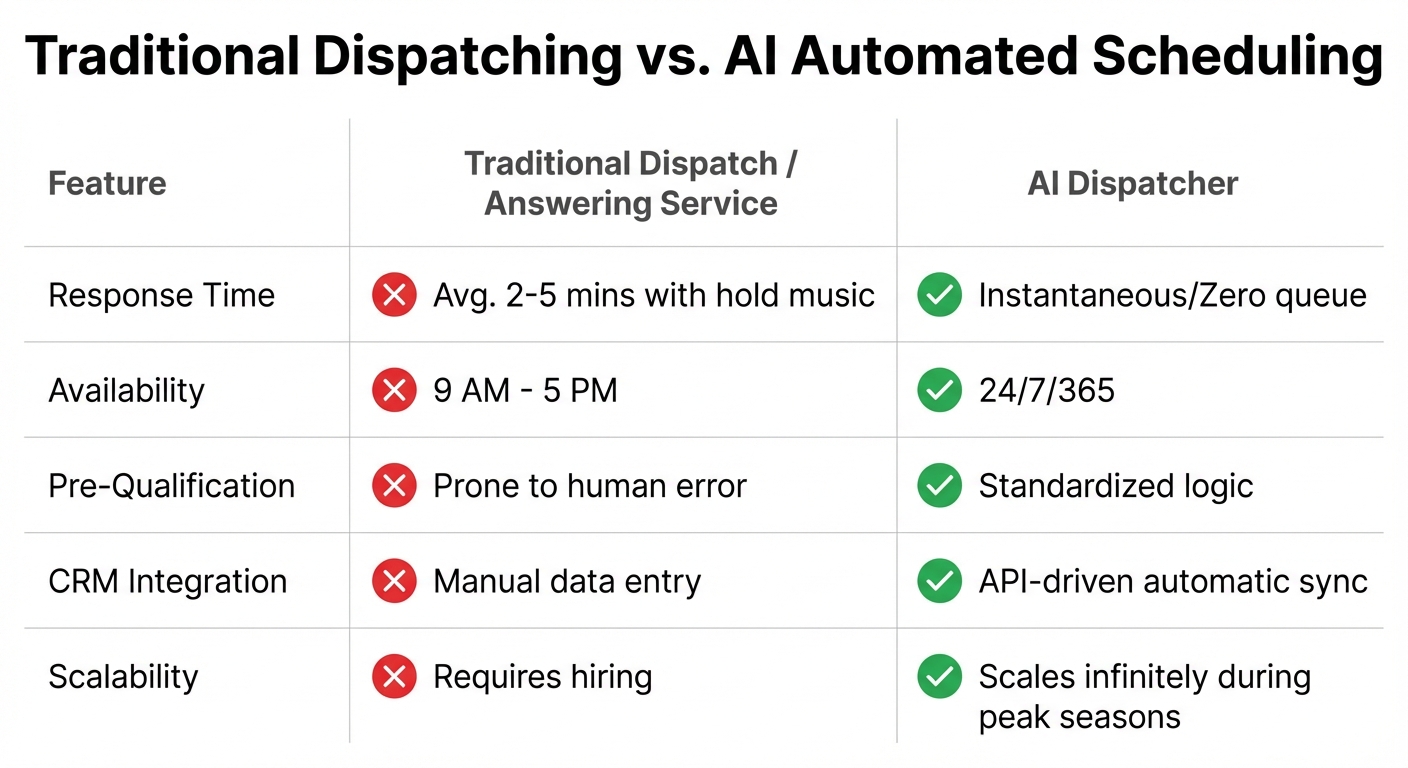
Traditional answering services average 2-5 minute wait times with queue music—an eternity when a customer has water pouring into their basement. AI dispatchers respond instantly with zero queue time. In emergency service scenarios where customers are simultaneously calling multiple contractors, this immediate response creates a decisive competitive advantage.
Every second counts. The contractor who answers immediately signals reliability, professionalism, and availability—exactly the qualities desperate customers seek during emergencies.
Availability Economics: 24/7 Without Premium Rates
Traditional dispatchers work 9-5, with premium rates applying to after-hours coverage. AI operates 24/7/365 at no additional cost, capturing the lucrative evening and weekend emergency market without increasing your overhead.
This economic model fundamentally changes the profitability equation. Instead of paying time-and-a-half for weekend dispatchers, you maintain consistent service at flat monthly rates regardless of call volume or timing.
Accuracy and Consistency: Logic vs. Memory
Human dispatchers rely on individual expertise and are inevitably prone to data entry errors, particularly during high-stress, high-volume periods. AI applies standardized pre-qualification logic every single time and eliminates double-booking through automated CRM synchronization.
This consistency also improves service quality. Every customer receives the same thorough intake questions, ensuring your technicians arrive fully prepared with accurate job information.
Scalability During Peak Seasons
When summer heatwaves drive HVAC call volume up 300%, traditional models require hiring temporary staff—with all the associated recruitment, training, and management costs. AI handles infinite concurrent conversations without capacity constraints.
This scalability proves particularly valuable for smaller operations that experience dramatic seasonal swings. You maintain professional, immediate response during your busiest periods without the overhead burden of year-round staffing for peak-season demand.
The ROI Calculation
The financial case for AI dispatching is compelling. Traditional dispatchers cost $35,000-$50,000 annually including salary and benefits. AI systems typically run $200-$500 monthly—roughly $2,400-$6,000 annually.
For a contractor capturing just 2-3 additional jobs monthly from after-hours leads previously lost to voicemail, the investment pays for itself. When you factor in eliminated double-booking costs, reduced administrative overhead, and improved customer satisfaction, the ROI often exceeds 500% within the first year.
Gartner predicts that conversational AI will reduce contact center agent labor costs by $80 billion in 2026, and this transformation is already reshaping the home service industry. Salesforce research found that 84% of IT leaders report generative AI helps their organization better serve customers and reduce overhead.
How Contractors Are Capturing 22% More Revenue With AI

Real-world implementation stories demonstrate AI dispatching’s transformative impact on home service businesses.
The HVAC Summer Surge Solution
A mid-sized regional HVAC company faced a recurring nightmare during the first summer heatwave: call volume would spike by 300%, resulting in abandoned calls and overwhelmed staff. Customers experiencing AC failures during 95-degree heat wouldn’t wait on hold—they’d immediately call the next contractor on their list.
The company deployed an AI conversational agent integrated directly with their CRM, programmed to triage total system failures as “Priority 1” and routine tune-ups as “Priority 2.” This intelligent prioritization ensured emergency situations received immediate attention while routine maintenance requests filled available non-urgent slots.
The results exceeded expectations:
- Zero abandoned calls: The AI handled unlimited concurrent inquiries simultaneously, ensuring every customer received immediate assistance regardless of call volume.
- 22% increase in emergency dispatch revenue: By capturing after-hours calls that previously went to voicemail, the company tapped into a substantial revenue stream they’d been losing to competitors.
- Reduced staff stress: With AI handling routine scheduling, human dispatchers focused on complex situations and customer relationship management, dramatically improving job satisfaction.
This pattern mirrors findings from Salesforce’s State of Service report, which found that organizations implementing generative AI significantly improve customer service while reducing operational overhead.
The Solo Plumber’s Breakthrough
An independent plumbing contractor faced a simpler but equally frustrating challenge: he physically couldn’t answer phones while working under sinks or in crawlspaces. Every missed call represented not just lost revenue but a competitive disadvantage against larger companies with dedicated office staff.
He implemented an SMS-based AI scheduling bot integrated with his local SEO-optimized website. When customers clicked “Book Now,” they engaged in a text conversation where the AI identified plumbing issues, checked his real-time calendar, and confirmed appointments—all while he continued working at job sites.
The outcomes transformed his business:
- Complete elimination of double-bookings: Bi-directional CRM synchronization ensured the AI only offered genuinely available time slots, ending the embarrassing conflicts that damaged his reputation.
- Enhanced SEO performance: The improved user experience and immediate response times led to higher conversion rates, sending positive engagement signals to Google that complemented his SEO strategy. Customers who received instant responses were more likely to complete bookings and leave positive reviews.
- Reclaimed 5+ hours weekly: Time previously lost to phone tag, scheduling coordination, and fixing double-booking errors was redirected to billable service work.
The Success Formula
Both cases demonstrate the same pattern: AI captures leads that would otherwise be lost, those leads convert at higher rates due to immediate response, and revenue increases while operational stress decreases. This isn’t theoretical efficiency—it’s measurable business growth driven by technology that works tirelessly on behalf of contractors who are already working at capacity.
Your 4-Step Strategy to Deploy AI Dispatching

Implementing AI dispatching requires strategic planning to maximize ROI and avoid common pitfalls. For marketing agencies like Lithium Marketing driving high-quality traffic to contractor websites, educating clients on proper implementation ensures that increased lead volume translates to captured revenue.
Step 1: Define Your Pre-Qualification Parameters
Before deploying AI, map your ideal intake questions based on your specialty. These questions enable the AI to triage urgency and ensure proper technician assignment.
For Electricians:
- Panel amperage and age
- Type of wiring (aluminum, copper, knob-and-tube)
- Presence of GFCIs and arc-fault protection
- Specific symptoms (burning smell, flickering lights, complete power loss)
For Plumbers:
- Is water currently leaking?
- What fixture is affected?
- Age of system and last service date
- Water pressure issues or drain blockages
For HVAC Technicians:
- System type (central air, heat pump, ductless)
- Age of unit
- Heating or cooling issue
- Strange noises or odors
- Last maintenance date
These diagnostic questions serve dual purposes: they help your technicians arrive prepared with the right tools and knowledge, and they establish your professionalism in customers’ minds from the very first interaction.
Step 2: Audit and Clean Your CRM Data
AI systems depend entirely on accurate scheduling data. Poor data in equals poor scheduling out—this preparation is non-negotiable.
Before integration:
- Verify all technician calendars are current and complete, including vacation time, training days, and service blocks
- Confirm service territory mappings are geographically accurate with realistic drive-time calculations
- Establish clear appointment type categories (emergency, routine service, estimate, maintenance contract)
- Standardize pricing information so the AI can provide accurate estimates when appropriate
This data cleanup often reveals inefficiencies in your current operations. Contractors frequently discover scheduling gaps, overlapping territories, or inconsistent service categorizations that were creating problems long before AI implementation.
Step 3: Establish Human Handoff Protocols
While AI handles approximately 80% of routine scheduling autonomously, define clear escalation rules for situations requiring human expertise:
- Major commercial bids → Senior estimator
- Specialized licensing requirements (high-voltage electrical, underground utilities) → Operations manager
- Customer expressing dissatisfaction or mentioning previous problems → Customer service lead
- Complex multi-system projects → Project coordinator
Seamless escalation preserves customer experience while leveraging AI efficiency. The customer should never feel like they’ve been “stuck with a robot”—instead, they should feel like they’ve received immediate assistance with the option for specialized human attention when their situation requires it.
Step 4: Integrate With Your Marketing Strategy
For agencies like Lithium Marketing driving organic traffic through SEO, AI scheduling maximizes lead capture ROI by creating synergies across your digital presence:
Faster response times improve website conversion rates: When potential customers submit inquiries through your website and receive immediate engagement, conversion rates increase dramatically compared to forms that disappear into a void with “we’ll contact you soon” messages.
Positive user experience signals strengthen SEO performance: Google’s algorithms increasingly prioritize user experience metrics. When visitors engage with your AI dispatcher, spend time on your site completing bookings, and ultimately convert, these signals indicate quality content and service—boosting your organic rankings.
24/7 availability captures traffic from all time zones and schedules: If your local SEO efforts are reaching customers across a metropolitan area, people searching at midnight or on Sunday mornings can instantly book appointments rather than waiting for business hours to call.
The synergy between SEO lead generation and AI lead capture creates a competitive moat. Competitors might match your search rankings, but if they’re sending calls to voicemail while you’re booking appointments, you’ll win the revenue battle.
Strategic Considerations for Successful Implementation
Start with one communication channel—phone, SMS, or web chat—and expand as your confidence grows. Trying to deploy across all channels simultaneously often creates confusion and dilutes your ability to optimize each touchpoint.
Monitor AI performance metrics weekly during the first month: conversion rates, escalation frequency, and customer satisfaction scores. This data reveals optimization opportunities and builds your confidence in the system’s capabilities.
Train staff on the new workflow to ensure smooth customer handoffs when needed. Your team should understand when and why the AI escalates calls, how to access the pre-qualification information the AI has already gathered, and how to provide feedback for system improvements.
Research from Harvard Business Review on AI transformation in project management validates this strategic approach: successful implementations combine technological capability with thoughtful process design and ongoing human oversight.
Final Thoughts
The home service industry is undergoing a fundamental shift. Success no longer belongs solely to the most skilled technicians—it flows to those who are most accessible when customers need them. As local SEO continues driving critical traffic to contractor websites, the ability to instantly capture, pre-qualify, and schedule those leads determines which businesses thrive and which struggle.
AI dispatchers solve the operational paradox that has plagued home service professionals for decades: how to simultaneously deliver excellent field service while managing business operations. By eliminating missed calls, preventing double-bookings, and capturing after-hours emergency revenue, automated scheduling technology doesn’t just save time—it fundamentally protects and grows revenue.
This technology isn’t about replacing human expertise; it’s about creating a protective barrier that safeguards every lead your marketing generates. For the plumber under a sink, the electrician in an attic, or the HVAC tech on a rooftop, AI dispatchers serve as tireless business partners that ensure no opportunity slips away while they focus on delivering the exceptional service that built their reputation.
The question isn’t whether AI scheduling will become standard in home services—it’s whether you’ll adopt it before your competitors do.
Ready to Transform Your Lead Capture?
Discover how AI dispatching integrates with comprehensive SEO strategies to maximize your revenue potential.
References:
- Forbes / Invoca. (2022). The Hidden Cost of Missed Calls and How to Fix It. https://www.forbes.com/sites/forbescommunicationscouncil/2022/05/24/the-hidden-cost-of-missed-calls-and-how-to-fix-it/
- U.S. Bureau of Labor Statistics. (2023). Occupational Outlook Handbook: Heating, Air Conditioning, and Refrigeration Mechanics and Installers. https://www.bls.gov/ooh/installation-maintenance-and-repair/heating-air-conditioning-and-refrigeration-mechanics-and-installers.htm
- Harvard Business Review. (2023). How AI Will Transform Project Management. https://hbr.org/2023/04/how-ai-will-transform-project-management
- McKinsey & Company. (2023). The economic potential of generative AI: The next productivity frontier. https://www.mckinsey.com/capabilities/quantumblack/our-insights/the-economic-potential-of-generative-ai
- Zendesk. (2024). CX Trends Report 2024. https://www.zendesk.com/blog/cx-trends/
- Gartner. (2022). Gartner Predicts Conversational AI Will Reduce Contact Center Agent Labor Costs by $80 Billion in 2026. https://www.gartner.com/en/newsroom/press-releases/2022-08-31-gartner-predicts-conversational-ai-will-reduce-contac
- Salesforce. (2024). State of Service Report (5th Edition). https://www.salesforce.com/resources/research-reports/state-of-service/