
 Commercial glass
Town & Country Glass
13Xorganic traffic
145 to 1,849 visits a month
- top-3 rankings, up from 1
- 109
- top-3 rankings, up from 1
- Google Ads conversion rate
- 29.9%
- Google Ads conversion rate
Web design in Tigard, Oregon
A Tigard homeowner on a phone sees your finished jobs, your reviews and a call button right away, on a WordPress site you own.
 Google PartnerView our Partners listing
5.0on Google · read our reviews
Google PartnerView our Partners listing
5.0on Google · read our reviews
Businesses
we’ve worked with
Businesses we’ve worked with
Tigard web design, in short
Lithium Marketing builds WordPress sites for Tigard service businesses, and the house a customer is calling about shapes what the site should show. The median Tigard home was built in 1988 and is worth $610,500, so the typical job is on a house a few decades old and worth protecting, and its owner wants to see your past work before letting you in.
With the population up 5.7% from 2020 to 2025, many Tigard homeowners are new to town and have no neighbor to ask for a name, so your website does the convincing. We put project photos, reviews and your main services where a phone visitor sees them first, and the domain, hosting and content are registered to you from launch day on.
Search in Tigard
“Pest control tigard” draws about 70 searches a month, and the person searching usually wants someone soon. The first screen they see on your site should show your phone number, service area and hours, so they can tell without scrolling that you cover their part of town and when you can come.
Many visitors arrive from your Google Business Profile, tapping its website button after reading your reviews. That button should open the page that matches what they were looking at, and the page should repeat the name, phone number and services shown on the profile, so the visitor knows they landed in the right place.
| Search | Searches a month | Cost per click |
|---|---|---|
| web design tigard | 10 | not reported |
| web designer tigard | under 10 | not reported |
| website design tigard | under 10 | not reported |
Source: Google Ads keyword data, average monthly U.S. searches. "Under 10" = below Google’s reporting floor.
Source: one Google results page for “plumber tigard”, as Google showed it to a searcher located in Tigard. Search ad counts exclude sponsored local listings. Results shift by searcher and day.
The Tigard market
In Tigard, 16.8% of homes were built in 2010 or later, so a good share of your customers live in newer houses. Their owners tend to hire for upgrades more than repairs, such as a finished basement, a patio, smart wiring or new landscaping, so show those projects with photos and a line on what you did.
Washington County is home to 611,708 people, and a Tigard business often takes jobs well past the city line. A service-area page that lists the cities you cover, with a photo from a job in each, tells a visitor from Sherwood or Aloha that you’ll come to them.
Sources: U.S. Census Bureau 2025 population estimates, ACS 2020–2024 and 2023 County Business Patterns.
Trades in Washington County
Washington County has 307 residential remodelers, and each one sells a big, slow decision. A remodeler’s site should give each kind of job, such as kitchens, baths and additions, its own page and gallery, and ask for the budget and start date on the request form.
Pest control is a smaller field, with 29 companies countywide, and its customers rarely browse. For them, the phone number, the pests you treat and the cities you cover go at the top, with booking one tap away.
County Business Patterns
Trade and home service businesses in Washington County
Establishments by industry, 2023
Source: U.S. Census Bureau, 2023 County Business Patterns (NAICS establishment counts).
The build
You see and approve the design before we build, and we test the finished site on real phones before launch.
Pick the jobs you’re proudest of and the work you want more of, and send photos. We build the page list from your services and the cities you cover.
Each service gets its own page, and each city you work in gets a short page with a photo from a job there.
You approve the phone design first, with the call button, reviews and photos where a thumb lands, then the desktop version.
Forms, call buttons and tracking get checked on real phones, old page addresses get redirected to the new ones, and a private Loom video shows you how to make edits.
What every Lithium website includes
The same eight parts go into every website build, wherever the business is.
Proof
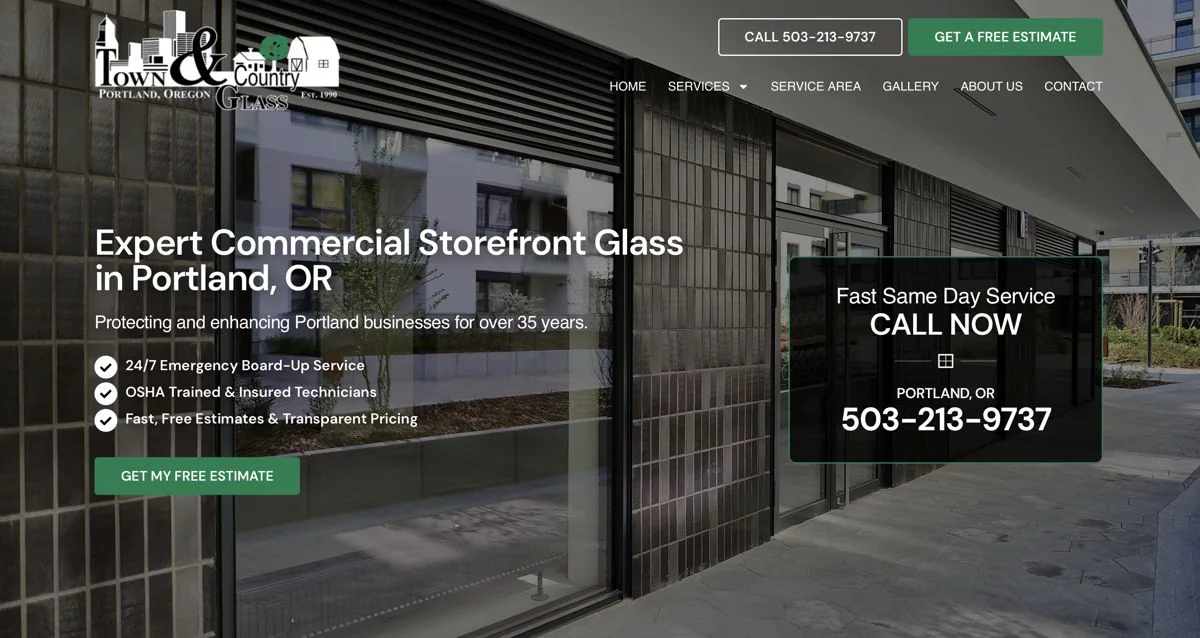
Portland’s Town & Country Glass, a commercial glass company from Tigard’s own metro, is the case on the card. Its new website, SEO and Google Ads all came from Lithium, and the card reports what that work produced. Chris Martin of Mt. Hood Pro Painting, quoted beside it, says his phone has kept ringing since Lithium took on his marketing.
Commercial glass13Xorganic traffic
145 to 1,849 visits a month
“Ever since we've used Lithium Marketing, our phone has been ringing off the hook and we can hardly keep up with the leads we get from Google, Facebook or through our website. Most of our leads other than referrals are through Google and it's all because of Lithium Marketing.”
 Chris MartinMt. Hood Pro Painting
Around Tigard
If you take jobs in Tualatin, Lake Oswego or Wilsonville, a short page for each city, with a photo from a job there, tells customers you’ve worked on their side of town. The links below open each nearby city’s own page, with its home ages and trade searches.
Published price
$5,000
typical project
Larger sites get a fixed proposal after a 30-minute discovery call. Six to nine weeks from kickoff to launch. You own the domain, hosting account, WordPress install and content.
FAQ

Still curious?
Call (503) 766-5964 or email [email protected].
The page count. A typical service business site is $5,000, while a remodeler who wants a gallery page for each kind of project, or a business that wants separate pages for a dozen cities, gets a fixed proposal for the bigger build before anything starts.
Six to nine weeks for most service business sites. The schedule depends mostly on how fast photos and feedback come back, so the sooner you send job photos, the sooner the site goes live.
A planned switch protects them. We map each old page that gets visits or has links pointing at it to the matching new page, then watch Search Console after launch for anything missed. Some movement in the first weeks is normal with any move, and the redirects keep Google pointed at the pages it already knows.
You can. Editing a WordPress page works like editing a document, and the private Loom video we record on your finished site shows where each change is made: new job photos, a price update, a new service. If you’d rather not touch it, our hosting and maintenance plan covers updates and small changes.
No. Phone photos of real jobs beat stock photos, as long as they’re well lit and show the finished work. We’ll tell you which shots to take, and we crop and color-correct what you send.
Free action plan
We’ll open your current site on a phone before the call and note where a visitor would give up. On a short video call, a co-founder goes through those spots with you and quotes the new build, with its page list and launch window.
What we’ll cover
2000 NE 42nd Ave Ste D Unit 2370, Portland, OR 97213
Prefer to pick a time? Book a 30-minute call with DJ