

Table of Contents
- The Industry’s Dirty Secret: Beautiful Websites That Don’t Convert
- Why Every Second Costs You Customers: The Speed-to-Revenue Connection
- Your Mobile Site IS Your Business Card: Why Mobile Optimization Isn’t Optional
- Building Digital Trust: Why Credentials Matter More Than Design Awards
- Case Studies: What Happens When You Optimize for Revenue, Not Awards
- Final Thoughts
Your website won’t pay your bills just because it’s pretty. If you’re an Oregon contractor who’s invested thousands in a stunning website redesign only to watch your phone stay silent, you’re not alone. Every week, home service professionals across Portland, Eugene, Salem, and Bend discover a painful truth: aesthetic appeal doesn’t automatically translate to booked jobs. The gap between traffic and revenue isn’t bridged by beautiful imagery or trendy animations. It’s bridged by Conversion Web Design—the strategic science of turning website visitors into paying customers. This isn’t just marketing jargon. According to Forrester Research, every dollar invested in user experience returns $100 in revenue, representing a staggering 9,900% ROI. For contractors operating on tight margins in competitive Oregon markets, this isn’t a luxury—it’s the difference between growth and stagnation. In this article, you’ll discover the technical pillars that separate vanity projects from revenue-generating digital storefronts. You’ll see real conversion data, understand the psychology behind why prospects click “Call Now,” and learn why speed, mobile optimization, and trust signals matter more than award-winning design.
The Industry’s Dirty Secret: Beautiful Websites That Don’t Convert

Most Oregon web design agencies operate under a fundamentally flawed business model. They sell “branding,” “user experience,” and “cutting-edge design” without ever connecting these concepts to what actually matters: measurable lead generation. Walk into any Portland design studio, and you’ll hear passionate conversations about parallax scrolling, color psychology, and which awards their latest project might win. What you won’t hear is hard data about conversion rates, form completions, or call tracking metrics. This creates a dangerous disconnect between what agencies prioritize and what contractors actually need.
The Traditional Agency Model
The conventional web design firm builds portfolios showcasing artistic expression. They chase design trends, invest in elaborate animations, and pursue industry recognition. For their contractor clients, this means receiving websites optimized for award submissions—not emergency service calls at 2 AM when a water heater explodes.
The Contractor Reality Check
Home service professionals don’t need avant-garde design experiments. They need prospects who search “emergency plumber Portland” to immediately see a clickable phone number, clear service area information, and credible trust signals. Every second a confused visitor spends searching for your contact information is a second they’re considering your competitor instead. A review of Oregon agency blogs reveals this competitive blind spot. Content obsessively focuses on design trends and aesthetic theory while avoiding conversations about return on investment. This creates a strategic opportunity for agencies like Lithium Marketing that prioritize conversion metrics over design awards.
The Missing Link
True conversion optimization requires understanding three interconnected disciplines that most designers ignore:
- User Psychology – How prospects make split-second trust decisions
- Technical Performance – The measurable impact of speed and mobile usability
- Local Search Behavior – What drives high-intent Oregon service searches
Stanford University’s research on web credibility found that 75% of users judge a company’s trustworthiness based solely on website design. But here’s the critical nuance that traditional agencies miss: “credible design” doesn’t mean artistic sophistication. It means strategically placed license numbers, authentic customer reviews, and transparent contact information—elements that reduce buyer anxiety rather than impress design judges.
Why Every Second Costs You Customers: The Speed-to-Revenue Connection
In emergency service scenarios, user patience evaporates faster than water from a burst pipe. When an Oregon homeowner’s HVAC fails during a July heatwave or their basement floods during winter rains, they aren’t leisurely browsing design portfolios. They’re one slow-loading page away from calling your competitor.
The User Psychology of Impatience
Crisis-driven searches create a unique psychological state where discomfort actively escalates with every passing second. A homeowner standing in ankle-deep water doesn’t care about your website’s elegant animations. They care about one thing: can they reach you immediately? This behavioral reality makes page load time the most overlooked conversion factor in home service marketing. Yet most Oregon contractors have never even tested their mobile site speed.
The Portent Data Bomb
Research analyzing millions of page loads reveals a conversion cliff that most agencies refuse to discuss with clients:
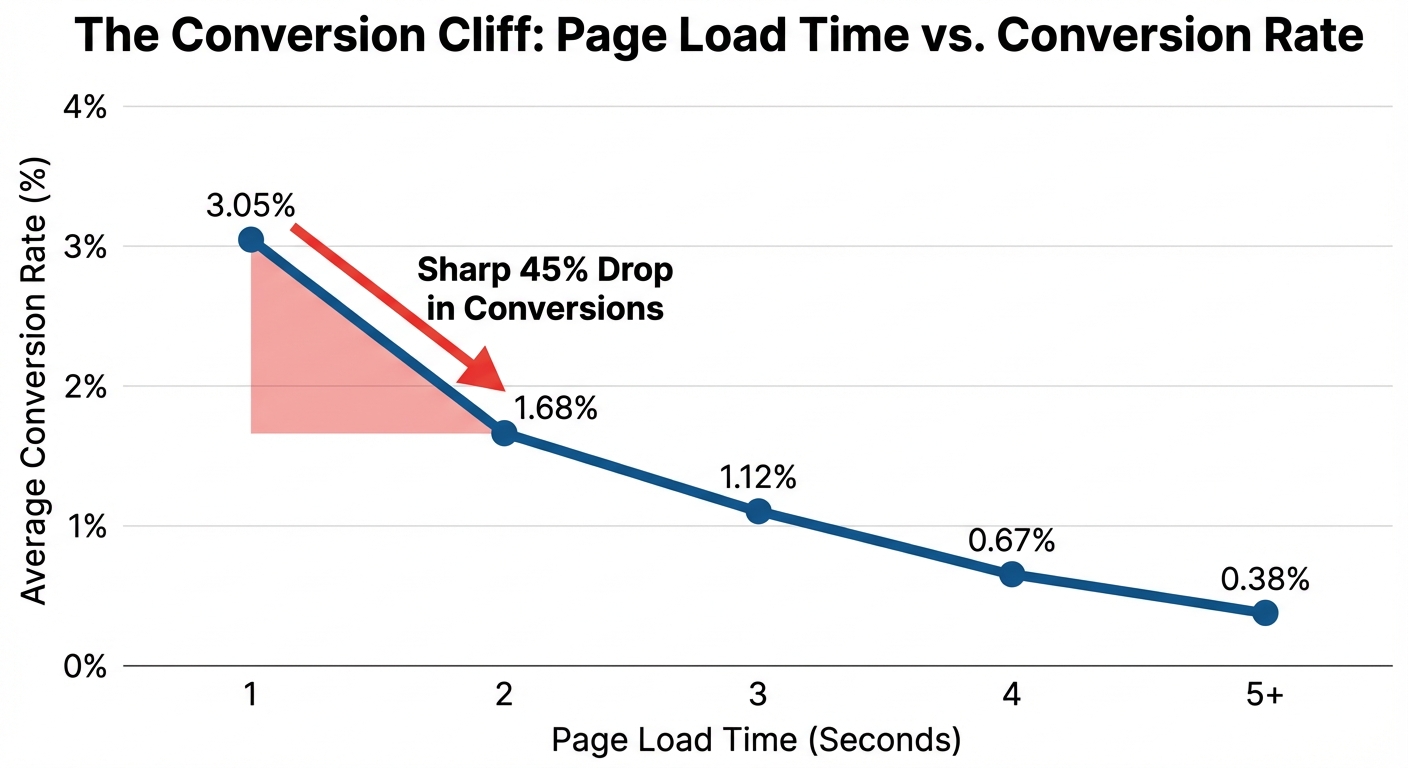
A website loading in just 1 second converts at 3.05%. Increase that load time to 5 seconds, and conversions collapse to 0.38%—an 87% revenue loss driven purely by technical performance. Every additional second of load time doesn’t just frustrate users; it mathematically decimates your lead generation.
Google’s Algorithm Enforcement
Speed isn’t just a user experience issue anymore—it directly impacts your visibility in search results. Google’s Core Web Vitals update made page loading performance, interactivity, and visual stability official ranking factors. Contractors with slow sites face a double penalty: lower search rankings and higher bounce rates from the traffic they do receive.
Technical Translation for Non-Technical Readers
When we discuss “optimization,” we’re referring to specific technical interventions that deliver measurable results:
- Image Compression – Reducing file sizes without visible quality loss
- Lazy Loading – Deferring non-critical images until users scroll to them
- Minimized JavaScript – Eliminating code bloat that blocks page rendering
- Content Delivery Networks (CDN) – Serving files from servers geographically closer to users
These aren’t abstract technical concepts—they’re revenue multipliers. A Portland plumber who reduces mobile load time from 4 seconds to 2 seconds doesn’t just improve user experience. They potentially double their conversion rate based on Portent’s data.
Your Mobile Site IS Your Business Card: Why Mobile Optimization Isn’t Optional
Since 2019, Google has exclusively used your mobile site’s performance to determine search rankings. Desktop-optimized websites, no matter how beautiful, are functionally invisible in local search results. This isn’t a future trend—it’s the current reality of digital marketing. Yet walking through Oregon contractor websites reveals a consistent pattern: responsive layouts that technically “work” on mobile but fail to convert at acceptable rates.
The Mobile-First Reality
Google’s mobile-first indexing means the search engine crawls, indexes, and ranks based solely on your mobile site’s architecture. If your mobile experience is slower, harder to navigate, or missing critical content compared to desktop, you’re being penalized in rankings—regardless of your desktop site’s quality. For Oregon contractors competing in local search, this creates a simple equation: mobile performance = visibility = revenue.
The “Near Me” Opportunity
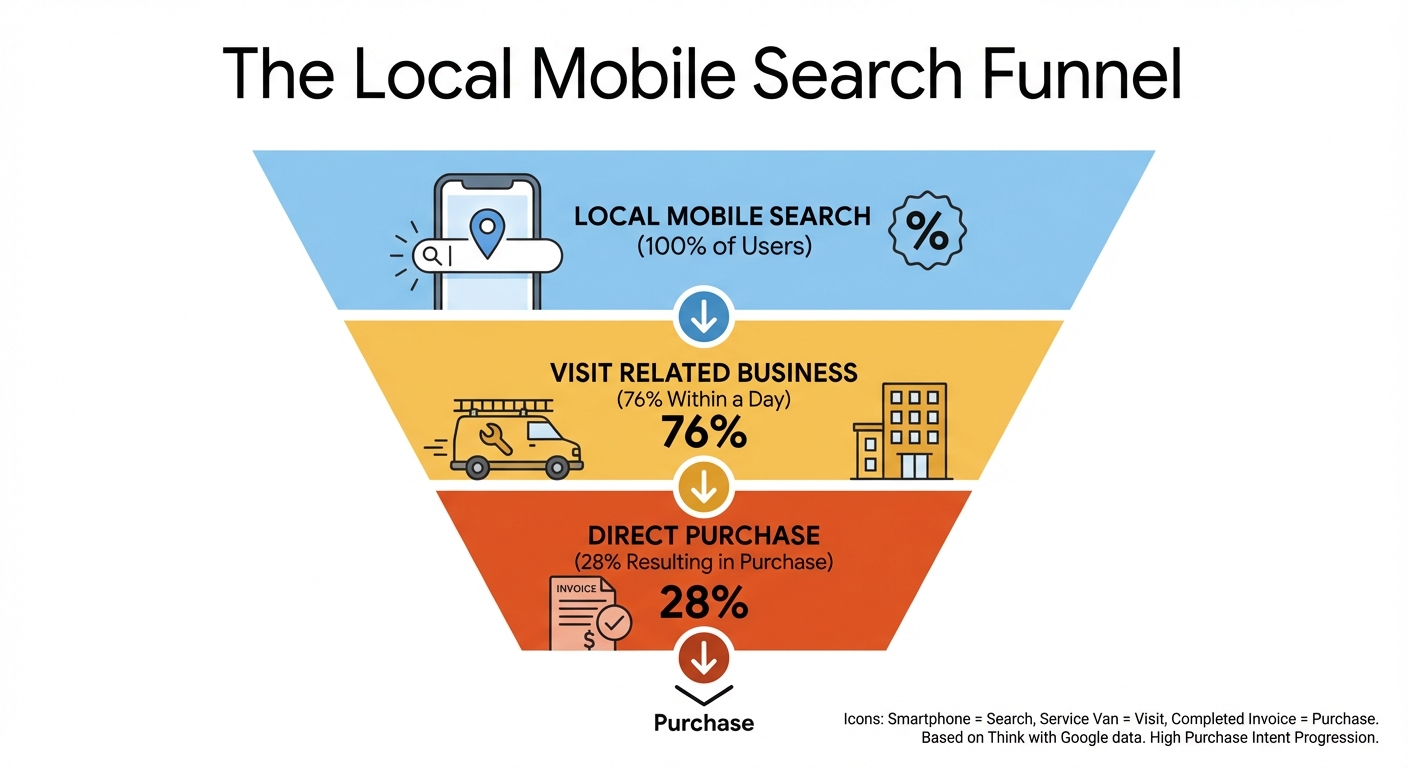
Think with Google’s research reveals that 76% of mobile local searchers visit a business within 24 hours, with 28% resulting in immediate purchases. For Oregon contractors, this represents the highest-intent traffic available. Someone searching “emergency plumber near me” on their smartphone isn’t comparison shopping—they’re ready to hire within hours. Missing this opportunity because your phone number requires pinch-zooming or your contact form won’t autofill is revenue malpractice.
The Tap Test
Mobile conversion hinges on friction elimination. Every unnecessary tap, zoom, or form field increases abandonment risk. Effective mobile-first design implements:
- Click-to-Call Buttons – Phone numbers that dial with a single tap
- Autofill Contact Forms – Pre-populated fields using browser data
- Thumb-Friendly Navigation – Touch targets sized for easy mobile interaction
- Persistent CTAs – Call buttons that remain visible while scrolling
These aren’t superficial design choices—they’re psychological interventions that reduce decision-making friction at the exact moment prospects are ready to convert.
Responsive vs. Mobile-First Design
Most Oregon agencies still build desktop-first, then use responsive techniques to make designs “work” on smaller screens. This backwards approach produces mobile experiences that feel cramped and awkward because they fundamentally are—desktop layouts forced into mobile constraints. True mobile-first design starts with the smallest screen, optimizing for thumb navigation and limited visual space, then scales up to desktop. This approach ensures your highest-intent traffic (mobile emergency searchers) receives the best possible experience.
Building Digital Trust: Why Credentials Matter More Than Design Awards
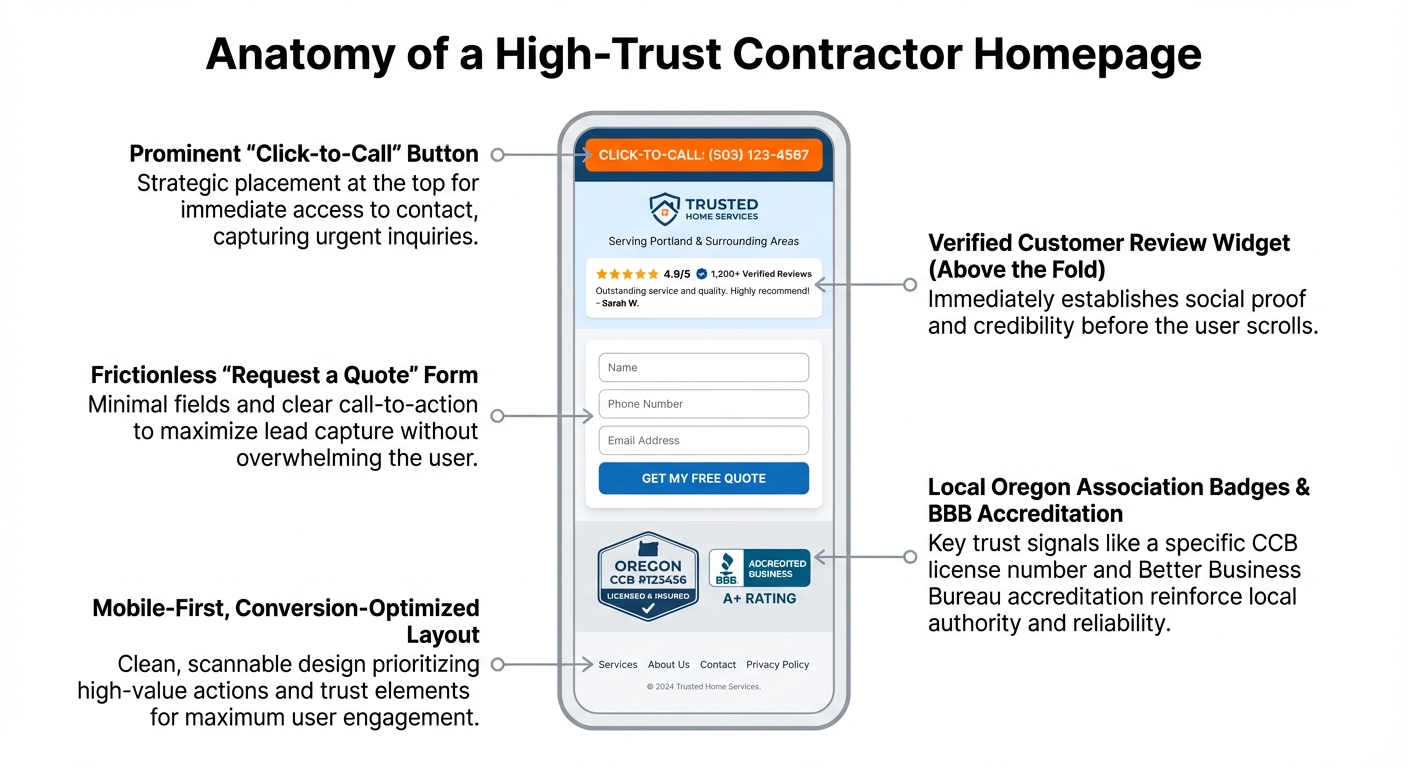
Stanford’s research on web credibility establishes that users make snap judgments about trustworthiness within 50 milliseconds of landing on a site. Before a visitor consciously processes your service offerings or reads a single sentence, their brain has already assessed whether you’re credible. This creates a critical challenge for Oregon contractors: you’re asking strangers to grant access to their homes and trust you with expensive repairs. Digital trust signals either accelerate or destroy that decision-making process.
The Credibility Threshold
Design quality matters in this 50-millisecond window, but what is designed matters exponentially more. A visually stunning website featuring abstract imagery and clever copy fails the credibility test if it lacks concrete proof of legitimacy. Contrast this with a clean, professional site that immediately displays:
- Oregon Contractors Board (CCB) license number
- Better Business Bureau accreditation
- Industry certifications (NATE for HVAC, master plumber licenses)
- Google review widgets showing recent 5-star ratings
- Team photos with recognizable Oregon backgrounds
The second example might not win design awards, but it converts at significantly higher rates because it reduces buyer anxiety.
The Social Proof Imperative
BrightLocal’s 2023 survey confirms that 98% of consumers read online reviews for local businesses. For contractors, this statistic represents both an opportunity and a vulnerability. Prospects will research your reputation regardless—the only question is whether you make that research easy or force them to hunt for information. Strategic trust signal implementation means:
Association Badges Above the Fold
Display CCB licenses, industry certifications, and local chamber memberships in your header or hero section. Visitors shouldn’t need to scroll to confirm you’re legitimate.
Video Testimonials with Local Context
Embed authentic client testimonials featuring recognizable Oregon locations. When Portland prospects see customers in Laurelhurst or Bend residents recognize Mt. Bachelor in the background, local familiarity triggers trust responses.
Transparent Pricing Indicators
Even without listing exact prices, showing “typical project ranges” or guaranteeing free estimates reduces uncertainty. Prospects interpret pricing transparency as business confidence—hiding costs suggests you have something to hide.
The Trust Muscle Memory Effect
Nielsen Norman Group research on trust patterns reveals that users develop automatic trust responses to familiar credibility markers. Once a contractor consistently displays certain trust signals across their digital presence, conversion rates compound over time. Your Oregon prospects have learned through repeated exposure that legitimate contractors display licenses, maintain high review ratings, and provide transparent contact information. When your website matches these learned patterns, visitors unconsciously classify you as trustworthy—accelerating their decision to call. Conversely, when your site lacks these expected signals, prospects experience cognitive dissonance: “Why doesn’t this company show their license number? Why can’t I find recent reviews? Maybe I should keep searching.” In competitive Oregon markets, that moment of hesitation is when you lose the lead to a competitor whose website better matches trust expectations.
Case Studies: What Happens When You Optimize for Revenue, Not Awards
Theory and research establish why conversion web design matters. Real-world implementations prove it works.
Case Study 1: The “Clarity Over Complexity” Redesign
| Phase | Details |
|---|---|
| The Problem | A home service provider had high monthly traffic but minimal conversions. Their previous agency delivered a visually impressive site featuring carousel animations, competing calls-to-action, and slow mobile load times. Traffic arrived, briefly admired the design, then left to call competitors. |
| The Solution | We applied core UX principles that traditional designers often resist because they seem “too simple”:
|
| The Results | The cleaner design with strategic trust heuristics led to faster user decision-making. By establishing “trust muscle memory” through familiar credibility patterns, form completions increased significantly. The lesson: simplicity scales conversions. Complex design impresses other designers; clear design converts prospects into customers. |
Case Study 2: The Mobile Speed Intervention
| Phase | Details |
|---|---|
| The Problem | A regional contractor had invested in responsive design but struggled with mobile conversion despite decent traffic. Their desktop site performed well, but mobile visitors consistently bounced at higher rates. |
| The Solution | We focused exclusively on mobile performance optimization:
|
| The Results | The technical improvements produced measurable business impact: 25% increase in mobile conversion rates and 30% reduction in bounce rate. By simply making the mobile experience faster and less frustrating, the same traffic generated significantly more revenue. |
The Oregon Contractor Advantage
These results take on additional significance within Oregon’s competitive landscape. Portland metro alone has thousands of service providers competing for identical “emergency plumber” or “HVAC repair” searches. When prospects research 3-5 contractors before making a decision, conversion optimization becomes the tiebreaker. The contractor whose site loads fastest, displays trust signals most prominently, and makes calling easiest doesn’t just win a slight edge—they capture the entire lead while slower competitors remain invisible in the decision-making process.
Final Thoughts
The evidence establishes a clear paradigm shift: aesthetic appeal without conversion architecture is a vanity investment. Oregon contractors don’t need websites that win design awards—they need digital storefronts that function as automated sales teams, capturing emergency leads at 2 AM when traditional marketing stops working.
The Three Non-Negotiables
Successful contractor websites share three technical pillars:
- Blazing Speed – Sub-2-second mobile load times that prevent bounce before prospects even see your content
- Mobile-First Design – Tap-to-call simplicity that eliminates friction between search and contact
- Strategic Trust Signals – Reviews, certifications, and transparency that reduce buyer anxiety
These aren’t independent features to gradually implement over time. They’re interconnected requirements that work synergistically to transform traffic into revenue.
The Competitive Reality
As Google’s algorithms evolve and consumer expectations rise, conversion optimization is no longer optional—it’s the baseline for digital survival in saturated Oregon markets. Your competitors are discovering these principles. The contractors who implement them first capture disproportionate market share because they’re visible in search and effective at converting that visibility into booked jobs.
The Lithium Marketing Difference
At Lithium Marketing, we position ourselves differently than traditional Oregon web design agencies. We’re not interested in building portfolio pieces that impress other designers. We’re focused on ROI metrics that grow your business—lead generation, conversion rates, and cost-per-acquisition. Our expertise combines local contractor marketing knowledge with technical performance optimization and behavioral psychology. We understand that a Portland plumber’s website needs to function fundamentally differently than a Salem roofer’s, and both require approaches distinct from Eugene HVAC providers.
Is Your Website Working for You, or Just Looking Pretty?
Most Oregon contractors have never audited their site performance through a conversion lens. They know their monthly traffic numbers but can’t answer basic questions:
- What percentage of mobile visitors call within 24 hours?
- How many form submissions do you generate per 100 site visits?
- What’s your average mobile page load time compared to competitors?
These metrics determine whether your website is an asset or a liability. If you’re driving traffic but not seeing proportional lead generation, conversion leaks are costing you revenue every single day. Lithium Marketing specializes in identifying and fixing these conversion barriers. Our process starts with comprehensive performance audits that reveal exactly where prospects drop off in the journey from search to contact. Then we implement the technical, design, and psychological interventions proven to transform traffic into customers.
Ready to Discover Your Website’s True Potential?
Get a no-obligation site performance audit and see exactly where you’re losing leads—and how to capture them instead.
References:
- Forrester Research. (2016). The ROI of UX Research. Retrieved from https://www.forrester.com/report/The-Six-Steps-For-Justifying-Better-UX/RES117708
- Portent. (2022). Site Speed is (Still) Impacting Your Conversion Rate. Retrieved from https://www.portent.com/blog/analytics/research-site-speed-hurting-everyones-revenue.htm
- Google Search Central Blog. (2020). Evaluating page experience for a better web. Retrieved from https://developers.google.com/search/blog/2020/05/evaluating-page-experience
- Think with Google. (2016). How People Use Their Phones for Local Search. Retrieved from https://www.thinkwithgoogle.com/marketing-strategies/app-and-mobile/local-search-mobile-search-micro-moments/
- Stanford University Persuasive Technology Lab. (2004). Stanford Guidelines for Web Credibility. Retrieved from https://credibility.stanford.edu/guidelines/index.html
- BrightLocal. (2023). Local Consumer Review Survey. Retrieved from https://www.brightlocal.com/research/local-consumer-review-survey/
- Nielsen Norman Group. (2021). Trust Muscle Memory: Why Users Trust (or Don’t Trust) Your Site. Retrieved from https://www.nngroup.com/articles/trust-muscle-memory/
- Think with Google. (2018). Find out how you stack up to new industry benchmarks for mobile page speed. Retrieved from https://www.thinkwithgoogle.com/marketing-strategies/app-and-mobile/mobile-page-speed-new-industry-benchmarks/