
 Commercial glass
Town & Country Glass
13Xorganic traffic
145 to 1,849 visits a month
- top-3 rankings, up from 1
- 109
- top-3 rankings, up from 1
- Google Ads conversion rate
- 29.9%
- Google Ads conversion rate
Web design in Wilsonville, Oregon
Wilsonville contractors get a WordPress website they own, with finished-job galleries up front and a quote button within thumb’s reach on every phone.
 Google PartnerView our Partners listing
5.0on Google · read our reviews
Google PartnerView our Partners listing
5.0on Google · read our reviews
Businesses
we’ve worked with
Businesses we’ve worked with
Web design for Wilsonville
Every site Lithium Marketing builds for a Wilsonville contractor or home service business is planned around one job: getting the visitor to call or ask for a quote. Wilsonville’s houses are younger than the county’s: the median Wilsonville home was built in 1998, against 1985 for Clackamas County as a whole. With houses that young, the site should give remodels, additions and outdoor projects as much room as repairs.
About a quarter of the housing is newer still: 25.3% of Wilsonville homes were built in 2010 or later. If you build patios and fences, upgrade lighting or replace builder-grade fixtures in houses like those, photos of that work, labeled by neighborhood, show a buyer you’ve already worked on a house like theirs.
Search in Wilsonville
For “plumber wilsonville”, Yelp appeared more than once in the top 10 below the Map Pack. A customer who finds you there, or in the pack, and then opens your website should find proof right away: photos, a service list and a way to reach you without hunting.
Your site has to give that customer more than the directory does. A Yelp profile shows a few photos and reviews, while your website can show every finished project, every service and every city you cover, with the call button right where a visitor’s thumb rests.
| Search | Searches a month | Cost per click |
|---|---|---|
| web design wilsonville | under 10 | not reported |
| web designer wilsonville | under 10 | not reported |
| website design wilsonville | under 10 | not reported |
Source: Google Ads keyword data, average monthly U.S. searches. "Under 10" = below Google’s reporting floor.
Source: one Google results page for “plumber wilsonville”, as Google showed it to a searcher located in Wilsonville. Search ad counts exclude sponsored local listings. Results shift by searcher and day.
Wilsonville homes
Only 16.1% of Wilsonville homes were built before 1980, compared with 43.6% across Clackamas County. A Wilsonville site can spend less space on old-wiring and old-pipe repair and more on the remodels, replacements and upgrades that newer homes call for.
Planned communities shape the market too, with Villebois on the western edge and Charbonneau across the river. A gallery page for each planned neighborhood you work in, showing jobs you’ve finished there, tells a buyer you know houses like theirs.
Sources: U.S. Census Bureau 2025 population estimates, ACS 2020–2024 and 2023 County Business Patterns.
Trades in Clackamas County
Clackamas County has 344 new home builders and 310 residential remodelers. Those firms sell large projects, so their sites need real finished rooms, not stock photos: a project page for each kind of build, with photos from start to finish and a quote form that collects the project details.
Painting contractors number 116 in the county, and a painter’s site has two tasks: make the estimate request quick, then back it up with photos of finished interiors and exteriors. For repair calls the order flips. A plumbing or electrical site leads with the number to call and the areas covered, because that visitor has water on the floor or a dead outlet.
County Business Patterns
Trade and home service businesses in Clackamas County
Establishments by industry, 2023
Source: U.S. Census Bureau, 2023 County Business Patterns (NAICS establishment counts).
The build
Six to nine weeks is typical from kickoff to launch, with your sign-off at each stage.
We start with what you already have: phone photos of finished jobs, the services that pay best and the cities your crews reach. Lithium writes the copy, so there’s no homework beyond that.
Each kind of job you want more of gets its own page and gallery, so a Villebois homeowner looking for a patio lands on patio work.
You see the designs on your own phone first, since the call button and galleries have to work there, and on a desktop after that.
Before launch we test every form and call link, redirect your old addresses and connect GA4 and call tracking. Afterward a private Loom video shows you how to add new jobs.
What every Lithium website includes
The same eight parts go into every website build, wherever the business is.
Proof
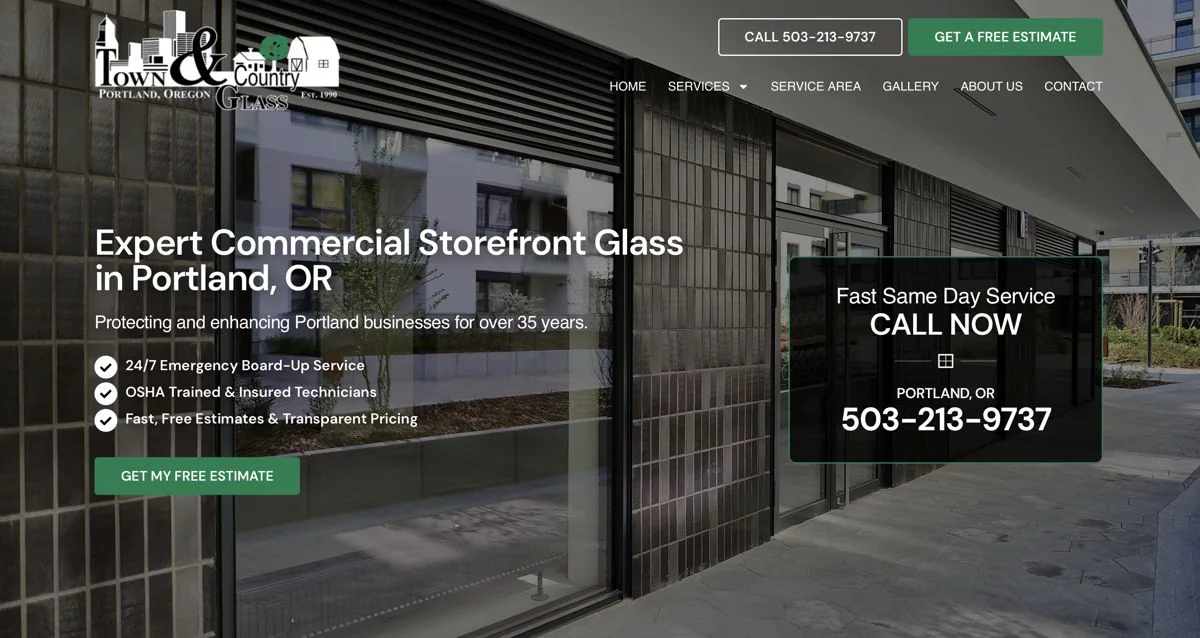
For Town & Country Glass, a commercial glass company in Portland, Lithium designed a new website and ran SEO and Google Ads to bring people to it. The card’s figures come from those three together, for a business in the same metro area as Wilsonville. Marc Rickabaugh of Rickabaugh Construction, quoted beside it, hired Lithium to update his own website and SEO.
Commercial glass13Xorganic traffic
145 to 1,849 visits a month
“We used the team at Lithium Marketing to update our website and increase our SEO. We couldn't have been happier with the results! We receive compliments about our updated website on a regular basis!”
 Marc RickabaughRickabaugh Construction
Around Wilsonville
Housing can change as you cross a city line, so the jobs you feature on a city page should fit the houses there. Before you write one, open the web design page for that town below and check how old its homes are. The Oregon link lists every other city we cover.
Published price
$5,000
typical project
Larger sites get a fixed proposal after a 30-minute discovery call. Six to nine weeks from kickoff to launch. You own the domain, hosting account, WordPress install and content.
FAQ

Still curious?
Call (503) 766-5964 or email [email protected].
A typical service business site: a WordPress build with service pages, project galleries, tap-to-call and quote forms, plus the copy, schema, GA4 and call tracking and a private Loom walkthrough. You own the domain, the WordPress install and everything on it. Larger sites, such as a remodeler with dozens of project types, get a fixed proposal before work starts.
Six to nine weeks from kickoff to launch is typical. The pace depends mostly on how quickly photos and approvals come back, and we write the copy and handle the build, testing and redirects in between.
Yes. The domain, hosting account, WordPress install and content are yours, so you can move the site whenever you like. If you’d prefer not to manage hosting, Lithium offers optional hosting and maintenance for $99/month, and the site stays yours either way.
If you take jobs there, yes. Searches often name the customer’s own city, so a Tualatin page reaches searches a Wilsonville page won’t. Each city page needs its own jobs, photos and details, though, or Google treats it as a copy. The web design pages for those cities, linked above, are the place to start.
No. Phone photos of finished jobs work well when they’re sharp and well lit, and they show buyers your own work, which stock images can’t. Send what you have, and we’ll tell you which jobs need a better shot before launch.
Free action plan
Send your current website, or tell us you don’t have one, along with a few photos of jobs you’re proud of. On a short video call, a co-founder walks through the page plan, the cost and the timeline for your build.
What we’ll cover
2000 NE 42nd Ave Ste D Unit 2370, Portland, OR 97213
Prefer to pick a time? Book a 30-minute call with DJ