

Table of Contents

Picture this: It’s 11 PM on a Tuesday. A homeowner discovers a burst pipe flooding their basement. Panicked, they grab their phone and search “emergency plumber near me.” Your business appears at the top of the results—those SEO investments are paying off. They tap the call button. The phone rings once, twice, three times. Then voicemail. They hang up and immediately call the next contractor on the list. That competitor answers in seconds, and just like that, you’ve lost a $2,500 emergency job.
This scenario plays out thousands of times every night across the home services industry. Here’s the hard truth: businesses responding to inquiries within five minutes are 100 times more likely to capture the lead. Meanwhile, 80% of callers won’t leave voicemail—they’ll simply move on to your competitor who picks up the phone.
For contractors investing heavily in SEO and local advertising through agencies like Lithium Marketing, this represents a critical failure point. You’re spending thousands to drive high-intent traffic to your business, but if calls go unanswered after hours, that marketing spend is evaporating into thin air.
The question facing every home service business owner today isn’t whether to have after-hours coverage—it’s which solution will actually capture those leads without breaking the bank. In this article, we’ll compare traditional human answering services against modern AI voice assistants across three critical dimensions: cost, reliability, and lead capture capability. By the end, you’ll have the data you need to make an informed decision that protects your marketing investment and maximizes revenue.
The High Cost of a Missed Emergency Call
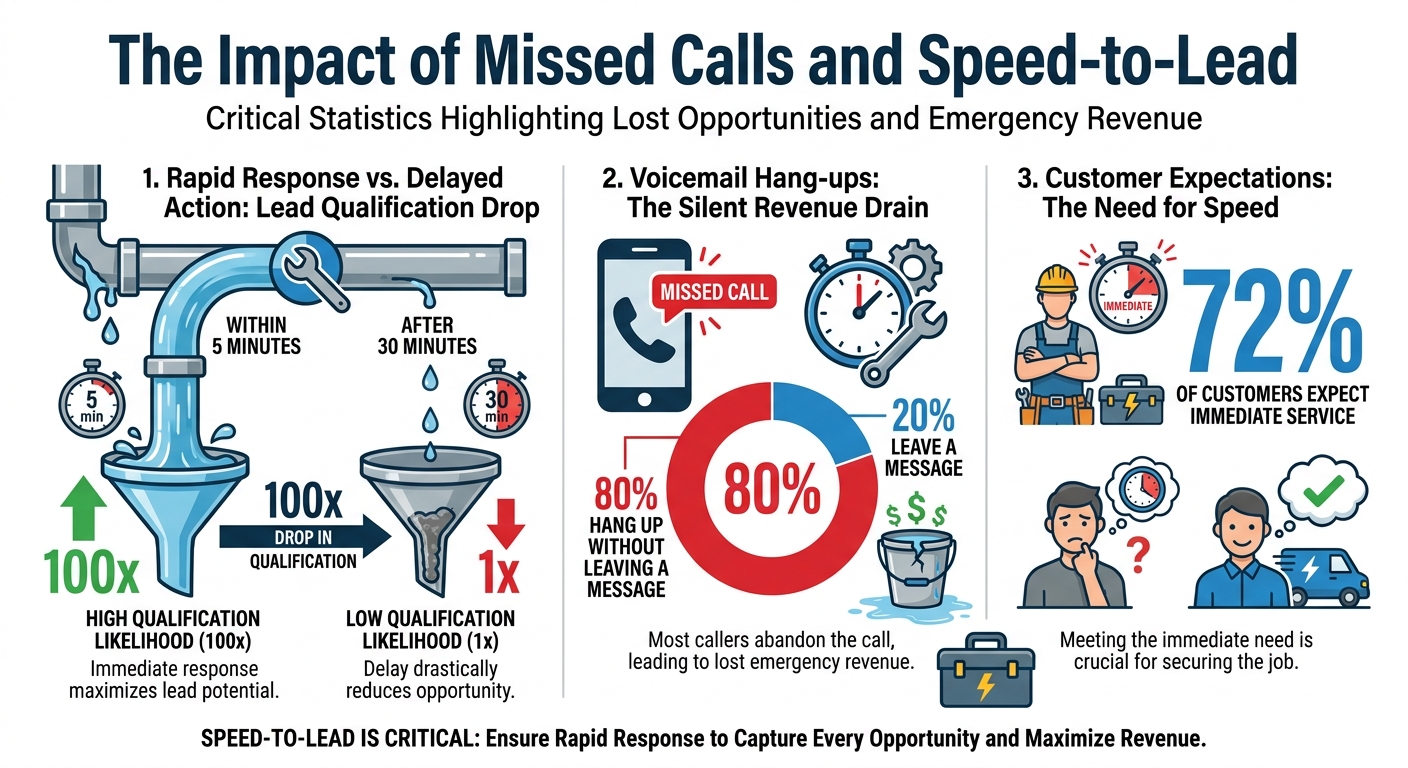
Emergency calls represent the most lucrative opportunities in the home services industry—and they don’t happen during business hours. When someone’s HVAC fails during a July heatwave or an electrical panel sparks at midnight, they’re experiencing genuine distress. These aren’t price shoppers calling three contractors for estimates. They need help now, and price resistance is minimal.
Consider the numbers: 72% of customers expect immediate service, and most actually prefer automated solutions if they accelerate resolution. This isn’t about preference—it’s about urgency. A homeowner with no heat in January or standing water in their living room isn’t browsing reviews or comparing quotes. They’re calling whoever answers first.
The “speed-to-lead” principle quantifies this reality in stark terms. Research from Harvard Business Review demonstrates that the gap between a five-minute response and a 30-minute response isn’t incremental—it’s exponential. The contractor who answers at 10 PM captures the job. The one who calls back at 8 AM the next morning gets a polite “we already had someone come out, but thanks anyway.”
Key Insight:
Emergency service calls represent your highest-margin work. A burst pipe repair, emergency HVAC restoration, or electrical hazard resolution typically command premium pricing with little negotiation. These jobs often exceed $1,000-$3,000 in revenue.
Yet traditional business hours—8 AM to 5 PM, Monday through Friday—represent exactly when these emergencies aren’t happening. Nights, weekends, and holidays are peak times for home service crises. The disconnect between when your phones are staffed and when customers need you most represents a massive opportunity gap.
The baseline problem is simple: if your after-hours strategy is voicemail, you’re systematically surrendering your most profitable leads to competitors who answer their phones. The real question is how to bridge that gap efficiently.
The Old Guard: Why Human Call Centers Are Losing Ground

Traditional Business Process Outsourcing (BPO) answering services have been the standard solution for decades. These services employ human agents working in call centers, following scripts to capture caller information and relay messages to contractors. For many years, this was the only game in town—and it’s important to acknowledge what human answering services do well.
The Strengths
Human agents bring genuine empathy to emotionally charged situations. When a panicked homeowner calls about a flooded basement at 2 AM, a trained operator can provide reassurance, ask clarifying questions, and adapt their tone to match the situation’s urgency. This human touch has real value, particularly in highly stressful scenarios where customers need to feel heard and understood.
Human flexibility also matters. If a caller provides ambiguous information or describes a problem in unconventional terms, a skilled agent can pivot, probe deeper, and extract the details needed to properly route the call. This adaptability is difficult to replicate programmatically.
Where Traditional Services Struggle
Despite these advantages, traditional answering services face structural limitations that increasingly undermine their effectiveness:
High and Variable Costs: Most BPO services charge a monthly retainer plus per-minute or per-call fees. During busy seasons—HVAC contractors during summer, plumbers during winter freeze events—call volumes can double or triple. These variable costs spike exactly when your business is generating peak revenue, cutting directly into profit margins. A contractor might budget $500 monthly for answering services only to face $1,800 bills during a summer heatwave.
Lack of Industry Specialization: BPO agents typically handle calls for dozens of different industries simultaneously. The person taking your emergency plumbing call at 11 PM might have just finished a call for a law office and will take a medical practice call next. This lack of specialization leads to misclassified leads, incomplete data capture, and generic responses that poorly represent your brand. An agent might fail to ask critical qualifying questions—”Is this covered by your home warranty?” or “Have you shut off the main water valve?”—that your team would consider standard protocol.
Hold Times During Surges: Here’s the cruel irony: traditional answering services are supposed to ensure calls get answered, but during unexpected surges, customers still experience hold times. A severe weather event that triggers dozens of simultaneous emergency calls can overwhelm even large call centers. When that happens, customers hear hold music—and many hang up to call your competitor.
Manual Data Transfer Delays: Even when a traditional service successfully captures a caller’s information, there’s a manual handoff process. The agent sends an email or text message to your on-call technician. That technician must then manually enter the information into your dispatch system, look up the customer’s service history, check availability, and call the customer back. This entire process adds 15-30 minutes of delay—an eternity when your competitor’s AI system has already auto-scheduled the job.
Real-World Example:
A homeowner calls about a flooded basement at 11:30 PM. Your traditional answering service puts them on hold for two minutes while other calls are handled. The homeowner, watching water rise, decides two minutes is too long and hangs up. They call the next contractor, who answers instantly via AI, and books the job on the spot. You never even knew the call came in.
This isn’t a theoretical problem—it’s happening every night. The structural limitations of human-staffed call centers, while understandable, create systematic lead loss that directly contradicts the investment you’re making in marketing and advertising.
The New Standard: AI Voice Assistants Built for Contractors

Modern AI answering services represent a fundamental departure from both traditional human call centers and legacy Interactive Voice Response (IVR) systems. If you’re associating AI with the frustrating “press 1 for sales, 2 for support” phone trees of the past, that technology is now obsolete. Today’s conversational AI, powered by Natural Language Processing and Large Language Models, conducts genuinely human-like conversations.
What Makes Modern AI Different
Legacy IVR systems were rigid, script-based, and universally hated by customers. Modern AI voice assistants use Natural Language Understanding to comprehend intent, context, colloquialisms, and even regional accents. When a panicked homeowner says, “My water heater is making a weird banging sound and there’s water everywhere,” the AI doesn’t require them to navigate a menu—it understands this is an emergency water heater failure and immediately initiates the appropriate response protocol.
Core Capabilities That Transform Operations
Instant Pickup, Every Time: AI answers in zero seconds, with no hold times, regardless of call volume. Whether you receive one call or 100 simultaneous calls at midnight, every caller connects immediately. This eliminates the single biggest weakness of traditional services—availability during surges.
Infinite Scalability: A traditional call center might have 50 agents, which sounds substantial until a major weather event triggers 200 simultaneous calls. AI systems handle unlimited concurrent conversations without degradation in service quality. During a winter storm that triggers dozens of furnace failures, your AI assistant answers every single call instantly while your competitors’ answering services collapse under volume.
Direct CRM Integration: This is where AI fundamentally changes the operational workflow. Instead of a human agent typing notes into an email, AI systems push structured data directly into your CRM via API. The caller’s name, address, phone number, description of the problem, urgency level, and preferred service window flow automatically into ServiceTitan, Housecall Pro, Jobber, or whatever platform you use. No manual data entry. No transcription errors. No delays.
Automated Scheduling: The most sophisticated AI systems cross-reference your technicians’ real-time availability calendars and book appointments automatically. A homeowner calls at 11 PM about a furnace failure. The AI verifies the issue, confirms the address, checks which technician is on emergency call, identifies the first available slot (perhaps 7 AM the next morning), and books the appointment—all in a single conversation. The homeowner receives a confirmation text with the technician’s name, photo, and estimated arrival time. Your technician wakes up to a fully-briefed job already in the dispatch queue.
The Financial Impact
Gartner research projects that conversational AI will reduce contact center labor costs by $80 billion by 2026. For small and medium-sized contractors, this translates to operational cost reductions of 50-70% compared to traditional answering services while simultaneously improving lead capture rates.
Where AI Still Lags
Honesty requires acknowledging that emotional intelligence remains an area where AI is improving but hasn’t yet achieved full parity with skilled human agents. An AI can recognize distress in a caller’s voice and respond with programmed empathy (“I understand this is stressful; let’s get you help right away”), but it lacks the nuanced emotional calibration of an experienced human operator handling a truly distraught caller.
However, this gap is narrowing rapidly. More importantly, in the home services industry, speed and reliability often matter more than perfect empathy. A homeowner with a flooded basement primarily wants confirmation that help is coming—now. An AI that answers instantly, books the job immediately, and sends confirmation within 60 seconds often provides a superior customer experience compared to a human agent who’s empathetic but slow.
The transformation AI brings isn’t just operational—it’s strategic. By eliminating the bottleneck between lead generation and lead capture, AI ensures that your marketing investments actually convert into revenue. When Lithium Marketing drives high-intent traffic to your business, AI makes certain those leads don’t slip through the cracks.
The Verdict: Which Solution Wins for Your Business?
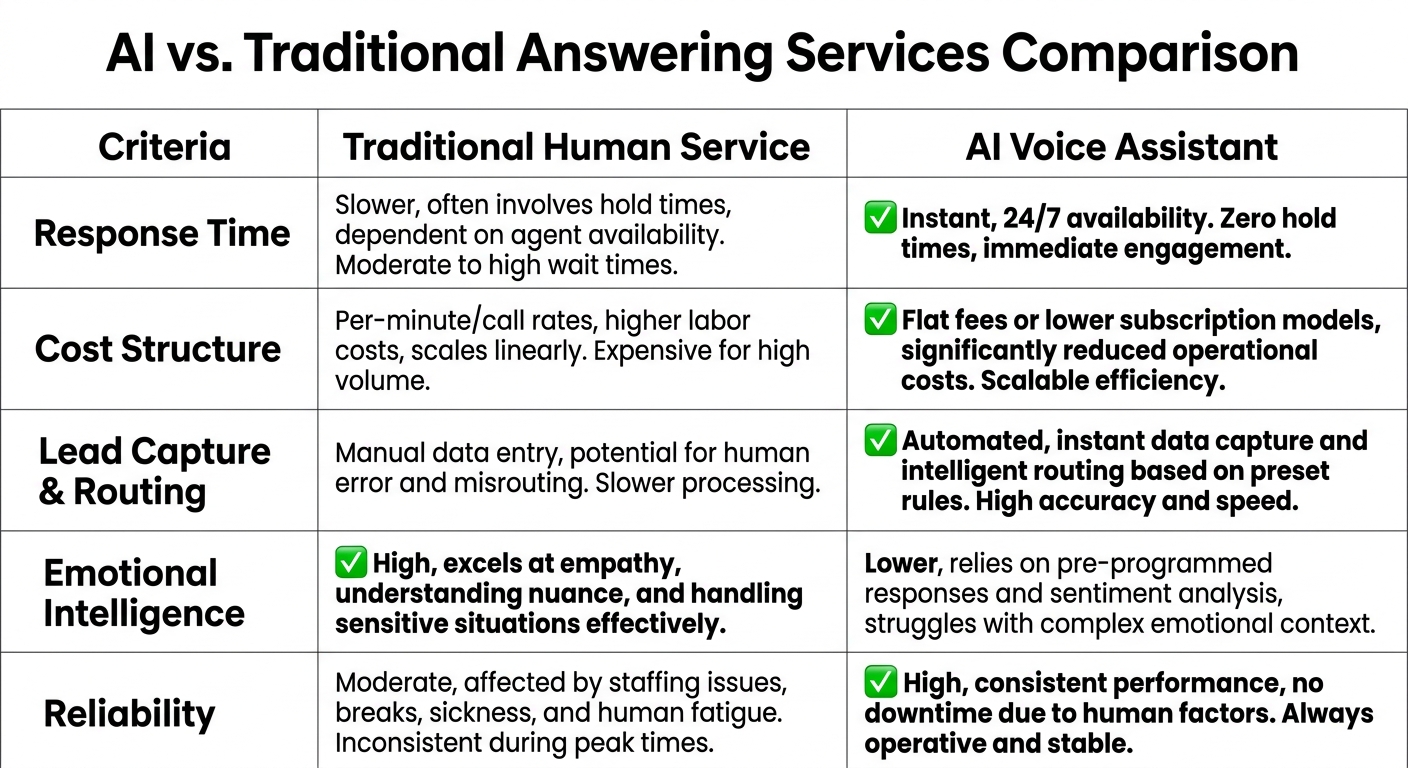
The comparison chart above synthesizes five critical operational metrics where traditional answering services and AI voice assistants compete directly. Let’s walk through each dimension with practical examples that illustrate the real-world impact on your business.
Response Time
A homeowner calls at midnight about a sparking electrical panel—a genuine emergency. With a traditional answering service, what happens? If agents are available and call volume is normal, the call might be answered within 15-30 seconds. But if multiple emergencies hit simultaneously, the caller hears hold music. Many hang up within 60 seconds and call the next contractor.
With AI, the response time is zero seconds, every time. No hold music. No queue. The instant the caller dials, they’re connected to a responsive system that begins gathering information and initiating the service protocol. When emergencies are time-sensitive and customers are stressed, this difference is decisive. Winner: AI
Cost Structure
Traditional answering services typically charge $300-600 monthly retainers plus $1.25-2.50 per minute. For an HVAC contractor receiving 100 after-hours calls monthly, with average call durations of 3 minutes, the monthly cost might be $500 (retainer) + $450 (per-minute charges) = $950. During summer peak season when call volume triples, that same contractor faces $500 + $1,350 = $1,850 monthly.
AI answering services generally charge flat SaaS subscription fees ranging from $200-800 monthly regardless of call volume, or pay-per-use models at $0.05-0.15 per minute—dramatically lower than human agents. For that same HVAC contractor, peak season costs remain fixed or increase minimally. Over a year, the cost difference often exceeds $8,000-12,000. Winner: AI
Lead Capture & Routing
Here’s where operational efficiency diverges sharply. With traditional services, an agent takes the call, writes down details, and sends an email or text to your on-call technician: “John Smith called about a water heater leak at 123 Main St. Thinks it’s urgent. Call him at 555-0123.”
Your technician sees this message, manually enters the information into your CRM, looks up the customer’s service history (if they’re an existing client), checks their availability, and then calls the customer back to schedule. This process takes 15-30 minutes under optimal conditions.
With AI, the entire workflow is automated. The caller’s information flows directly into your CRM with structured fields populated correctly. The system flags the urgency level, cross-references technician availability, and books the appointment automatically. The customer receives immediate confirmation. Your technician wakes up to a fully-briefed job ready to execute. Time from call to scheduled appointment: 90 seconds. Winner: AI
Emotional Intelligence
A homeowner calls, crying, because her elderly mother’s furnace failed and the house is 45°F. A skilled human agent can provide genuine emotional support, speak soothingly, and reassure the caller that help is coming while building trust and rapport.
An AI assistant can recognize distress indicators in voice patterns and respond with programmed empathy, but it lacks the deep emotional calibration that comes naturally to experienced human operators. For highly emotional, complex situations requiring nuanced human judgment, traditional services retain an advantage—though this gap is narrowing as AI emotional recognition improves. Winner: Traditional
Reliability
Traditional services are staffed by human beings who require breaks, work shifts, call in sick, experience fatigue, and have finite capacity. During unexpected surges or staffing shortages, service quality degrades. An agent handling their 50th call of a shift at 3 AM isn’t performing at the same level as during their first call.
AI systems operate at 100% uptime, unaffected by time of day, call volume, staffing issues, or fatigue. Performance at 3 PM is identical to performance at 3 AM. During a severe weather event that triggers 200 simultaneous emergency calls, the system handles all of them without degradation. Winner: AI
The Bottom Line
AI dominates on speed, cost, reliability, and operational efficiency—the metrics that directly impact your bottom line and lead conversion rates. Traditional services retain a narrow advantage in emotional intelligence for complex situations, but for the vast majority of after-hours calls in the home services industry, AI provides superior outcomes at a fraction of the cost.
Case Studies: Contractors Who Made the Switch
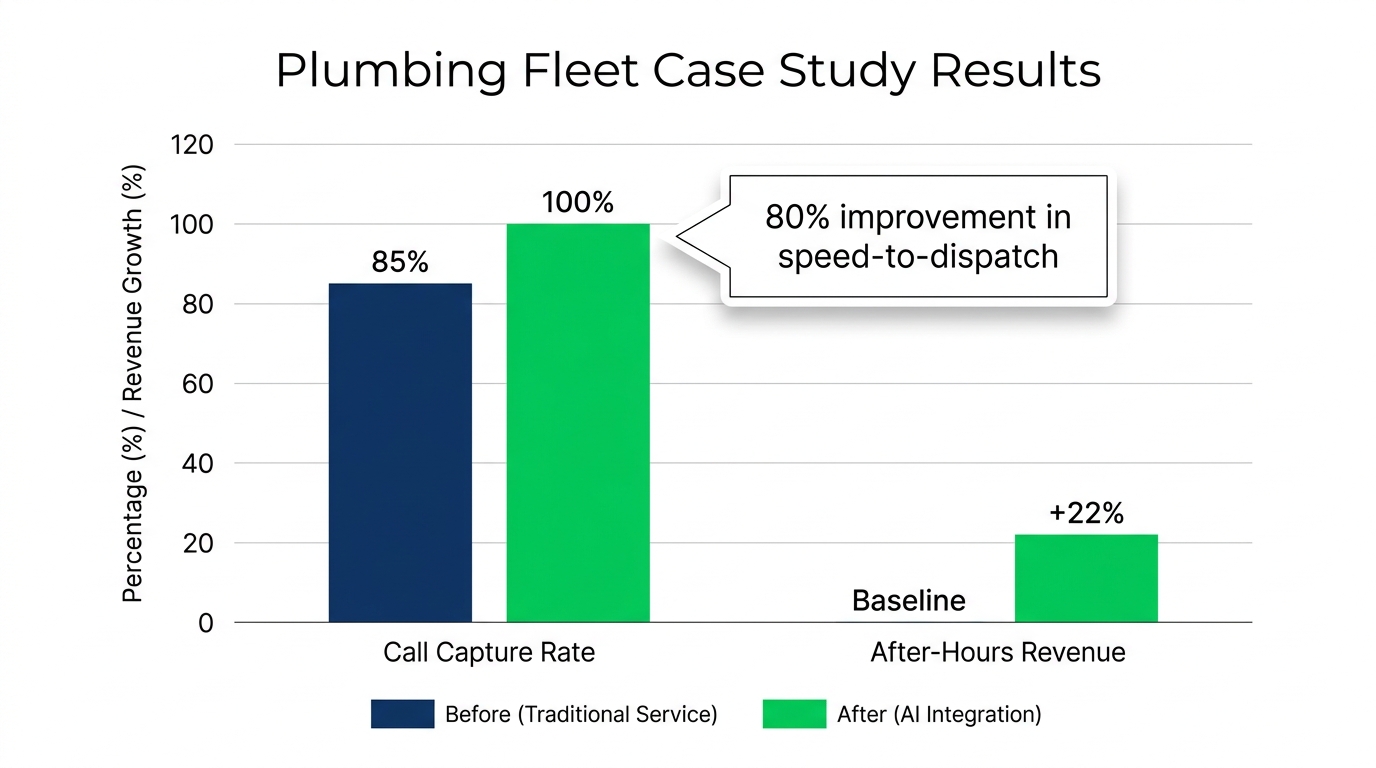
The comparison chart above illustrates the dramatic performance improvements achieved by a regional plumbing company after switching to AI. Let’s examine two detailed case studies that demonstrate the real-world impact of this transition.
Case Study 1: Regional Plumbing Company Eliminates Lead Loss
The Problem: A seven-truck plumbing operation serving a mid-sized metropolitan area was losing approximately 15% of after-hours emergency calls due to capacity limitations at their outsourced call center. During analysis, they discovered that missed calls typically occurred during surge periods—late evenings on weekends, during severe weather, and when multiple emergencies coincided.
Even when calls were answered, the manual message relay process added an average 20-minute delay between when a customer called and when a technician actually contacted them back. In the plumbing business, where emergencies like burst pipes require immediate response, a 20-minute delay meant losing jobs to faster competitors.
The AI Implementation: The company integrated a conversational AI voice assistant that connected directly to their ServiceTitan dispatch system. The AI was programmed with industry-specific protocols, including critical pre-qualification questions like “Have you located and shut off the main water valve?” and “Is there active flooding occurring now?”
When calls came in, the AI immediately captured customer information, assessed urgency using a structured triage protocol, and automatically created service tickets in the dispatch system with all relevant details pre-populated. For genuine emergencies, the system sent instant alerts to on-call technicians via text with the customer’s information, issue description, and priority level.
The Results:
- Zero missed calls after hours—100% capture rate compared to the previous 85%
- 80% improvement in speed-to-dispatch, with average response time dropping from 20 minutes to under 4 minutes
- 22% increase in after-hours revenue over six months, attributed directly to higher lead capture and faster response times
- Customer satisfaction scores improved by 18 percentage points, with customers specifically citing “immediate response” and “didn’t have to wait for a callback” in feedback
“We were spending $1,200 monthly on our old answering service and still losing calls. Now we pay $400 monthly for AI, capture every lead, and our technicians start their day with fully-briefed jobs already scheduled. The ROI was immediate.”
Case Study 2: HVAC Contractor Eliminates Seasonal Cost Volatility
The Problem: An HVAC contractor in a region with extreme summer heat faced a recurring operational challenge: call volume quadrupled during peak season (June through August). Their traditional answering service charged overage fees that resulted in monthly bills spiking from $600 in winter to $2,200 in July—cutting directly into their most profitable season’s margins.
Additionally, even with increased staffing, the call center experienced hold times during extreme heat events when dozens of AC failures occurred simultaneously. The contractor estimated they were losing 20-25 emergency calls per summer to hold-time abandonment.
The AI Implementation: The company deployed an AI answering service on a flat-rate monthly SaaS subscription of $500 regardless of call volume. The system integrated with Housecall Pro and was trained on HVAC-specific triage protocols to differentiate between genuine emergencies (complete system failures) and less urgent issues (routine maintenance).
The Results:
- 65% reduction in operational communication costs, with summer peak spending dropping from $2,200 to $500 monthly
- Zero hold times even during the busiest weeks of summer—every call answered instantly regardless of volume
- Annual savings of $9,600 in answering service costs alone
- Improved technician utilization because automated scheduling distributed emergency calls more efficiently across available technicians
“Last summer during the heatwave, we took 420 calls in a single week. Our old service would have charged us a fortune and customers still would have been on hold. The AI handled everything seamlessly. Every single caller got through, and we didn’t lose a single lead to hold-time abandonment.”
Common Themes Across Implementations
Both case studies highlight consistent patterns:
- Immediate ROI: Cost savings and improved lead capture delivered positive returns within the first month
- Scalability Without Cost Penalty: AI handled volume surges without premium pricing
- Operational Efficiency: Automated CRM integration eliminated manual data entry and reduced dispatch delays
- Competitive Advantage: Instant answering and faster response times captured leads that would have otherwise gone to competitors
For contractors working with Lithium Marketing to generate high-quality local leads through SEO and digital advertising, AI answering services ensure that the traffic being driven to your business actually converts into booked jobs rather than lost opportunities.
Key Takeaways
The evidence is clear: for home service contractors, after-hours responsiveness isn’t optional—it’s the operational backbone that determines whether your marketing investments generate revenue or evaporate into missed opportunities. Every dollar spent on SEO, local advertising, and digital presence through agencies like Lithium Marketing is only as valuable as your ability to capture the leads those efforts generate.
Traditional human answering services served the industry well for decades, and they still offer genuine value in situations requiring deep emotional intelligence and complex problem-solving. However, their structural limitations—high variable costs, capacity constraints, hold times during surges, and manual handoff delays—increasingly undermine their effectiveness in an industry where speed-to-lead is measured in minutes, not hours.
AI answering services eliminate these bottlenecks while delivering measurable advantages:
- Zero missed calls, with instant pickup regardless of call volume or time of day
- Dramatic cost reductions through flat-rate pricing or pennies-per-minute charges instead of dollar-per-minute human agent rates
- Automated CRM integration that eliminates manual data entry and accelerates dispatch by 80% or more
- Perfect reliability unaffected by staffing shortages, shift changes, or human fatigue
The gap that once existed in emotional intelligence—where human agents held a clear advantage—continues to narrow as AI systems become more sophisticated at recognizing and responding to emotional cues. More importantly, in the context of emergency home service calls, customers prioritize speed and certainty over perfect empathy. A homeowner with a flooded basement wants immediate confirmation that help is coming; an AI that books the job in 90 seconds often delivers superior customer satisfaction compared to a human agent who’s empathetic but requires callbacks and manual scheduling.
In 2024, adopting AI for after-hours operations isn’t just a cost-saving measure—it’s a competitive imperative. Contractors who implement AI answering services now will dominate their local markets by capturing leads that their competitors miss. Those who wait will continue hemorrhaging emergency calls to faster, more efficient operations.
The decision facing home service contractors isn’t whether technology will reshape their industry—it already has. The question is whether you’ll lead that transformation or lose market share to competitors who answered the call first.
Ready to Capture Every After-Hours Opportunity?
Don’t let another emergency call slip through your fingers. Ensure you never miss another after-hours opportunity with integrated AI solutions that maximize your marketing ROI.
Contact Lithium Marketing Today
Learn how we integrate AI answering solutions with cutting-edge SEO and local lead generation strategies.
References:
- Oldroyd, J. B., McElheran, K., & Elkington, D. (2011). The Short Life of Online Sales Leads. Harvard Business Review. Retrieved from https://hbr.org/2011/03/the-short-life-of-online-sales-leads
- Forbes Business Council. (2021). Why Missed Calls Are Costing Your Business Money. Forbes. Retrieved from https://www.forbes.com/sites/forbesbusinesscouncil/2021/08/11/why-missed-calls-are-costing-your-business-money/
- Zendesk. (2023). Zendesk Customer Experience Trends Report. Retrieved from https://www.zendesk.com/blog/customer-experience-trends/
- Gartner. (2022). Gartner Predicts Conversational AI Will Reduce Contact Center Agent Labor Costs by $80 Billion in 2026. Retrieved from https://www.gartner.com/en/newsroom/press-releases/2022-08-31-gartner-predicts-conversational-ai-will-reduce-contac
- McKinsey & Company. (2023). The State of AI in 2023: Generative AI’s Breakout Year. Retrieved from https://www.mckinsey.com/capabilities/quantumblack/our-insights/the-state-of-ai
- Salesforce. (2023). State of Service Report: Customer Service Trends. Retrieved from https://www.salesforce.com/news/stories/customer-service-trends/