
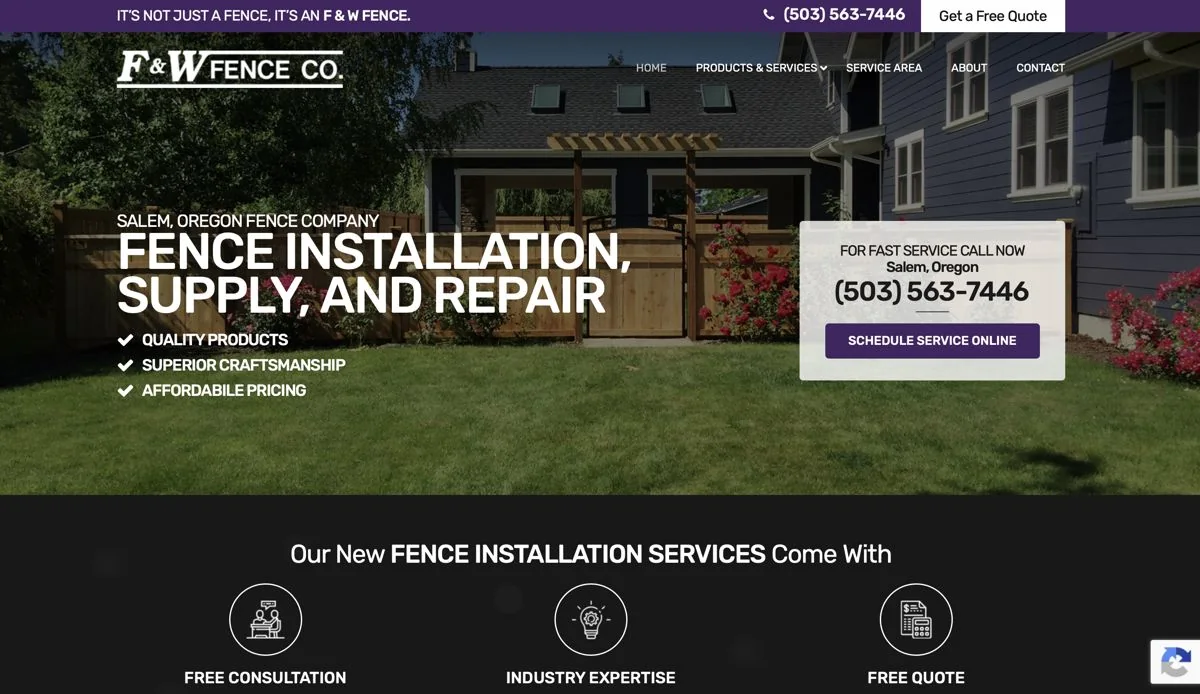
 Fence
FenceF&W Fence Co.
4Xmore ranking keywords
190 to 745 keywords
- top-3 rankings (3 to 28)
- 9X
- top-3 rankings (3 to 28)
- core search conversion rate
- 27.78%
- core search conversion rate
Websites that help Anchorage buyers decide
Show Anchorage customers the work you do and make estimates easier to request with a WordPress website your business owns outright.
 Google PartnerView our Partners listing
5.0on Google · read our reviews
Google PartnerView our Partners listing
5.0on Google · read our reviews
Businesses
we’ve worked with
Businesses we’ve worked with
Let your work make the case
Lithium Marketing creates WordPress websites that help Anchorage service companies explain their work and bring in quote requests. In Anchorage, 44.5% of homes were built before 1980. If your team works on older properties, your site should show those projects and explain the repairs or improvements you performed.
A visitor should be able to tell what you do without opening a photo gallery and guessing. We write the service descriptions, arrange your project photos and make calling or requesting an estimate easy on a phone. You review the content and designs, and the finished website belongs to your business.
Match the page to the search
For 'roofing company anchorage', Google estimates 480 searches a month. A person arriving from that search needs to see the roofing work you offer and how to get an estimate. We give repair and replacement information enough room to explain the differences, with a clear contact action beside it.
Garage door repair searches naming Anchorage also average 480 per month. A repair page should make it easy to describe the problem or call, while an installation page can show options and completed projects. Any business selling both immediate help and planned work needs to make that difference clear.
| Search | Searches a month | Cost per click |
|---|---|---|
| web design anchorage | 210 | $9.15 |
| website design anchorage | 210 | $9.15 |
| web designer anchorage | 10 | not reported |
Source: Google Ads keyword data, average monthly U.S. searches. "Under 10" = below Google’s reporting floor.
Source: one Google results page for “plumber anchorage”, as Google showed it to a searcher located in Anchorage. Search ad counts exclude sponsored local listings. Results shift by searcher and day.
Make projects informative
Homes built in 2010 or later make up 7.3% of Anchorage's housing. If your portfolio includes newer construction as well as older homes, group projects by the work performed. A customer comparing contractors can then find an example that resembles the job they have in mind.
Write a few plain sentences beside each selected project: what the customer needed, what your team handled and what changed. A homeowner planning an upgrade needs more than an attractive finished photo. That same detail gives a property manager a way to judge if your experience fits a repair or replacement request.
Sources: U.S. Census Bureau 2025 population estimates, ACS 2020–2024 and 2023 County Business Patterns.
Different work deserves different pages
Painting businesses account for 44 establishments in Anchorage Municipality. A painter can help buyers compare bids by explaining preparation, the surfaces covered and the estimate process. We put that explanation beside finished-job photos so a visitor understands what the company offers before submitting a form.
Anchorage Municipality's business record includes 47 new home builders. A builder needs space for completed homes and project scope, while a repair company needs service availability and a prominent phone link. The design follows how your customer hires you; the same layout should not force every service into the same sales pitch.
County Business Patterns
Trade and home service businesses in Anchorage Municipality
Establishments by industry, 2023
Source: U.S. Census Bureau, 2023 County Business Patterns (NAICS establishment counts).
A build you take part in
We do the writing and building. You supply the job knowledge and check that the site presents your business accurately.
We use your service list and customer questions to plan the pages. Send examples of completed jobs so the copy describes work your team can deliver.
Phone and desktop designs show how customers will read the service, view your projects and ask for an estimate. You review the copy alongside those layouts.
We build the approved designs in WordPress, test forms and phone links, and set up analytics and call tracking. A test request must reach the intended recipient.
We plan redirects for old pages before release. After launch, a private Loom walkthrough shows your team how to update the site.
What every Lithium website includes
The same eight parts go into every website build, wherever the business is.
Website work in a wider program
F&W Fence Co. received a website from Lithium as well as SEO and Google Ads. The case study records results across that work, giving you more to inspect than a screenshot. Beside it, Willard Power Vac president Daniel Busby talks about his company's experience hiring Lithium.
Fence4Xmore ranking keywords
190 to 745 keywords
“Lithium Marketing has been amazing for our business. They have greatly increased our web traffic and helped us land hundreds of jobs. Before we started using Lithium we were sitting on page 8 in google. We are now sitting in the top spots in all the areas we do work.”
 Daniel BusbyPresident, Willard Power Vac
Websites beyond this market
Planning a site for more than Anchorage? The linked guides look at web design in separate markets, from Fairbanks and Badger to Juneau, with Bellingham in Washington also included. The Alaska directory provides the full state list.
Published price
$5,000
typical project
Larger sites get a fixed proposal after a 30-minute discovery call. Six to nine weeks from kickoff to launch. You own the domain, hosting account, WordPress install and content.
FAQ

Still curious?
Call (503) 766-5964 or email [email protected].
A typical service-business website costs $5,000. More pages, a larger project portfolio or additional functionality can change the scope, so larger builds receive a fixed proposal after discovery. We agree on the page plan before building so you can see what you are paying for.
Ownership stays with you: the domain, hosting, WordPress installation and content are yours. Continuing SEO or advertising is a separate choice. Your team gets a walkthrough for routine edits, and you can keep using the website if you later change who handles your marketing.
The optional $99/month plan covers secure private hosting on a dedicated high-speed server, daily backups, software and security updates, and basic website changes. It is separate from the build price. Choose it if you want Lithium to handle that upkeep while your team focuses on customers.
We review existing URLs and plan redirects before moving the site. Pages with traffic or links need a suitable home in the new structure. We also check forms, phone links and tracking at launch; preserving the route to your content is part of the build, though rankings can change.
Missing project material or delayed reviews can hold up a build. Typical projects take six to nine weeks from kickoff to launch, with the scope and review stages agreed in advance. Gather job photos and your service details early, and designate someone who can approve the copy and design.
Free action plan
Send your site link, project examples and the questions customers ask before hiring you. A co-founder will walk through the recommended pages and build cost with you on a short video call.
What we’ll cover
2000 NE 42nd Ave Ste D Unit 2370, Portland, OR 97213
Prefer to pick a time? Book a 30-minute call with DJ