
 Garden center
Drake’s 7 Dees
380%more organic traffic
in one year
- Google Ads conversion rate
- 26.4%
- Google Ads conversion rate
- leads in 60 days
- 744
- leads in 60 days
Websites for Dallas businesses
We build Dallas service businesses a WordPress site they own outright, with job photos up front and a call button a thumb can reach.
 Google PartnerView our Partners listing
5.0on Google · read our reviews
Google PartnerView our Partners listing
5.0on Google · read our reviews
Businesses
we’ve worked with
Businesses we’ve worked with
Built around your jobs
A Lithium Marketing website shows Dallas customers the kind of house you work on, and Dallas housing runs to both ends: 48.1% of its homes date from before 1980, and 14.4% from 2010 or later. Your site should carry both, with repair and upgrade work on older houses next to finished jobs in newer ones, so either kind of owner sees a house like theirs.
Some of the older stock is historic. Swiss Avenue has houses in every style from Victorian to neoclassical, and East Dallas’s historic district has one of the largest collections of Frank Lloyd Wright-inspired prairie-style homes in the United States. If you work on houses like those, a gallery page for older and historic homes tells an owner you’ve handled one before.
From search to site
A search for “landscaping dallas” (about 1,900 a month) and one for “water damage restoration dallas” (about 1,300) bring very different visitors to a website. Landscaping is planned work and water damage can’t wait, so a landscaping site should open on its gallery of finished yards and a restoration site on the phone number and the hours a crew can come out.
When we checked “plumber dallas”, the Map Pack came first on the results page. A visitor who taps through from your listing there has already seen your star rating, so the home page should pick up from it: reviews, the area you serve and a call button, all in the first screen.
| Search | Searches a month | Cost per click |
|---|---|---|
| web design dallas | 2,900 | $20.45 |
| website design dallas | 2,900 | $20.45 |
| web designer dallas | 480 | $16.00 |
Source: Google Ads keyword data, average monthly U.S. searches. "Under 10" = below Google’s reporting floor.
Source: one Google results page for “plumber dallas”, as Google showed it to a searcher located in Dallas. Search ad counts exclude sponsored local listings. Results shift by searcher and day.
Dallas housing
Dallas’s median year built is 1981. If your trade replaces aging roofs, water heaters, electrical panels or HVAC systems, give each replacement job its own page with photos and a short description of what you found, not a spot in one general gallery.
From 2015, single-family home sales in the Dallas area, pre-owned and new, were leading the nation. If many of your customers are recent buyers who haven’t hired anyone for the house yet, your website may be the first thing they see of you, so it should say plainly who you are, where you work and how a job starts.
Sources: U.S. Census Bureau 2025 population estimates, ACS 2020–2024 and 2023 County Business Patterns.
What each trade’s site needs
Dallas County has 185 painting contractors, and painting is sold on finished work. A painter’s site needs a gallery split by job type, such as interiors, exteriors and cabinets, with a quote form that asks for the rooms and the timing.
Dallas sits at the lower end of Tornado Alley and is prone to hailstorms. If storm work is part of your roofing or restoration business, a hail damage page and a plain explanation of how your inspections work give an owner something to read before they call.
County Business Patterns
Trade and home service businesses in Dallas County
Establishments by industry, 2023
Source: U.S. Census Bureau, 2023 County Business Patterns (NAICS establishment counts).
How the site gets made
Each stage waits for your approval, and testing happens before launch, never after.
On a video kickoff we go through your services, the parts of Dallas you cover and the jobs you want more of, and you send photos from real work.
We write every page ourselves from that call and your photos, and you review finished text, not a blank template.
Pages go up on WordPress and get tested on real phones for speed, and every call button and form gets a tracking tag before launch.
Before the switch, every old page address that gets traffic points to its replacement. After launch you get a recorded video tour covering how to swap photos and edit text.
What every Lithium website includes
The same eight parts go into every website build, wherever the business is.
A client’s numbers
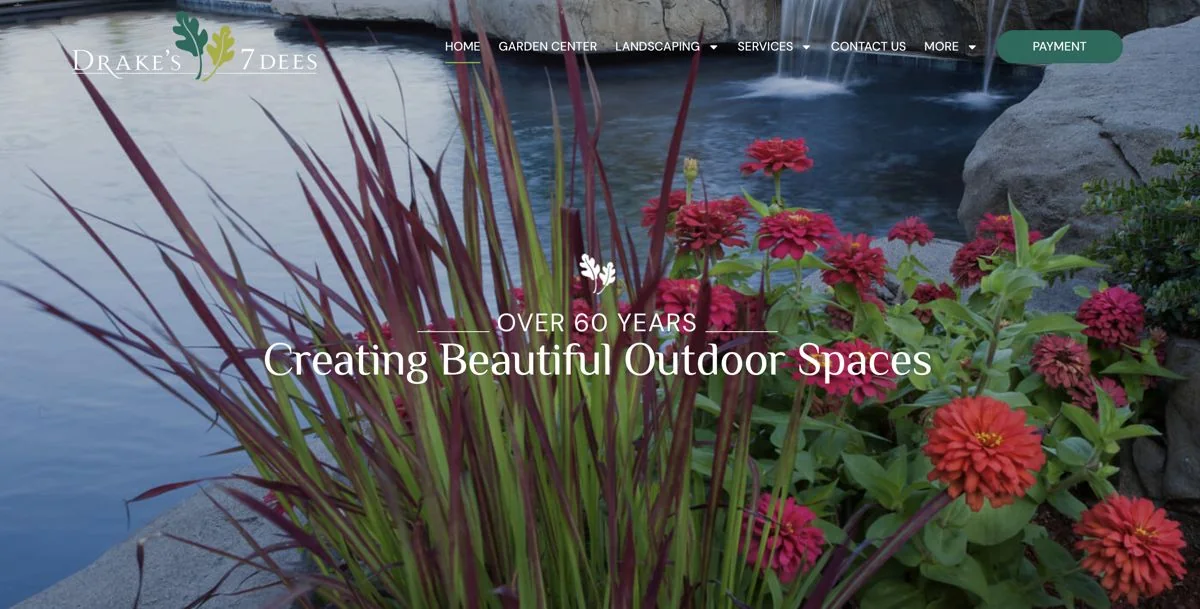
Drake’s 7 Dees is a garden center. Lithium built its new website and ran its SEO and Google Ads, and the numbers on the card come from all three working together. Drake Snodgrass of Drake’s 7 Dees adds his own words beside it.
Garden center380%more organic traffic
in one year
“Lithium has moved us to page 1 in Google search organically. Prior to working with them we spent a huge part of our marketing budget on paid search. Website redesign was a great experience.”
 Drake SnodgrassDrake’s 7 Dees
Nearby Texas cities
Every suburb you take jobs in can get a page on your site that shows work you finished there and names the neighborhoods its residents use. Below are links to Lithium’s web design pages for Mesquite, Garland, Irving, Richardson, Carrollton and Grand Prairie, then the Dallas-Fort Worth metro and the Texas city list.
Published price
$5,000
typical project
Larger sites get a fixed proposal after a 30-minute discovery call. Six to nine weeks from kickoff to launch. You own the domain, hosting account, WordPress install and content.
FAQ

Still curious?
Call (503) 766-5964 or email [email protected].
Page count, mostly. A site with your service pages, an about page, reviews and a gallery fits the typical $5,000. Separate galleries for kitchens, baths and additions, or a page for each city you cover across the metro, add writing and design time. For a larger build like that, you get a fixed written proposal after a discovery call, and nothing starts until you approve it.
All of it does. The domain, the WordPress files, the photos and the copy sit in accounts registered to you from the start, so leaving Lithium changes who maintains the site, not who owns it.
Six to nine weeks from kickoff to launch for a typical site. Most of that calendar goes to writing pages and to your reviews of each stage, so sending photos and answers quickly is the surest way to stay near the short end.
If you want us to. Hosting and maintenance is an optional $99 a month and covers hosting, daily backups, software updates and basic site changes. You can also host the site yourself, since it’s yours either way, and your team can edit it in WordPress without touching code.
Start with photos: finished jobs, your crew and trucks, and before-and-after pairs if you have them. Add your full service list, the Dallas areas and suburbs you cover, and the logins for your current site and domain, and we take it from there.
Free action plan
Send your site’s address and tell us which jobs you’d most like to book. A co-founder will open it with you on a short video call, point out where visitors are likely dropping off and outline the pages a rebuild would add.
What we’ll cover
2000 NE 42nd Ave Ste D Unit 2370, Portland, OR 97213
Prefer to pick a time? Book a 30-minute call with DJ