
 Septic
Byers Septic Service
9Xorganic traffic
91 to 799 visits a month
- more ranking keywords (36 to 395)
- 11X
- more ranking keywords (36 to 395)
- conversion rate
- 23.1%
- conversion rate
Web design in Kennewick, Washington
Kennewick builders get an owned WordPress site that distinguishes their work from partner contributions and prepares a useful first project conversation.
 Google PartnerView our Partners listing
5.0on Google · read our reviews
Google PartnerView our Partners listing
5.0on Google · read our reviews
Businesses
we’ve worked with
Businesses we’ve worked with
A photo needs an honest label
Lithium Marketing designs websites for Kennewick service companies with project evidence a visitor can understand. For a builder whose gallery mixes company projects and partner work, the first task is to explain the company’s actual role before using those images to invite another job.
51.2% of Kennewick housing was built before 1980. If the builder accepts existing-property projects, show the relevant work and scope rather than letting a ground-up build photo stand for every service. The housing figure supplies context for the owner’s project selection; the company’s real work supplies the proof.
Make the click useful
The recorded web-design phrases naming Kennewick total 340 monthly searches. That is agency-shopping evidence. A builder’s customer needs to find the right service and understand who performed the displayed work, rather than read about searches for designers.
The plumbing results snapshot places the Map Pack before the other observed results. A visitor arriving from a listing or referral still needs useful proof on the site. We link appropriately labeled project examples to the service conversation, so the gallery is more than a collection of finished images.
| Search | Searches a month | Cost per click |
|---|---|---|
| web design kennewick | 170 | not reported |
| website design kennewick | 170 | not reported |
| web designer kennewick | under 10 | not reported |
Source: Google Ads keyword data, average monthly U.S. searches. "Under 10" = below Google’s reporting floor.
Source: one Google results page for “plumber kennewick”, as Google showed it to a searcher located in Kennewick. Search ad counts exclude sponsored local listings. Results shift by searcher and day.
Location without borrowed claims
For a builder that accepts both ground-up work and renovations, give each service its own supported project examples. 12.8% of Kennewick housing was built in 2010 or later. A gallery showing only later-built properties leaves an existing-property buyer without a relevant example; label the actual work and company contribution in each selected project.
The same standard applies to residential proof: identify the type of work and what your company was responsible for. A visitor can then compare it with the service they want. Unverified projects should not be used to fill a gap in the portfolio.
Sources: U.S. Census Bureau 2025 population estimates, ACS 2020–2024 and 2023 County Business Patterns.
Specific scope beats a generic gallery
Benton County records 101 home builders. A builder’s site should distinguish its own delivery from design, supply or trade-partner contributions. The establishment figure does not tell us which of those roles any business performed.
The county lists 50 painting contractors too. A painting contribution can be valuable evidence when it is labeled as painting. Presenting a finished room without that context can accidentally imply responsibility for the whole renovation.
County Business Patterns
Trade and home service businesses in Benton County
Establishments by industry, 2023
Source: U.S. Census Bureau, 2023 County Business Patterns (NAICS establishment counts).
Make the proof usable
Approve the project labels before using the images to support an inquiry.
We identify company work, partner work and examples with missing provenance. Only supported material becomes public proof.
The builder explains its role and the service shown in each selected project. The page does not imply a larger scope than the record supports.
Examples sit with the services they demonstrate. The visitor can understand the accepted project before beginning the contact request.
We review the form and mobile path with the receiving staff. They confirm that the inquiry collects useful context without claiming an accepted project.
What every Lithium website includes
The same eight parts go into every website build, wherever the business is.
Proof
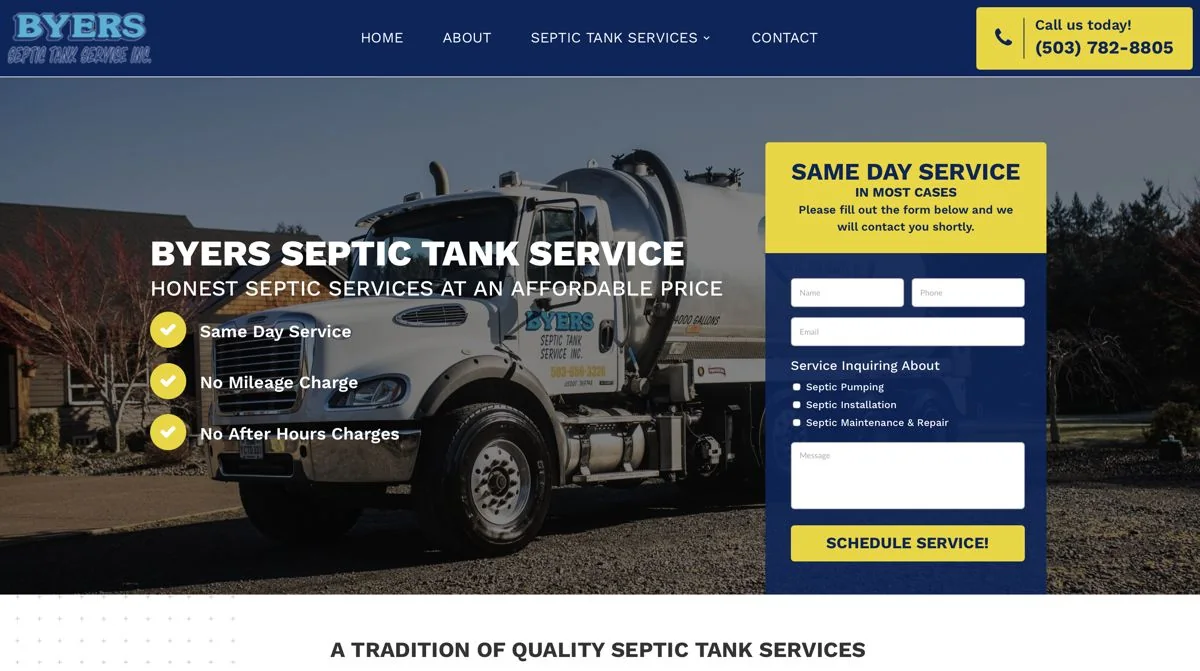
Byers Septic Service is the subject of the case below. Its program included website design, SEO and Google Ads, so the evidence should be read as that combined work. Nathan Boos of Hillsview Building comments separately on his experience with Lithium.
Septic9Xorganic traffic
91 to 799 visits a month
“A lot of options out there for websites and SEO. I’ve worked with this team for years now and would highly recommend them. They know their stuff and deliver results. More importantly to me- they care about service and follow through on what they say they will do. Easy to work with and communicate with. Thank you!”
 Nathan BoosHillsview Building
Sites for real coverage
The web-design group includes Pasco, Richland, Walla Walla, Yakima, Wenatchee and The Dalles, OR, with the Washington directory. When your site describes work in one of those markets, use its actual project records. A city link does not establish a portfolio claim or a builder’s coverage.
Published price
$5,000
typical project
Larger sites get a fixed proposal after a 30-minute discovery call. Six to nine weeks from kickoff to launch. You own the domain, hosting account, WordPress install and content.
FAQ

Still curious?
Call (503) 766-5964 or email [email protected].
Yes, when the page identifies the builder’s actual contribution accurately. The visitor should be able to distinguish company work from the partner’s scope. We use your project records to write those labels instead of implying every finished element was yours.
Leave unsupported claims out until the details can be verified. A smaller collection with accurate scope is more useful than a large gallery with uncertain attribution. We can begin the site structure while you gather the records for selected examples.
Place the relevant evidence beside the service explanation and a clear invitation to describe a project. The form should start a conversation your staff can review. It should not assume a visitor’s job is accepted merely because it resembles a gallery image.
The site’s size determines whether it fits the typical project or needs a larger fixed proposal. Better documentation helps us write accurate content; it is not itself a published price multiplier. The discovery conversation establishes the proposed build scope.
The business owns the site, domain, hosting and content. The private Loom walkthrough explains how the completed site works. Tell us which project updates staff expects to make so the handoff addresses the parts they will use.
Free action plan
Bring the gallery and describe which work belongs to your company or a partner. On a short video call, a co-founder will help choose the proof and service path the site needs.
What we’ll cover
2000 NE 42nd Ave Ste D Unit 2370, Portland, OR 97213
Prefer to pick a time? Book a 30-minute call with DJ