
 Septic
Byers Septic Service
9Xorganic traffic
91 to 799 visits a month
- more ranking keywords (36 to 395)
- 11X
- more ranking keywords (36 to 395)
- conversion rate
- 23.1%
- conversion rate
Website design in McAllen, Texas
McAllen homes carry a median value of $190,400, so your website has to show finished work that earns a homeowner's trust before they call.
 Google PartnerView our Partners listing
5.0on Google · read our reviews
Google PartnerView our Partners listing
5.0on Google · read our reviews
Businesses
we’ve worked with
Businesses we’ve worked with
A site a customer can use
A homeowner in McAllen can open several contractor sites before calling one. Lithium Marketing designs and builds WordPress websites that put your finished jobs, your service list and a tap-to-call button in front of that homeowner on the first screen.
McAllen's median home was built in 1995, and 25.4% of McAllen's housing went up before 1980. An older house means repair, upgrade and patch work that a photo explains faster than a paragraph, which is why the gallery comes before the sales copy.
What McAllen searches for
“web design mcallen” and “website design mcallen” each draw 90 searches a month. That is a small pool, and the trade searches are where the calls are. A customer can meet a contractor in those listings first.
Take the “plumber mcallen” results page we checked: Angi, Facebook and Yelp held three of the top 10 spots. A customer who leaves a directory for your site has already read one version of your business, so the site should not read like a different company. Keep the name and phone number identical, and let the photos carry what the profile could not.
| Search | Searches a month | Cost per click |
|---|---|---|
| web design mcallen | 90 | not reported |
| website design mcallen | 90 | not reported |
| web designer mcallen | under 10 | not reported |
Source: Google Ads keyword data, average monthly U.S. searches. "Under 10" = below Google’s reporting floor.
Source: one Google results page for “plumber mcallen”, as Google showed it to a searcher located in McAllen. Search ad counts exclude sponsored local listings. Results shift by searcher and day.
The housing behind the work
McAllen's median home value is $190,400, and 59.5% of McAllen's occupied homes belong to their owners. A site that treats every visitor as a price shopper misses the owner who wants to see a finished kitchen, a repaired roof or a replaced panel before calling.
Newer homes make up 18.0% of McAllen's housing, and older homes make up the rest. The two need different photos and different pages: repair work for the older houses, finish work and upgrades for the newer ones.
Sources: U.S. Census Bureau 2025 population estimates, ACS 2020–2024 and 2023 County Business Patterns.
Trades in Hidalgo County
New home builders number 124 in Hidalgo County, and residential remodelers 71. Their buyers want to see finished rooms, full houses and the details of a build, so a gallery and a page for each kind of project do more than a services list.
A repair trade lives on the phone. An electrical contractor among the county's 85 needs the number at the top of every screen and a page that loads fast in a driveway. A painting contractor is a different sale: 13 in the county, and the buyer wants a finished-room gallery beside a quote form that works on a phone.
County Business Patterns
Trade and home service businesses in Hidalgo County
Establishments by industry, 2023
Source: U.S. Census Bureau, 2023 County Business Patterns (NAICS establishment counts).
The build
We start with your photos and service list, review the design on a phone and a desktop, then test every link and form before launch.
You send photos of finished work and the list of services behind them, and we write the copy from those jobs, not from a template.
The first design you see is the phone version, and the desktop version follows it.
We build each page in WordPress and test every form, phone link and tracking tag before launch, so a broken one cannot go unnoticed.
We redirect the old pages Google already trusts and record a private Loom walkthrough that shows you how to change text and swap photos yourself.
What every Lithium website includes
The same eight parts go into every website build, wherever the business is.
A client case
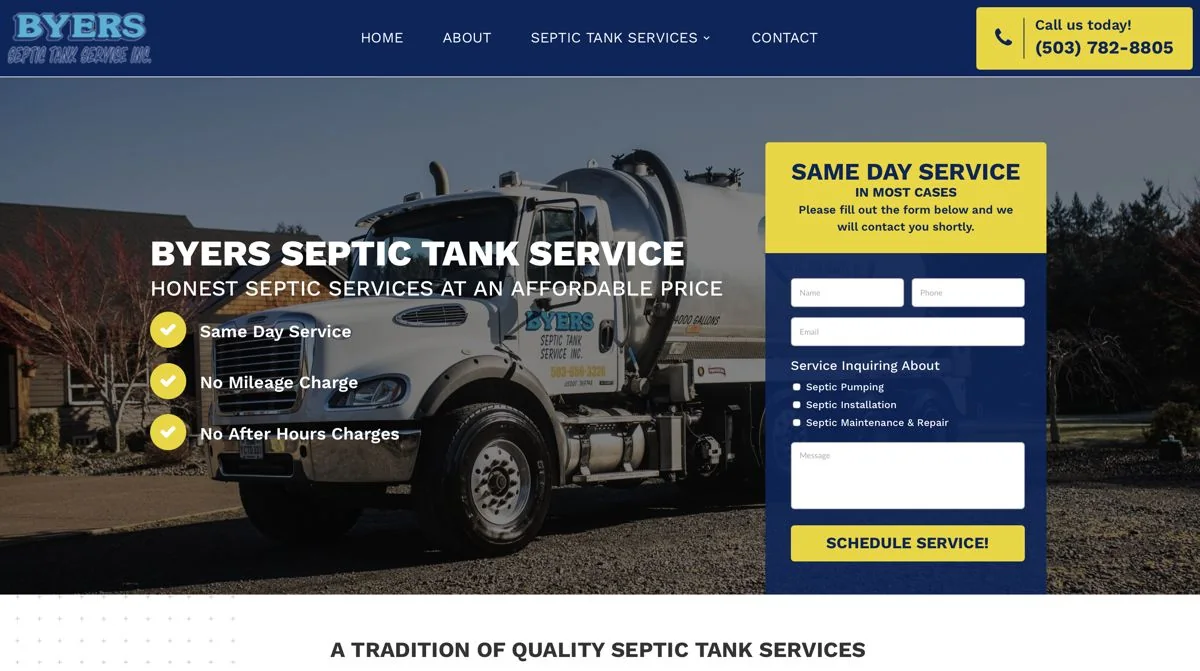
Byers Septic Service used Lithium for three pieces of work: a new website, SEO and Google Ads, and the card's numbers come from all three. Marc Rickabaugh of Rickabaugh Construction describes the website and SEO work in the quote beside it.
Septic9Xorganic traffic
91 to 799 visits a month
“We used the team at Lithium Marketing to update our website and increase our SEO. We couldn't have been happier with the results! We receive compliments about our updated website on a regular basis!”
 Marc RickabaughRickabaugh Construction
Other Texas cities
A city page belongs on your site once the jobs come from there. The links below go to Edinburg, Brownsville, Laredo and Corpus Christi, and the Texas page covers the rest.
Published price
$5,000
typical project
Larger sites get a fixed proposal after a 30-minute discovery call. Six to nine weeks from kickoff to launch. You own the domain, hosting account, WordPress install and content.
You get a typical service-business site: six to nine weeks from kickoff to launch, WordPress, your service pages, job photos, tap-to-call and tracking. A larger site with many project galleries gets a fixed proposal after a discovery call.
The domain, the hosting, the WordPress install and the pages are all registered in your name, so they stay with you if the relationship ends. Nothing sits in a Lithium account.
Text and photos are editable without code, because it is WordPress. A private Loom recording shows your team how, and the optional $99 a month plan adds hosting, daily backups, software and security updates and basic website changes for anyone who would rather not touch it.
Ten good photos, the services each one shows and the towns your crews cover. The kickoff call is where we agree the copy and the page list.
We map each old page to its closest new one and redirect the addresses that earn traffic or links, then watch Search Console for the first weeks after launch. The rankings are Google's call, but the pages it already trusts keep pointing at the same services.
Free action plan
Send the site you have now and five photos of finished jobs. A co-founder will lay out the page list, the price and the timeline over a short video call.
What we’ll cover
2000 NE 42nd Ave Ste D Unit 2370, Portland, OR 97213
Prefer to pick a time? Book a 30-minute call with DJ