
 Glass
GlassDixie Glass
76%more conversions
January vs the January before
- ads conversion rate
- 15.57%
- ads conversion rate
- organic traffic
- +18.2%
- organic traffic
Website design for Miami's service trades
Show Miami customers the work you do with a WordPress website built for estimate requests and owned entirely by your business.
 Google PartnerView our Partners listing
5.0on Google · read our reviews
Google PartnerView our Partners listing
5.0on Google · read our reviews
Businesses
we’ve worked with
Businesses we’ve worked with
Make your work visible
Lithium Marketing turns your service knowledge and completed projects into a Miami website customers can use to choose your business. In Miami city, 50.8% of housing was built before 1980. If older-property repairs and renovations are part of your work, give those jobs room on the site with photos and a description of what your crew did.
A finished photo needs an explanation. We write the pages so a visitor can recognize the service, see where you work and contact you from a phone. WordPress gives your team a way to add completed jobs after launch, while call and form tracking shows which pages generate leads.
From search to estimate
“Pest control miami” records about 1,600 monthly searches. A pest company should help that visitor find the treatment it offers and understand how to arrange service. Apply that same test to every trade page: can someone identify their job and contact the company without searching through the menu?
The recorded average for “water damage restoration miami” is 390 searches a month. If your firm provides restoration, a visitor describing damage needs direct contact and a clear account of your services. Put that information in readable text, with images supporting the explanation.
| Search | Searches a month | Cost per click |
|---|---|---|
| web design miami | 1,000 | $20.67 |
| web designer miami | 1,000 | $20.67 |
| website design miami | 1,000 | $20.67 |
Source: Google Ads keyword data, average monthly U.S. searches. "Under 10" = below Google’s reporting floor.
Source: one Google results page for “plumber miami”, as Google showed it to a searcher located in Miami. Search ad counts exclude sponsored local listings. Results shift by searcher and day.
Show the right property work
The share of Miami city housing built in 2010 or later is 19.2%. Include examples from newer properties if you work on them, alongside older-home projects. Group the gallery by service so a homeowner can compare jobs like theirs.
Edgewater's residential buildings are mostly high-rise towers. Contractors who take that work should describe the scope they handle within a building and ask for the unit or property details needed for an estimate. A photograph of a tower alone leaves too much for the customer to work out.
Sources: U.S. Census Bureau 2025 population estimates, ACS 2020–2024 and 2023 County Business Patterns.
Help buyers compare
Painting contractors number 332 establishments in Miami-Dade County. A painter's service page can pair photos with a short account of surfaces prepared and work completed. Give the prospect enough detail to ask for a similar project, with the quote button close at hand.
For electrical work, Miami-Dade County records 827 contractor establishments. An electrician can use the site to distinguish repairs from upgrades or installation work. Other project trades benefit from the same structure: explain the job before asking the visitor to describe it.
County Business Patterns
Trade and home service businesses in Miami-Dade County
Establishments by industry, 2023
Source: U.S. Census Bureau, 2023 County Business Patterns (NAICS establishment counts).
A build you can review
The design follows what customers need to know, and you review the content before publication.
We use your service list, coverage and project photos to plan the site. Repair calls, estimate requests and larger projects get the explanation each needs.
We design the mobile and desktop layouts with readable job descriptions and visible contact options. You review how the site presents your business.
We build in WordPress and test forms, phone links and tracking. The test follows a visitor through the page and into the message your team receives.
We plan redirects for replaced pages and check the launch. A private Loom walkthrough covers editing your own content and adding job photos.
What every Lithium website includes
The same eight parts go into every website build, wherever the business is.
A business website in use
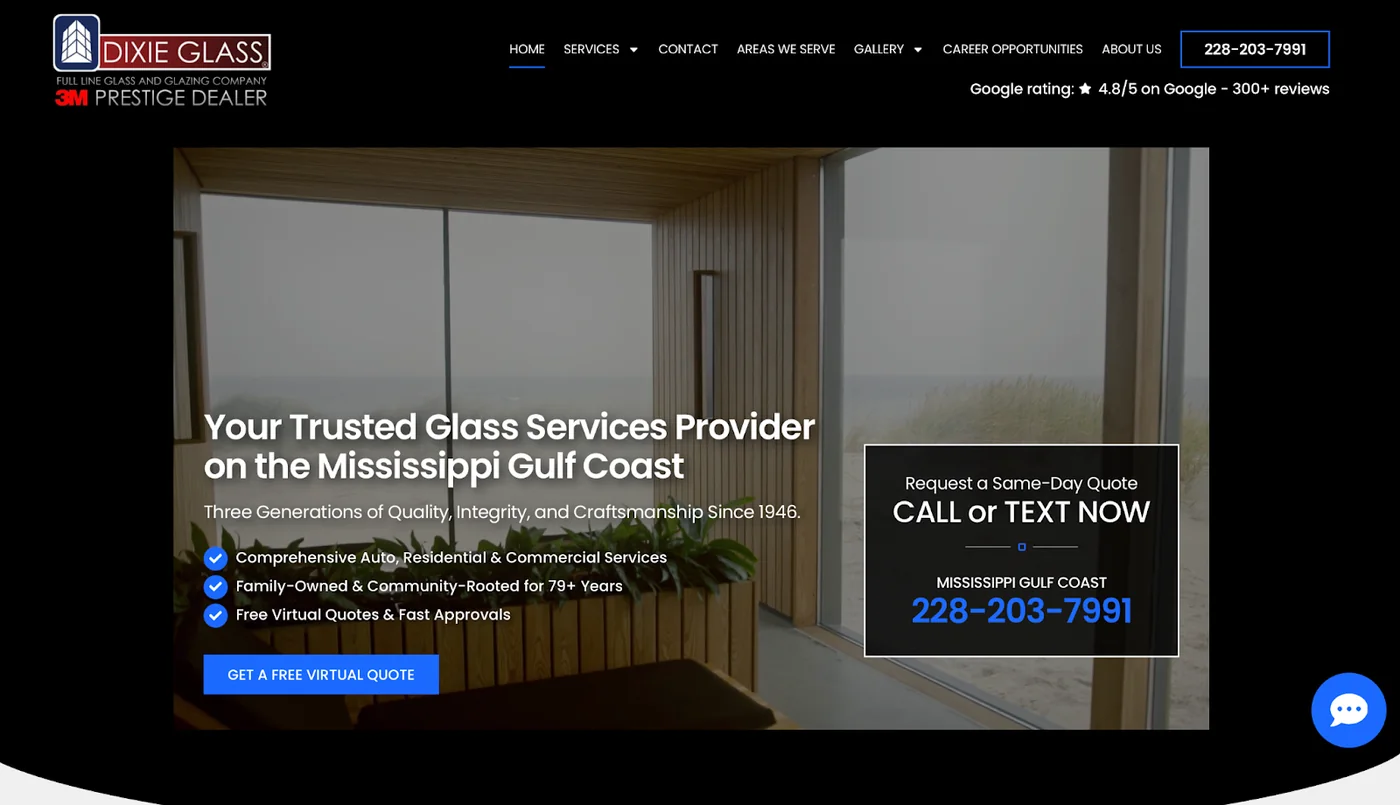
On the Mississippi Gulf Coast, Dixie Glass received a website build plus SEO and Google Ads from Lithium. Its case includes results from that broader program. Marc Rickabaugh, of Rickabaugh Construction, adds an owner's account of the website and SEO work on his own business.
Glass76%more conversions
January vs the January before
“We used the team at Lithium Marketing to update our website and increase our SEO. We couldn't have been happier with the results! We receive compliments about our updated website on a regular basis!”
 Marc RickabaughRickabaugh Construction
Plan the site's coverage
If you take jobs in Hialeah, Hollywood or Davie, explore the web design links below as you plan the pages. The South Florida overview and Florida city directory are there for businesses with broader coverage.
Published price
$5,000
typical project
Larger sites get a fixed proposal after a 30-minute discovery call. Six to nine weeks from kickoff to launch. You own the domain, hosting account, WordPress install and content.
FAQ

Still curious?
Call (503) 766-5964 or email [email protected].
A typical build costs $5,000. More pages, extensive project content or additional functionality can change the scope, and a larger site receives a fixed proposal after discovery. We identify those requirements before building starts so you can compare the full project with your budget.
Allow six to nine weeks from kickoff to launch for the usual website project. We agree on the page list, gather your business information and schedule the reviews. Having service details and usable job photos ready helps the design and content work move through those stages.
Your business owns the domain, hosting, WordPress installation and content. You can keep the site when your marketing arrangements change. The build also includes a private walkthrough so your team knows how to update text and photos without needing to commission a redesign.
Pages already producing leads should be reviewed before they are replaced. We look at their content, search traffic and contact options to decide what to preserve. If a rebuild is needed, redirects connect old URLs to their replacements; a redesign is not a promise that rankings stay unchanged.
You can handle upkeep yourself or choose Lithium's optional hosting and maintenance at $99/month. It includes hosting, daily backups, software and security updates, and basic website changes. We explain the ongoing responsibilities before launch so your new site has a clear maintenance plan.
Free action plan
Your finished jobs are the starting material. Bring a few photos and the address of the website you want to improve; a co-founder will discuss how to present that work on a short video call. Leave with a free plan for the build.
What we’ll cover
2000 NE 42nd Ave Ste D Unit 2370, Portland, OR 97213
Prefer to pick a time? Book a 30-minute call with DJ