
 Fence
FenceF&W Fence Co.
4Xmore ranking keywords
190 to 745 keywords
- top-3 rankings (3 to 28)
- 9X
- top-3 rankings (3 to 28)
- core search conversion rate
- 27.78%
- core search conversion rate
Web design in Moreno Valley, California
Moreno Valley service businesses get a fast WordPress site they own, real job photos, and a call button one tap away on a phone.
 Google PartnerView our Partners listing
5.0on Google · read our reviews
Google PartnerView our Partners listing
5.0on Google · read our reviews
Businesses
we’ve worked with
Businesses we’ve worked with
Moreno Valley web design, answered
The median home in Moreno Valley was built in 1988, which makes repair, upgrade and replacement work the bread and butter for most trades here. Lithium Marketing builds WordPress sites for Moreno Valley service businesses around exactly that work: finished-job photos, clear service pages and a call button a thumb away on a phone.
Riverside County’s median home value is $557,300, and at that level of investment the finished work is what sells the next job. Your site should lead with real project photos and reviews, with the quote form close behind.
Search in Moreno Valley
Your website is where the search ends up. “electrician moreno valley” draws about 140 searches a month and “garage door repair moreno valley” about 110, and each of those searchers lands on a page that either answers in seconds or gets abandoned.
Facebook and Yelp both held top-10 spots for “plumber moreno valley” when we checked, which is one more reason your site and your listings should agree on the basics. A visitor who lands on a slow page after that will not give you a second chance.
| Search | Searches a month | Cost per click |
|---|---|---|
| web design moreno valley | 10 | not reported |
| web designer moreno valley | under 10 | not reported |
| website design moreno valley | under 10 | not reported |
Source: Google Ads keyword data, average monthly U.S. searches. "Under 10" = below Google’s reporting floor.
Source: one Google results page for “plumber moreno valley”, as Google showed it to a searcher located in Moreno Valley. Search ad counts exclude sponsored local listings. Results shift by searcher and day.
The Moreno Valley market
Two eras of housing sit side by side here, and each visits a website for different reasons. 18.7% of homes were built before 1980, and those owners bring calls about repair and replacement work. Another 6.5% arrived in 2010 or later, and those households ask about finishes, additions and outdoor living. A page built for one crowd can miss the other, so give each its own gallery, filled with photos of work you have finished.
Remodelers and repair trades sell in different ways. A remodeler wants a page for each project type, while a plumber or electrician wants the phone number and service area at the top. The homepage should show each kind of visitor the next step that fits.
Sources: U.S. Census Bureau 2025 population estimates, ACS 2020–2024 and 2023 County Business Patterns.
Trades in Riverside County
The county’s builders and remodelers do the long-cycle work: 802 residential remodelers and 411 new home builders in Riverside County. A job that takes months needs a site that carries it, so the site needs project galleries, a page for each kind of build, and a quote form that opens with scope and timing.
Urgent work wants one screen: a plumber or electrician puts the number, the coverage area and the hours where a thumb lands first. A painting contractor, one of 290 in Riverside County, is selling a finish, so the gallery leads and the quote button stays within reach.
County Business Patterns
Trade and home service businesses in Riverside County
Establishments by industry, 2023
Source: U.S. Census Bureau, 2023 County Business Patterns (NAICS establishment counts).
The build
Four points for your sign-off: the page list, the phone layout, the tracking, and the launch. The project stops at each one until you approve it.
We turn your service list and the work you want more of into a page list: one page per service, a gallery, and the areas you cover. You approve it before any layout work starts.
The first layouts arrive at phone width, since that is where most visitors land. The number sits in the top bar, finished jobs run through the middle, and the request form stays within a thumb’s reach.
Copy gets written from your notes and photos, and every form and number gets wired to GA4 and call tracking before launch, so calls arrive tagged with their source.
Old addresses point to their new pages, the site opens for calls, and a walkthrough recording shows your team how to swap a photo or add a finished job.
What every Lithium website includes
The same eight parts go into every website build, wherever the business is.
Proof
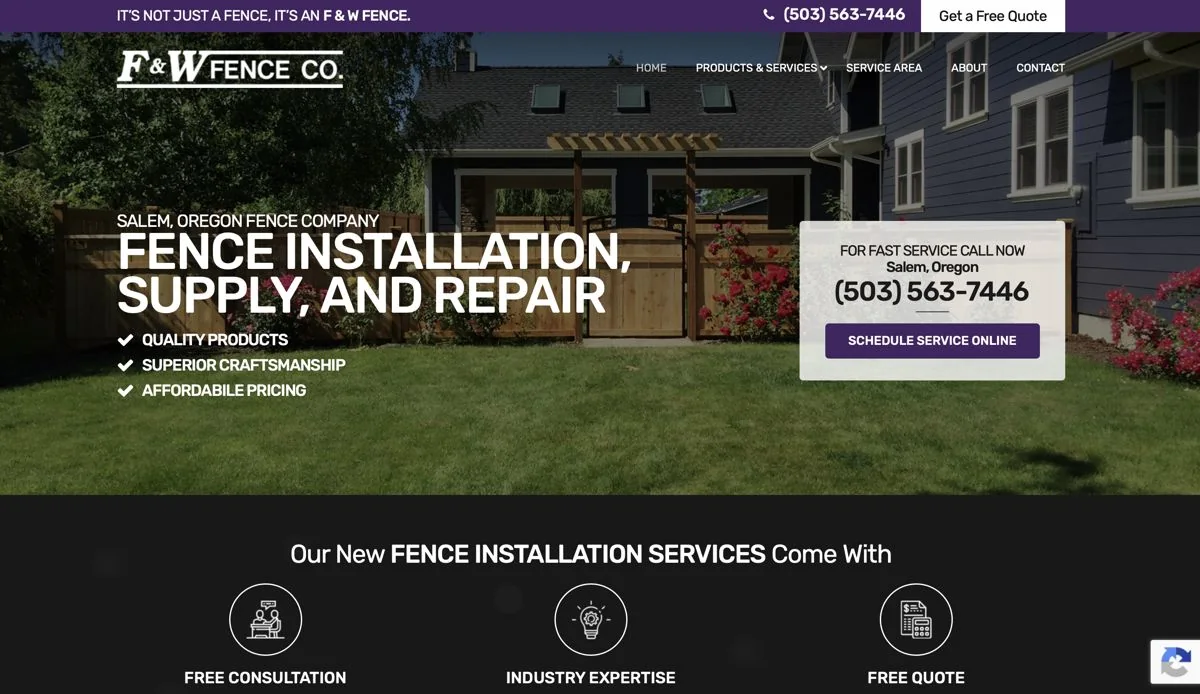
The card shows the growth F&W Fence Co. saw after Lithium built its website and ran its SEO and Google Ads, and the numbers belong to all three. The quote comes from Daniel Busby, who is the president of Willard Power Vac, a company that cleans air ducts, dryer vents and chimneys.
Fence4Xmore ranking keywords
190 to 745 keywords
“Lithium Marketing has been amazing for our business. They have greatly increased our web traffic and helped us land hundreds of jobs. Before we started using Lithium we were sitting on page 8 in google. We are now sitting in the top spots in all the areas we do work.”
 Daniel BusbyPresident, Willard Power Vac
Around Moreno Valley
A city page for each nearby market pays off: the links below cover web design for Riverside, San Bernardino, Jurupa Valley, Menifee, Rialto and Fontana, and each one has its own numbers. The Inland Empire page covers the metro, and the California page reaches the state.
Published price
$5,000
typical project
Larger sites get a fixed proposal after a 30-minute discovery call. Six to nine weeks from kickoff to launch. You own the domain, hosting account, WordPress install and content.
FAQ

Still curious?
Call (503) 766-5964 or email [email protected].
Page count drives the number. A small trade site with a few service pages and one gallery fits the typical figure. Once the build needs a page per service, a page for each nearby city and a photo archive to feed them, the scope grows, and you see that larger figure before design starts.
You do, and the domain comes with it. Everything lives in accounts you control, so the domain, the pages and every photo remain yours even if we part ways.
Rankings are not something anyone can promise, ours included. What the plan controls is the handoff: pages that pull links or visitors today keep a path to their new address, and Search Console gets watched through the switch so anything lost shows up early.
The site runs on WordPress, and a private video walkthrough shows you how. Changing text, swapping a photo or adding a finished job takes no code, and if you would rather not touch it, the optional hosting and maintenance plan at $99 a month handles hosting, daily backups, software and security updates, and basic website changes.
A handful of finished-job photos, a list of the services you sell, the cities you work in, and an hour for the kickoff call. Lithium writes the copy, and nothing is published until you have seen and approved it.
Free action plan
Start with two things: a link to your site and a few finished jobs worth showing. A co-founder will go over both on a short video call and show what the rebuild would change for your calls, with the price settled before work begins.
What we’ll cover
2000 NE 42nd Ave Ste D Unit 2370, Portland, OR 97213
Prefer to pick a time? Book a 30-minute call with DJ