
 Fence
FenceF&W Fence Co.
4Xmore ranking keywords
190 to 745 keywords
- top-3 rankings (3 to 28)
- 9X
- top-3 rankings (3 to 28)
- core search conversion rate
- 27.78%
- core search conversion rate
Your work deserves a better website
Show Virginia Beach customers why they should hire you with a WordPress website that your business owns from domain to content.
 Google PartnerView our Partners listing
5.0on Google · read our reviews
Google PartnerView our Partners listing
5.0on Google · read our reviews
Businesses
we’ve worked with
Businesses we’ve worked with
Turn experience into a hiring decision
Lithium Marketing turns your service expertise into a WordPress website that helps Virginia Beach customers choose a contractor and request an estimate. Homes built before 1980 make up 39.7% of Virginia Beach's housing stock. If your experience includes work on those homes, show the starting problem and the finished result where customers compare your services.
A good job photo needs an explanation. We write what the customer needed, what your company did and how someone can request similar work. That gives your website more to do than display a gallery, while short forms and visible phone links make the next step easy.
Build for the visit after the search
A landscaping company can meet searchers at a page built around its own offer: “landscaping virginia beach” has about 720 searches a month. We distinguish maintenance from installation if you sell both, then put examples beside the service descriptions. Customers can see what they are asking you to quote.
The recorded monthly volume for “electrician virginia beach” is 590. Someone looking for an electrician might need a repair or be planning an upgrade, so the website should make those options easy to find. We test the page on a phone, including the call button and the form your team receives.
| Search | Searches a month | Cost per click |
|---|---|---|
| web design virginia beach | 140 | $16.17 |
| website design virginia beach | 140 | $16.17 |
| web designer virginia beach | 20 | $81.63 |
Source: Google Ads keyword data, average monthly U.S. searches. "Under 10" = below Google’s reporting floor.
Source: one Google results page for “plumber virginia beach”, as Google showed it to a searcher located in Virginia Beach. Search ad counts exclude sponsored local listings. Results shift by searcher and day.
Show the work without guessing the job
Housing built in 2010 or later accounts for 8.8% of Virginia Beach's housing units. If your portfolio includes newer construction as well as older properties, organize examples by the service performed. A visitor should be able to compare a replacement, an addition or routine maintenance without guessing from the age of the house.
Virginia Beach's oceanfront has hundreds of hotels, motels and restaurants. If you serve commercial properties, give that work its own explanation and examples. A property manager should be able to see the services you provide and request a quote without filling out a form written only for homeowners.
Sources: U.S. Census Bureau 2025 population estimates, ACS 2020–2024 and 2023 County Business Patterns.
Make the portfolio explain the offer
Residential remodelers number 267 establishments in Virginia Beach city. A remodeler's website should let a customer inspect a finished room, learn what changed and understand how an estimate begins. We write those project details into the site so the owner does not have to retell the whole story on every call.
Painting contractors account for 72 establishments in Virginia Beach city. A painter can explain preparation and finishes alongside room photos; a roofer can describe the materials and work shown in a completed project. We choose page layouts around what helps customers judge your service, with the quote request close at hand.
County Business Patterns
Trade and home service businesses in Virginia Beach city
Establishments by industry, 2023
Source: U.S. Census Bureau, 2023 County Business Patterns (NAICS establishment counts).
From raw photos to a working website
You bring the knowledge of your business. We organize it, write the pages and build the WordPress site.
We review your photos and talk through what each project involved. The page list follows your services and the questions buyers ask.
You review designs that put service details, customer feedback and contact options in a readable order. We check the same content on small screens.
We build the approved pages, connect analytics and call tracking, and test submitted messages. Your team checks the service details before launch.
We plan redirects for existing URLs and check the launched pages. A private Loom walkthrough shows how to update your own WordPress content.
What every Lithium website includes
The same eight parts go into every website build, wherever the business is.
A service website with documented results
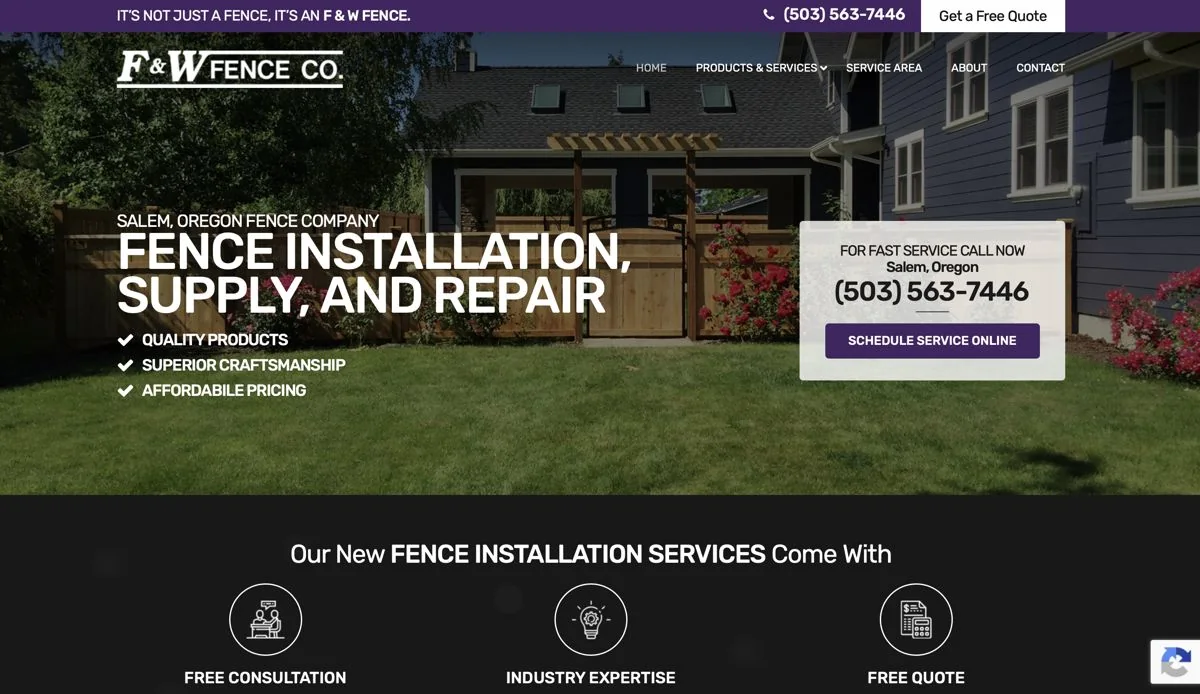
For F&W Fence Co., Lithium supplied web design as well as SEO and Google Ads. The case card records the results across that work. Matt Johnson shares his recommendation from his time running On-Target Landscape.
Fence4Xmore ranking keywords
190 to 745 keywords
“Lithium Marketing is awesome to work with and the results you’ll get are outstanding. Once I started working with them I saw increase in my online presence and my sales increased too. I would highly recommend them to anyone looking for help with marketing!”
 Matt JohnsonOn-Target Landscape
A website that describes your reach
Your website brief can include service pages for Norfolk, Chesapeake or other cities you cover. Explore the web design pages linked below, including Hampton, Suffolk, Newport News and Richmond, or browse the Virginia collection.
Published price
$5,000
typical project
Larger sites get a fixed proposal after a 30-minute discovery call. Six to nine weeks from kickoff to launch. You own the domain, hosting account, WordPress install and content.
FAQ

Still curious?
Call (503) 766-5964 or email [email protected].
A larger collection of service and project pages adds writing, design and build work. We review your existing site and the jobs you want it to show before setting the scope. If that calls for a larger website, you receive a fixed proposal before work begins.
Plan on six to nine weeks from kickoff to launch for a typical website. We need your business information, photos and feedback to keep it moving. The agreed plan covers design, content, development and testing, with launch timing set around the scope and your review availability.
Your business keeps the domain, hosting, WordPress installation and all website content. We make ownership and access clear during the project. You can continue editing the site, appoint another provider or choose our optional maintenance service without giving up those assets.
Usable photos from your completed jobs can support the website without a separate photo shoot. We review what you have and choose images that explain the work clearly. Your team supplies the project facts and permission to use the images; we write the descriptions that help customers understand them.
Your team can edit WordPress content, or you can choose optional hosting and maintenance at $99/month. That plan includes hosting, daily backups, software and security updates, and basic website changes. A private walkthrough helps whoever manages the site learn where to make routine edits.
Free action plan
Bring a link to your current site and photos of work you want Virginia Beach customers to see. A co-founder will discuss the page plan, project scope and build schedule on a short video call.
What we’ll cover
2000 NE 42nd Ave Ste D Unit 2370, Portland, OR 97213
Prefer to pick a time? Book a 30-minute call with DJ