

Table of Contents
- Why Your PPC Budget is Leaking Across State Lines
- Not All Clicks Are Created Equal: Targeting Transactional Intent
- The 400+ Negative Keywords That Saved $30,000 Annually
- Google’s Automation Wants Volume, You Need Revenue: The Case for Hybrid Management
- Stop Tracking Clicks. Start Tracking Revenue Per Dollar Spent.
- Final Thoughts
Oregon service businesses—from HVAC contractors in Portland to roofing specialists in Bend—face an increasingly expensive challenge: generating quality leads without hemorrhaging money on irrelevant clicks. In 2024, the average Cost Per Click for home services sits at $6.55, with legal services even higher at $8.67. Yet many local businesses waste up to 25% of their PPC budget on unqualified traffic due to poor targeting and broad keyword strategies. The problem isn’t PPC itself—it’s how it’s managed. While automated Google Ads campaigns promise simplicity, they often optimize for cheap clicks rather than revenue-generating conversions. For service businesses with smaller conversion volumes but higher ticket prices, this approach is financially disastrous. This guide reveals the data-driven strategies that separate profitable PPC campaigns from budget drains. You’ll discover why geographic precision, search intent targeting, and rigorous negative keyword management are non-negotiable for Oregon businesses—and how agencies like Lithium Marketing have pioneered ROI-focused methodologies that prioritize closed sales over vanity metrics.
- Why Oregon’s unique geography creates hidden ad spend leaks
- How to capture high-intent buyers while filtering out tire-kickers
- The specific PPC strategies that reduce Cost Per Acquisition by 45% or more
Why Your PPC Budget is Leaking Across State Lines
Oregon’s proximity to Washington creates a unique—and expensive—problem for local service businesses running Google Ads without precise geographic controls. The Pacific Northwest trap haunts Portland-area businesses daily. When using default radius targeting, contractors inadvertently advertise to Vancouver, WA residents. For businesses not licensed in Washington, every click from across the Columbia River is pure waste. A plumber in Northeast Portland might set a “20-mile radius” around their location, unknowingly spending hundreds of dollars monthly on clicks from homeowners they legally cannot serve.
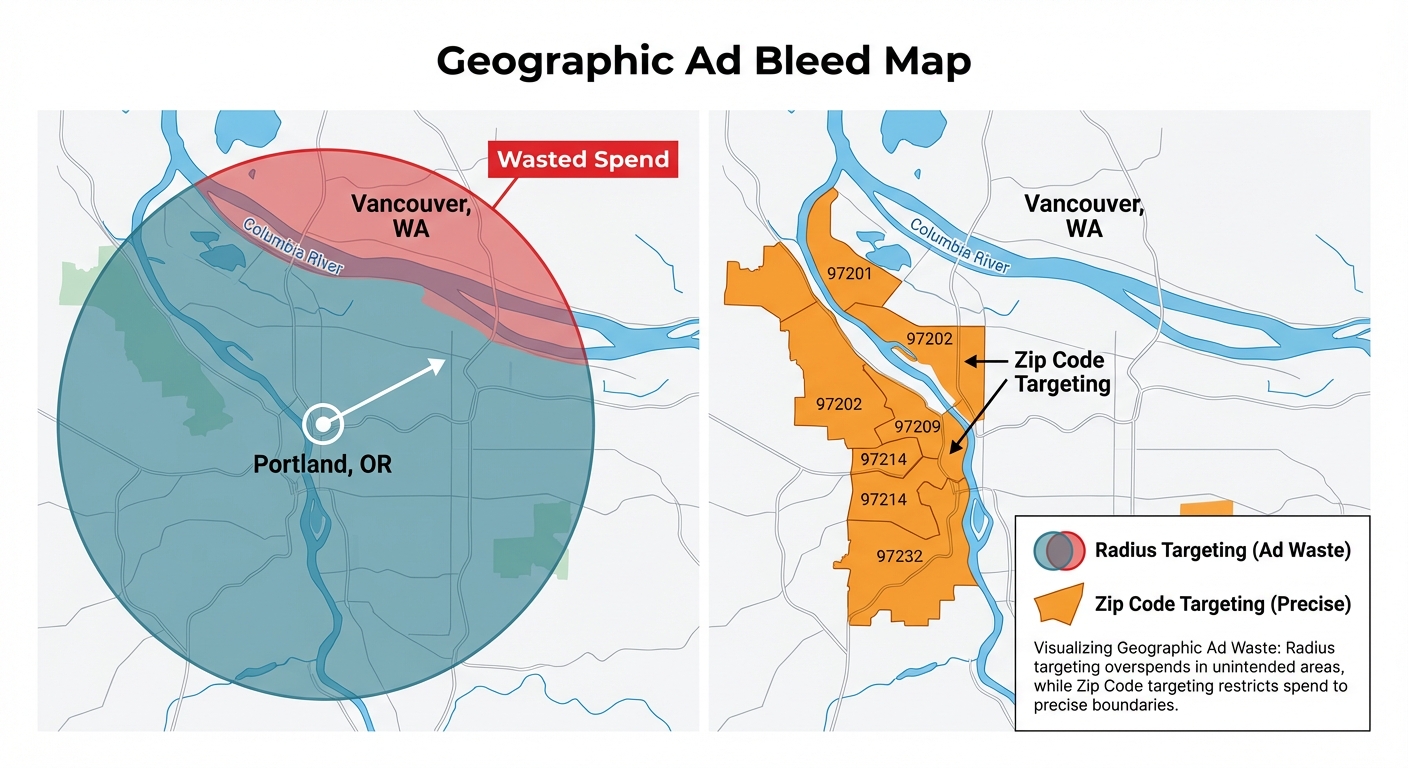
The SME context makes this particularly painful. Small businesses comprise 99.4% of all Oregon businesses and employ over 54.8% of the state’s private workforce. Most cannot afford to throw money at unqualified geographic spillover. When you’re competing against national franchises with seven-figure marketing budgets, every wasted dollar compounds your disadvantage. Without zip-code-level targeting and location exclusions, a $5,000 monthly budget can lose $750-$1,250 to out-of-service-area clicks before a single qualified lead is generated. That’s the equivalent of burning three to five high-quality leads every single month.
- Implement strict zip code targeting instead of radius-based targeting. Identify the specific zip codes within your service area and target those explicitly.
- Add negative location exclusions for neighboring states and counties outside your coverage zone. For Portland businesses, this means explicitly excluding Washington state and Oregon counties where you don’t operate.
- Use demographic overlays to focus on high-income zip codes within service areas. If your average job value is $8,500, targeting lower-income areas may generate clicks but rarely conversions.
- Monitor search terms reports weekly to identify geographic irrelevance patterns. You’ll often discover unexpected location-based search queries bleeding budget.
Default Google Ads settings are built for national e-commerce brands, not local service providers. The difference between profitable and disastrous campaigns often comes down to location controls most businesses don’t even know exist. When a Portland roofing company targets “emergency roof repair,” they need every click coming from someone they can actually help—not from across a state line they can’t cross.
Not All Clicks Are Created Equal: Targeting Transactional Intent
The single biggest mistake in PPC management is treating all traffic equally. High-converting campaigns obsessively filter for transactional intent while ruthlessly eliminating informational searchers.
The Intent Hierarchy Breakdown
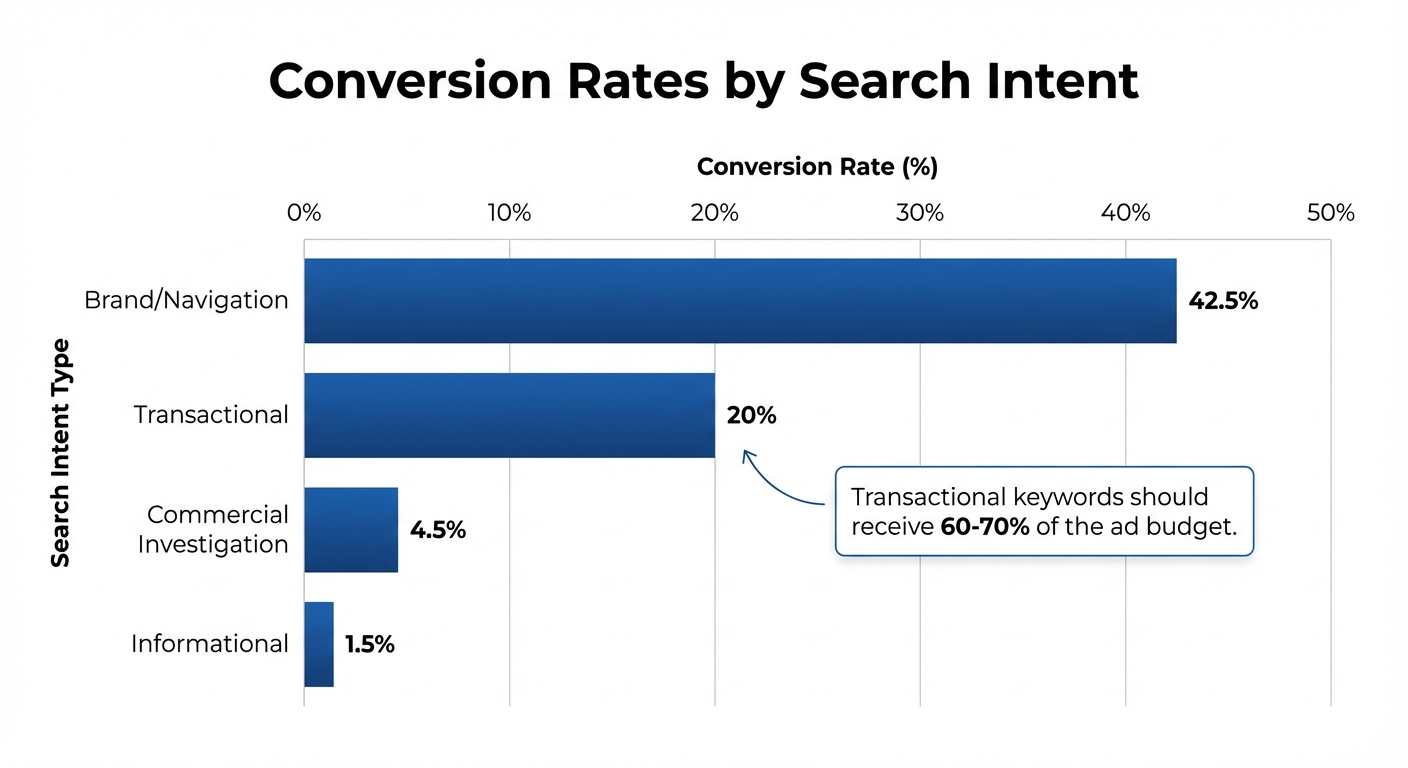
Informational intent searches like “How long do water heaters last?” generate clicks but rarely convert. The searcher is in research mode, potentially months away from making a purchase decision. Your ad spend subsidizes their education without earning their business. Navigational intent searches such as competitor name reviews deliver mixed value. While these searchers are closer to a decision, they’re actively investigating someone else. Unless your competitive differentiation is crystal clear, conversion rates remain unpredictable. Transactional intent searches like “Emergency water heater repair Portland OR” command higher CPCs but deliver 2.5x higher conversion rates. These searchers have a problem right now and need a solution immediately. They’re comparing providers, not gathering information.
Industry Performance Benchmarks
Industry benchmark comparison reveals telling disparities. Home services average 10.24% conversion rate versus legal services at 4.35%—but only when targeting the right intent levels. When campaigns mix informational and transactional keywords, these numbers plummet. The long-tail keyword advantage cannot be overstated. Targeting specific, high-intent phrases like “licensed commercial HVAC installer Beaverton” versus broad terms like “HVAC repair” dramatically improves lead quality while reducing competition. You’ll pay more per click, but each click carries genuine purchase intent. The emergency intent multiplier represents perhaps the most underutilized opportunity in service business PPC. Searchers using emergency keywords convert at 3-4x the rate of standard service queries. Someone typing “24-hour plumber burst pipe” at 11 PM isn’t price shopping—they’re desperately seeking immediate help. These campaigns deserve separate treatment with higher bids and extended ad schedules.
- 60-70% of budget → High-intent transactional keywords with clear commercial intent
- 20-30% → Mid-funnel consideration terms for brand building and competitive capture
- 10% maximum → Brand protection and competitor terms to prevent poaching
- 0% → Informational keywords (redirect this budget to SEO and content strategy instead)
A roofing contractor shifted budget from “roofing tips” keywords to “emergency roof leak repair [city]” targeting. CPC increased 30%, but Cost Per Acquisition dropped 45% because every click represented genuine commercial intent rather than casual browsing. The campaign generated fewer total clicks but dramatically more actual revenue.
The 400+ Negative Keywords That Saved $30,000 Annually
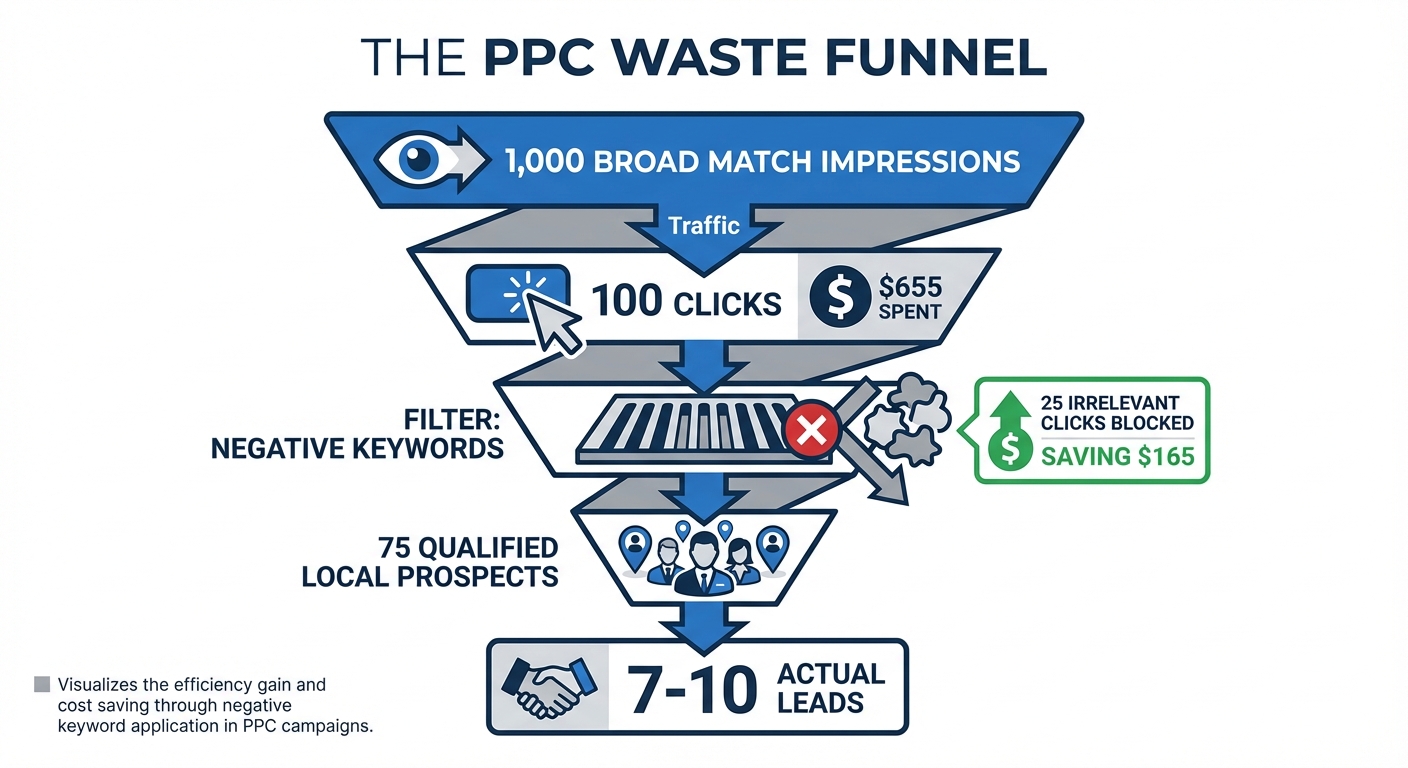
Most PPC accounts leak money through irrelevant search queries. A comprehensive negative keyword strategy is the fastest path to improved ROAS—yet it’s consistently neglected. The 25% waste statistic should alarm every business owner. Small businesses waste an average of 25% of total PPC spend due to inadequate negative keyword lists. For a $60,000 annual ad budget, that’s $15,000 in pure waste—money that could have hired another technician, purchased equipment, or dropped straight to the bottom line.
Common Budget Bleed Patterns
DIY searchers typing “DIY roof repair” or “how to install HVAC myself” will never hire you. They’re explicitly seeking to avoid professional services. Every click wastes money while building frustration. Job seekers searching “HVAC technician jobs Portland” or “plumbing apprenticeship opportunities” aren’t customers—they’re potential employees. Unless you’re actively hiring, these clicks serve no purpose. Wholesale/supply searches like “commercial HVAC parts wholesale” or “roofing materials supplier” come from contractors and building managers seeking materials, not installation services. Free/cheap modifiers including “free legal consultation,” “cheap emergency plumber,” or “discount HVAC repair” attract price-sensitive searchers incompatible with premium service positioning. These leads negotiate aggressively and churn quickly. Educational intent searches such as “HVAC repair course,” “plumbing certification requirements,” or “roofing license exam” represent students and career-changers, not service buyers.
The Continuous Optimization Requirement
The continuous optimization requirement separates amateur from professional management. Negative keyword management isn’t one-and-done. Weekly search term report reviews identify new waste patterns constantly. One HVAC campaign started bleeding budget into “virtual HVAC training” searches—a pattern impossible to predict upfront but obvious once discovered.
- Service exclusions covering services you don’t offer (e.g., if you’re residential-only, exclude “commercial,” “industrial,” “warehouse”)
- Geographic exclusions listing cities and regions outside your service area by name
- Customer type exclusions preventing residential/commercial mismatches
- Price qualifiers blocking “free,” “cheap,” “discount,” “coupon,” “deal,” “affordable”
- DIY/self-service terms eliminating “DIY,” “how to,” “tutorial,” “guide,” “tips,” “yourself”
- Employment/career terms excluding “jobs,” “hiring,” “career,” “salary,” “employment,” “work for”
A regional roofing contractor added over 400 negative keywords after an audit revealed ads triggering for “roofing supplies” and “how to patch a roof.” Within 60 days, their Cost Per Acquisition dropped 45% despite a slight CPC increase, because every remaining click carried genuine commercial intent. The campaign generated fewer total clicks but dramatically more actual sales. The math proves compelling: eliminating 25% waste from a $5,000 monthly budget saves $1,250—enough to acquire 15-20 additional qualified leads at typical home services CPA rates. Multiply that across 12 months, and negative keyword management alone saves $15,000 annually while improving lead quality.
Google’s Automation Wants Volume, You Need Revenue: The Case for Hybrid Management

While Google aggressively pushes Performance Max and fully automated campaigns, service businesses with high-ticket sales and lower conversion volumes need human oversight to prevent algorithm optimization toward cheap, low-quality leads.
The Automation Promise Versus Reality
The automation promise versus reality reveals a fundamental misalignment. Google’s pitch sounds compelling: “Machine learning optimizes better than humans.” The underlying problem? Algorithms require hundreds of conversions monthly to optimize effectively. Local service businesses often generate 20-50 leads per month—insufficient data for pure automation to function properly. What full automation optimizes for rarely aligns with business goals: Volume over value drives algorithmic decision-making. Algorithms chase the easiest conversions—form fills, phone clicks, chat initiations—without understanding lead quality. A spam form submission counts identically to a qualified $10,000 commercial HVAC inquiry in Google’s optimization logic. Spam inflation plagues fully automated campaigns. Without human review, algorithms often optimize toward spam form submissions and accidental clicks because these actions technically meet conversion definitions while costing less to acquire. Geographic drift expands campaigns beyond intended service areas to find cheaper clicks. Automation identifies that clicks cost less in rural areas 100 miles away, steadily shifting budget toward unserviceable locations.
The Hybrid Advantage
The hybrid management advantage combines algorithmic efficiency with human judgment, delivering 15-20% lower CPA for local service providers compared to fully automated approaches.
- Smart bidding with constraints leverages Target CPA or Maximize Conversions strategies, but sets strict bid caps and geographic boundaries. Allow the algorithm to optimize within carefully defined parameters rather than unlimited exploration.
- Manual keyword curation relies on human-selected exact and phrase match terms, never broad match alone. Humans understand context and commercial intent in ways algorithms cannot replicate with limited conversion data.
- CRM integration feeds closed/won sales data back to Google Ads—not just form fills—so algorithms optimize for actual revenue rather than low-quality lead volume. This single integration often improves ROAS by 40-60%.
- Weekly human audits review search terms, monitor quality scores, analyze competitor ad positioning, and identify emerging waste patterns before they consume significant budget.
- Ad copy testing develops messaging based on actual sales conversations and objection handling, not just CTR optimization. Humans understand what closes deals; algorithms only know what generates clicks.
Service businesses must implement offline conversion tracking that imports CRM data showing which leads actually closed. Otherwise, Google optimizes for junk leads that fill out forms but never convert to sales. The algorithm can’t distinguish between a $15,000 customer and a spam bot without this data connection.
When Automation Fails Service Businesses
- Low monthly conversion volume (fewer than 50 conversions) provides insufficient data for algorithmic learning
- High-ticket services ($5,000+ average job value) where one conversion matters more than ten cheap leads
- Complex sales cycles involving multiple touchpoints before close, where last-click attribution misrepresents true customer journey
- Seasonal demand fluctuations requiring strategic budget shifts that algorithms interpret as normal variance
A commercial HVAC contractor running fully automated campaigns saw volume increase but revenue decline. Investigation revealed the algorithm optimizing toward residential service calls (quick conversions, low revenue) rather than commercial installations (longer sales cycle, high revenue). Implementing hybrid management with manual commercial/residential campaign separation increased average job value 340% while reducing total lead volume 15%.
Stop Tracking Clicks. Start Tracking Revenue Per Dollar Spent.

Traditional PPC reporting focuses on vanity metrics that don’t correlate with business growth. ROI-focused management tracks only what impacts the bottom line.
The Vanity Metric Trap
The vanity metric trap consumes attention without driving results. Here’s what NOT to obsess over:
- Impressions measure visibility but mean nothing without conversions. A million impressions generating zero sales is worthless—actually worse than worthless since someone paid for that visibility.
- Click-Through Rate can indicate ad relevance, but high CTR with poor targeting equals expensive waste. A 12% CTR on irrelevant traffic costs more than a 3% CTR on perfect-fit prospects.
- Quality Score alone matters for CPC reduction but doesn’t guarantee conversions. You can achieve perfect 10/10 Quality Scores on keywords that never generate revenue.
- Total clicks represent activity, not results. More clicks don’t equal more revenue if they’re unqualified. Five clicks from emergency searchers outperform 50 clicks from information browsers.
The ROI-Focused Metrics Hierarchy
- Cost Per Acquisition reveals what you pay for each actual lead. This number must stay below your profit margin to remain sustainable.
- Return on Ad Spend calculates revenue generated per ad dollar. Target minimum 4:1 ROAS for most service businesses—every dollar spent should return four dollars in revenue.
- Customer Lifetime Value versus CPA provides the complete picture. If CLV is $15,000 and CPA is $250, that’s a 60:1 return over customer lifetime, making acquisition costs trivial.
- Conversion Rate by source segments performance by keyword, device, time, and geography. Not all traffic converts equally—identify patterns and double down on winners.
- Lead-to-close rate evaluates PPC on closed sales, not just form fills. A campaign generating 50 leads monthly at 10% close rate (5 sales) outperforms one generating 100 leads at 3% close rate (3 sales).
Why most agencies don’t report this way: It requires CRM integration and attribution complexity. Showing “1,000 clicks generated!” is easier than proving “12 closed deals worth $180,000 from $8,500 ad spend.” The latter requires integrating multiple data systems and tracking customers through complete sales cycles.
Industry Benchmark Context
| Industry | Average CPA | Top-Performing CPA | Improvement |
|---|---|---|---|
| Home Services | $65 | $40 | 38% |
| Legal Services | $110 | $70 | 36% |
However, these represent averages including both optimized and poorly managed campaigns. Top-performing campaigns achieve 30-50% better CPAs through strategic management. A well-managed Portland plumbing campaign might achieve $40 CPA versus the $65 industry average—a 38% improvement translating to 60% more leads from the same budget.
The Attribution Challenge
The attribution challenge complicates accurate measurement. Service businesses typically experience multi-touchpoint journeys: ad click → website visit → phone call → in-person estimate → closed deal weeks later. Proper ROI tracking requires:
- Call tracking with conversation intelligence recording and scoring calls to identify qualified conversations versus misdials
- Form submission tracking with lead source tagging preserving original ad/keyword data through CRM systems
- CRM integration passing closed/won data back to ad platforms for algorithmic optimization
- Multi-touch attribution modeling crediting all touchpoints rather than last-click-only attribution
Real-world ROI example in action: A Portland HVAC contractor invested $5,000 monthly in PPC, generating 20 leads at $250 CPA. Their lead-to-close rate of 30% produced 6 new customers monthly. With average job value of $8,500, monthly revenue from PPC reached $51,000—delivering 10.2:1 ROAS.
Without proper tracking, this appeared as merely “some traffic” and “leads we got from Google.” With complete attribution, it revealed PPC as their most profitable marketing channel, justifying budget increases and strategic expansion. The difference between tracking clicks and tracking revenue determines whether PPC functions as a cost center or profit center in your business.
Final Thoughts
PPC advertising remains one of the most powerful lead generation tools for Oregon service businesses—but only when managed with precision, local expertise, and an unrelenting focus on ROI over vanity metrics. The difference between profitable campaigns and budget drains comes down to three critical elements:
- Geographic precision that prevents waste on out-of-area traffic
- Intent-based targeting that captures buyers, not browsers
- Continuous optimization through negative keywords and human oversight
The data proves clear: businesses implementing strategic, hybrid PPC management see 15-20% lower Cost Per Acquisition, dramatically improved lead quality, and ROAS ratios that transform advertising from cost center to profit center. In an advertising landscape where CPCs continue rising and competition intensifies, you can’t afford to treat PPC as a “set it and forget it” channel. The question isn’t whether to invest in paid search—it’s whether you’ll invest strategically or simply donate money to Google. Oregon service businesses deserve PPC management built for their unique geographic, competitive, and economic realities. Agencies like Lithium Marketing have proven that local expertise, combined with data-driven optimization, delivers sustainable growth that generic, automated campaigns never will. The cost of amateur PPC management isn’t just wasted ad spend—it’s the customers you never reached, the revenue you never generated, and the market share competitors claimed while you burned cash on irrelevant clicks.
Ready to Stop Wasting Ad Spend and Start Generating Real ROI?
Get a comprehensive PPC audit that reveals exactly where your budget is going—and how to redirect it toward actual revenue.
References:
- U.S. Small Business Administration (SBA). (2023). 2023 Small Business Profile: Oregon. Retrieved from https://advocacy.sba.gov/wp-content/uploads/2023/11/2023-Oregon-Small-Business-Profile.pdf
- Search Engine Land. (2022). Location targeting in Google Ads: How to get it right. Retrieved from https://searchengineland.com/location-targeting-google-ads-385011
- Search Engine Journal. (2023). Understanding Search Intent for Better PPC ROI. Retrieved from https://www.searchenginejournal.com/ppc-search-intent/
- WordStream by LocaliQ. (2023). How Much Do Small Businesses Spend on Digital Marketing? Retrieved from https://www.wordstream.com/blog/ws/2023/05/10/small-business-marketing-statistics
- HubSpot. (2024). The Ultimate Guide to PPC Advertising. Retrieved from https://blog.hubspot.com/marketing/ppc
- WordStream. (2024). Google Ads Benchmarks for Your Industry. Retrieved from https://www.wordstream.com/blog/ws/2024/02/28/google-ads-benchmarks
- Neil Patel Digital. (2022). How Negative Keywords Can Save Your PPC Campaign. Retrieved from https://neilpatel.com/blog/negative-keywords/