
 Glass
GlassDixie Glass
76%more conversions
January vs the January before
- ads conversion rate
- 15.57%
- ads conversion rate
- organic traffic
- +18.2%
- organic traffic
Make today's remodeling offer clear beside the older portfolio
Build a Gillette remodeling website that explains the projects you accept today while keeping past work useful to prospective customers.
 Google PartnerView our Partners listing
5.0on Google · read our reviews
Google PartnerView our Partners listing
5.0on Google · read our reviews
Businesses
we’ve worked with
Businesses we’ve worked with
Past work can support a clear current service offer
Lithium Marketing can build a remodeling website around your current services, real project examples and a useful first request. If older portfolio work represents services the company no longer accepts, we can help visitors understand today's offer without losing the useful account of what your team completed. The customer gets a clear route to discuss the project your business is ready to assess.
Campbell County has 22 residential remodeling establishments. Your website can explain your own project types and initial assessment process within that category. Readable service pages and labeled examples prepare the visitor to introduce the actual property and desired change.
Give the customer a current service answer before the inquiry
We can organize the navigation around the remodeling work your company currently accepts. A past project account can explain the completed scope while the service invitation states the current offer. The visitor can see how to start their own discussion without needing to interpret the age of a photograph.
A phone-friendly form can collect project aims, the actual property and contact information. Before handoff, we check the agreed message path and show your team how to edit the WordPress pages. Staff receives useful context while the business has a practical way to keep its offer current.
| Search | Searches a month | Cost per click |
|---|---|---|
| web design gillette | under 10 | not reported |
| web designer gillette | under 10 | not reported |
| website design gillette | under 10 | not reported |
Source: Google Ads keyword data, average monthly U.S. searches. "Under 10" = below Google’s reporting floor.
Source: one Google results page for “plumber gillette”, as Google showed it to a searcher located in Gillette. Search ad counts exclude sponsored local listings. Results shift by searcher and day.
Explain completed work with the right present-day invitation
For a real remodeling example in Gillette, where 15.7% of housing was built in 2010 or later, we can show the original goal and what your team changed. Its service label can make the work understandable. The adjacent invitation then explains the projects your business accepts today.
For completed work in Campbell County, where 14.1% of housing was built in 2010 or later, the page can give the example equally clear context. The visitor's own property and desired change remain the useful first request. Your team assesses that project rather than assuming it matches a past example.
Sources: U.S. Census Bureau 2025 population estimates, ACS 2020–2024 and 2023 County Business Patterns.
Collect practical information for the company's assessment
A current remodeling page can ask who is arranging the work for customers in Gillette, where 73.2% of occupied homes are owner-occupied. The request can capture the desired space and change alongside that person's contact details. Staff has a clearer starting point for assessing fit.
For remodeling inquiries in Campbell County, where 77.7% of occupied homes are owner-occupied, we can retain the same useful property role. Gillette's winters are generally very cold but variable. A process page can explain your company's own planning and assessment steps so visitors understand what to discuss before a project timeline is agreed.
County Business Patterns
Trade and home service businesses in Campbell County
Establishments by industry, 2023
Source: U.S. Census Bureau, 2023 County Business Patterns (NAICS establishment counts).
Build around the offer the business is ready to deliver
Agree current services, explain real examples and hand over an owned site with a useful request path.
Make the service invitation consistent with the work your company is ready to assess.
Explain the original project and completed scope with a clear current service route.
Collect manageable goals, location and contact information for your receiving team.
Verify the agreed request route and provide Loom walkthroughs for the WordPress handoff.
What every Lithium website includes
The same eight parts go into every website build, wherever the business is.
Glass marketing and a separate service-business recommendation
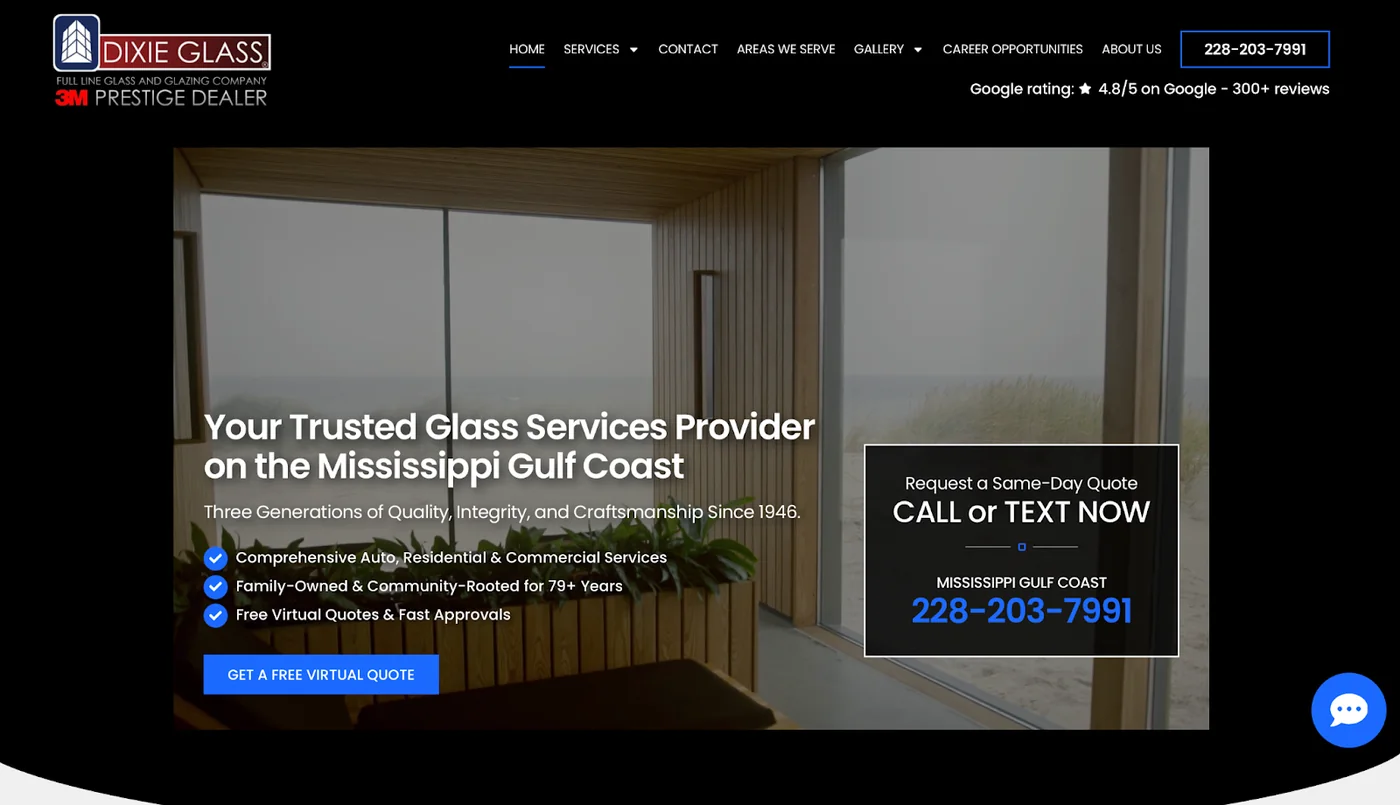
Dixie Glass is the Mississippi Gulf Coast glass business that received website design, SEO and Google Ads in the displayed case. Daniel Busby of Willard Power Vac provides the separate testimonial about increased traffic and jobs from working with Lithium Marketing.
Glass76%more conversions
January vs the January before
“Lithium Marketing has been amazing for our business. They have greatly increased our web traffic and helped us land hundreds of jobs. Before we started using Lithium we were sitting on page 8 in google. We are now sitting in the top spots in all the areas we do work.”
 Daniel BusbyPresident, Willard Power Vac
Keep the new project location beside the accepted service
Wyoming's directory connects web design information for Laramie and Casper in Wyoming, Billings in Montana and Rapid City in South Dakota. Your own remodeling site should state the business's working area with its current offer. Visitors can check coverage and send the actual project property to staff.
Published price
$5,000
typical project
Larger sites get a fixed proposal after a 30-minute discovery call. Six to nine weeks from kickoff to launch. You own the domain, hosting account, WordPress install and content.
FAQ

Still curious?
Call (503) 766-5964 or email [email protected].
Yes. Explain the completed work truthfully and make the current service invitation clear. Visitors should understand what your company accepts for a new request.
Your company owns the domain, hosting, WordPress installation and content. Loom videos show the practical editing tasks so the offer can stay current.
Manageable goals, the property and contact details give staff useful context. Detailed design and technical scope can follow in your company's assessment process.
A typical website build takes six to nine weeks. Agreed content inputs and review turnaround affect the timeline, which we set around the pages and request path your company needs.
They are separate services. The build gives the business owned content and a useful inquiry route; ongoing discovery work needs its own scope and reporting.
Free action plan
Review today's project offer and the portfolio that introduces your business with a co-founder by video. We'll define useful service pages, real project context and a practical customer request.
What we’ll cover
2000 NE 42nd Ave Ste D Unit 2370, Portland, OR 97213
Prefer to pick a time? Book a 30-minute call with DJ