
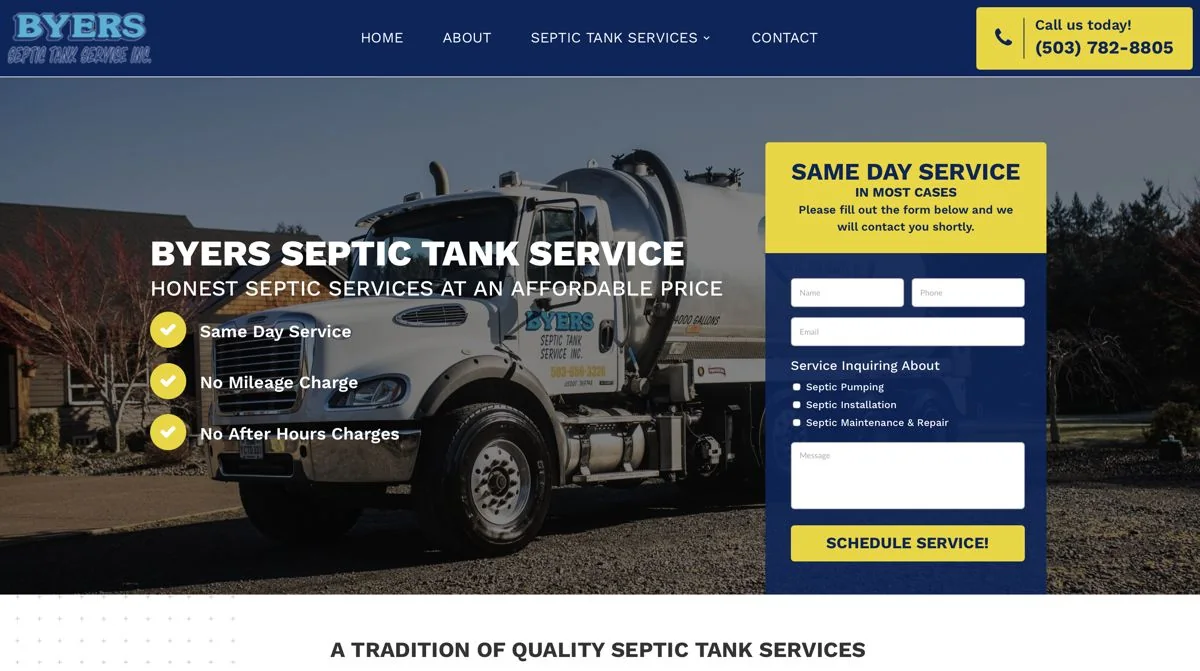
 Septic
Byers Septic Service
9Xorganic traffic
91 to 799 visits a month
- more ranking keywords (36 to 395)
- 11X
- more ranking keywords (36 to 395)
- conversion rate
- 23.1%
- conversion rate
Services for Jonesboro, Arkansas
Help Jonesboro customers request electrical work from a website that explains your repair and installation services before they send details.
 Google PartnerView our Partners listing
5.0on Google · read our reviews
Google PartnerView our Partners listing
5.0on Google · read our reviews
Businesses
we’ve worked with
Businesses we’ve worked with
Jonesboro website design for electrical inquiries
Lithium Marketing builds Jonesboro websites that help a customer describe electrical work before an electrician reviews it. A visitor may know they want a light installed but not the technical name of the job. We organize the site around familiar requests and your accepted services.
Craighead County has 42 electrical contracting establishments. Your pages need to explain the particular work your business will take: a fixture installation, a repair visit or a larger project. A photograph of a completed room should identify the electrical contribution.
Judge website design by the request it produces
“web design jonesboro” records 10 searches a month. Someone comparing designers should test a service page and its inquiry form, not only the homepage. Ask how the proposed build will let a customer describe electrical work without diagnosing the cause.
“electrician jonesboro” draws 140 monthly searches. The useful destination explains the job choices and provides a contact route near that explanation. We help the visitor move from a familiar concern to the right service information without asking them to pick an electrical fault.
| Search | Searches a month | Cost per click |
|---|---|---|
| web design jonesboro | 10 | not reported |
| web designer jonesboro | under 10 | not reported |
| website design jonesboro | under 10 | not reported |
Source: Google Ads keyword data, average monthly U.S. searches. "Under 10" = below Google’s reporting floor.
Source: one Google results page for “plumber jonesboro”, as Google showed it to a searcher located in Jonesboro. Search ad counts exclude sponsored local listings. Results shift by searcher and day.
Show the work on existing and later-built homes
The median Jonesboro home was built in 1991. For an electrical business, label the actual repair or installation shown in each example, including the part of the property involved. That makes a project photo useful to someone comparing similar work.
Housing built in 2010 or later accounts for 20.9% of the city’s stock. Keep examples of additions to an existing property distinct from your role in a complete building project. A finished-house image should not imply that your company carried out every trade’s work.
Sources: U.S. Census Bureau 2025 population estimates, ACS 2020–2024 and 2023 County Business Patterns.
Keep small installations visible beside larger projects
Craighead County records 21 home-building establishments. If your company works with builders as well as household customers, create an inquiry path for each accepted relationship. A homeowner should still be able to find a straightforward installation request.
Do not bury the contact step under equipment terminology. We can show the familiar request first, explain the scope you accept and let your electrician decide what assessment is needed. The form collects useful context instead of prescribing the work.
County Business Patterns
Trade and home service businesses in Craighead County
Establishments by industry, 2023
Source: U.S. Census Bureau, 2023 County Business Patterns (NAICS establishment counts).
Your next steps
The service menu should reflect what customers can describe and what your electricians agree to assess.
We group your accepted services using the wording your customers recognize, while retaining accurate electrical descriptions.
You identify what your electrician changed. We use that information to make project examples honest and useful.
We agree on the location and description your estimator needs, with a route for visitors who are unsure of the technical issue.
We check the service choices, form and delivered inquiry together so useful job context reaches the person who reviews it.
What every Lithium website includes
The same eight parts go into every website build, wherever the business is.
Work to inspect
Byers Septic Service’s case study brings together website design, SEO and Google Ads. The quote beside it is Matt Johnson’s account of working with Lithium at On-Target Landscape, a historical landscaping business.
Septic9Xorganic traffic
91 to 799 visits a month
“Lithium Marketing is awesome to work with and the results you’ll get are outstanding. Once I started working with them I saw increase in my online presence and my sales increased too. I would highly recommend them to anyone looking for help with marketing!”
 Matt JohnsonOn-Target Landscape
Explore the website pages linked beyond Jonesboro
Memphis and Southaven are listed alongside Conway and Little Rock. Each link opens a website-design page; the Arkansas directory helps you find the other city pages when considering the scope of a regional build.
Published price
$5,000
typical project
Larger sites get a fixed proposal after a 30-minute discovery call. Six to nine weeks from kickoff to launch. You own the domain, hosting account, WordPress install and content.
FAQ

Still curious?
Call (503) 766-5964 or email [email protected].
Yes, it can ask for what the customer observed and the work they want reviewed. Your electrician still decides the technical scope. We avoid requiring a diagnosis as the price of contacting you.
We label the work your company actually performed. Bring project photos and an accurate description of the electrical role. That lets visitors understand the example without mistaking your company for the general builder.
Yes, when that relationship is part of your accepted work. We can organize the customer choices so builder requests carry useful project context while household installations remain easy to find. The build scope is agreed before work begins.
The size of the site determines the larger proposal. We review the pages and functions the build needs before quoting. A larger service catalog may require more work than a compact site, so compare the agreed scope as well as the headline price.
You can update the WordPress site yourself. The private Loom walkthrough explains how to edit the content. Keep the same discipline after handoff: describe your actual contribution and use photos you have permission to publish.
Free action plan
Bring your service list and a few electrical project examples. A co-founder will use a short video call to help choose the customer routes and information your estimator needs.
What we’ll cover
2000 NE 42nd Ave Ste D Unit 2370, Portland, OR 97213
Prefer to pick a time? Book a 30-minute call with DJ