
 Septic
Byers Septic Service
9Xorganic traffic
91 to 799 visits a month
- more ranking keywords (36 to 395)
- 11X
- more ranking keywords (36 to 395)
- conversion rate
- 23.1%
- conversion rate
Web design in Indianapolis, Indiana
Indianapolis contractors get a WordPress site that loads fast on a phone, leads with photos of finished jobs and stays in their name.
 Google PartnerView our Partners listing
5.0on Google · read our reviews
Google PartnerView our Partners listing
5.0on Google · read our reviews
Businesses
we’ve worked with
Businesses we’ve worked with
Indianapolis web design, in short
A website from Lithium Marketing is built to turn an Indianapolis visitor into a call or an estimate request, and the design starts with the houses you work on. The median Indianapolis home was built in 1973, and 59.2% of the city’s homes went up before 1980, so your site should lead with the repairs, replacements and upgrades those houses need.
In Indianapolis, only 7.9% of the city’s homes date from 2010 or later. We ask which properties your crews work on, then choose examples that fit: a roof replacement, a drainage fix or a room addition. Show the original problem beside the finished job and explain how you solved it.
Search and your site
Search volumes give you a starting point: about 1,600 a month for “pest control indianapolis” and 1,000 for “landscaping indianapolis”. A visitor arriving from those searches needs to recognize the service immediately. We put the job you do, the area you cover and a contact button on the opening screen, then use project photos and customer reviews to support the offer.
Paid visitors raise the stakes. Google Ads clicks on “plumber indianapolis” average $53.81, and a page that loads slowly or hides the phone number can lose that visitor before they read a word. Every Lithium site is tested for speed on phones and built so calling takes one tap.
| Search | Searches a month | Cost per click |
|---|---|---|
| web design indianapolis | 1,000 | $12.24 |
| website design indianapolis | 1,000 | $12.24 |
| web designer indianapolis | 260 | $20.19 |
Source: Google Ads keyword data, average monthly U.S. searches. "Under 10" = below Google’s reporting floor.
Source: one Google results page for “plumber indianapolis”, as Google showed it to a searcher located in Indianapolis. Search ad counts exclude sponsored local listings. Results shift by searcher and day.
Indianapolis housing
Indianapolis grew in layers. Broad Ripple, Irvington and University Heights began as streetcar suburbs, and the city’s preservation commission oversees 13 local historic districts, including Lockerbie Square, Fletcher Place and Woodruff Place. If you restore trim, repaint old siding or rewire older homes, a gallery of jobs in neighborhoods like those shows a homeowner there that you have done that work before.
The median Indianapolis home value is $224,800. For a major repair or remodel, explain what the estimate covers and show comparable finished work before asking the visitor to contact you. The form can collect project size and timing so your team can prepare for the conversation.
Sources: U.S. Census Bureau 2025 population estimates, ACS 2020–2024 and 2023 County Business Patterns.
Marion County trades
Marion County’s 329 residential remodelers sell big projects, and a remodel buyer wants to see your finished kitchens, baths and basements before asking for a price. Sort the gallery by job type, and let the estimate form collect the room, the size and the timing.
Painting contractors (113 in the county) and new home builders (83) sell differently again. A painter needs fast contact for a quote next to a gallery of finished rooms and exteriors; a builder needs floor plans, lot photos and a page for each community it builds in.
County Business Patterns
Trade and home service businesses in Marion County
Establishments by industry, 2023
Source: U.S. Census Bureau, 2023 County Business Patterns (NAICS establishment counts).
The build
Most builds take six to nine weeks from kickoff to launch, with your sign-off at each stage.
We start with photos from your Indianapolis jobs, every service you sell and the townships and suburbs you cover, then write the copy after a kickoff call.
We arrange the mobile page so the service and contact button are easy to find, with photos supporting the job you want booked. You also review a desktop layout.
GA4 and call tracking go in, and every form and phone link gets tested on real devices before launch.
Old addresses with traffic are redirected to their new pages before launch day, and a private Loom walkthrough of your site arrives once it is live.
What every Lithium website includes
The same eight parts go into every website build, wherever the business is.
Results
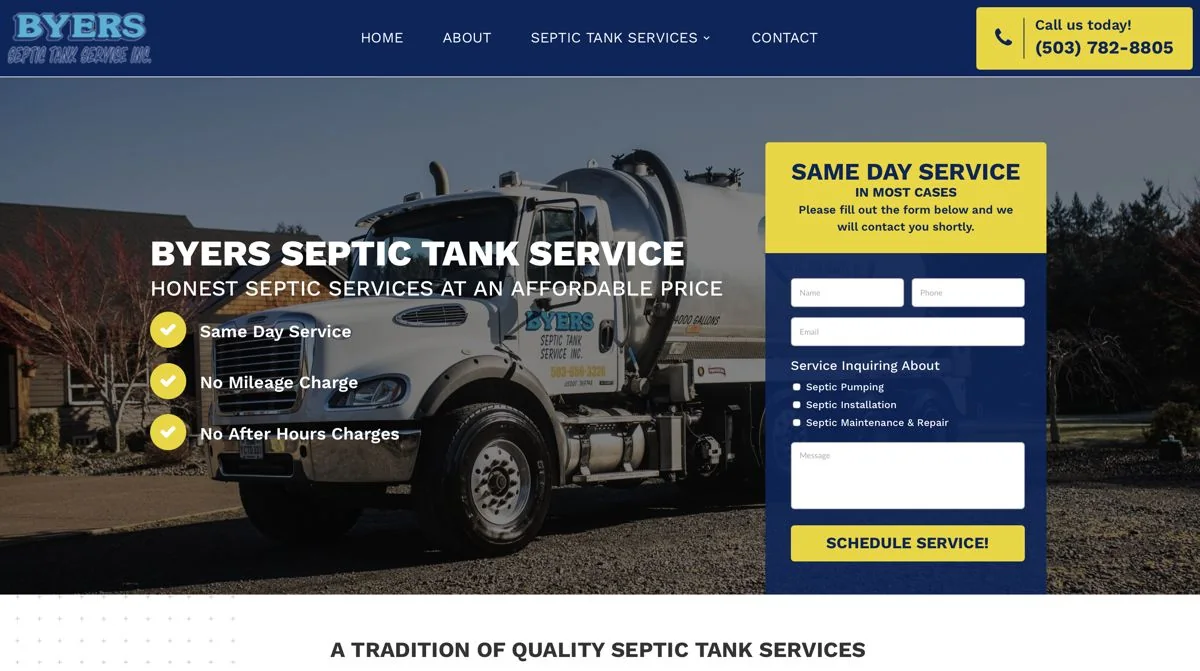
Byers Septic Service, a septic company, got a new website, SEO and Google Ads from Lithium, and the card reports what that package produced. In the quote, Marc Rickabaugh of Rickabaugh Construction talks about the website update and SEO Lithium did for his company.
Septic9Xorganic traffic
91 to 799 visits a month
“We used the team at Lithium Marketing to update our website and increase our SEO. We couldn't have been happier with the results! We receive compliments about our updated website on a regular basis!”
 Marc RickabaughRickabaugh Construction
Nearby cities
If your work reaches past Marion County, each linked page shows that city’s housing and search figures, and the Indiana link lists the rest of the state. A site can carry an area page for every city you serve.
Published price
$5,000
typical project
Larger sites get a fixed proposal after a 30-minute discovery call. Six to nine weeks from kickoff to launch. You own the domain, hosting account, WordPress install and content.
FAQ

Still curious?
Call (503) 766-5964 or email [email protected].
A WordPress site with a page for each service, galleries from your jobs, tap-to-call and estimate forms, GA4 and call tracking, schema, and a private Loom walkthrough. Bigger builds, such as a remodeler with dozens of project pages or a page for every township and suburb, get a fixed proposal after a discovery call.
You own it. The domain and hosting accounts are in your business’s name, and the WordPress site and its content belong to you. Leaving Lithium never means losing your site. If you want us to keep it updated, hosting and maintenance is an optional $99 a month.
Six to nine weeks from kickoff to launch is typical. The pace depends mostly on how fast photos, service details and design approvals come back from your side, so a business with job photos ready can move faster.
Start with photos from real Indianapolis jobs: before-and-after shots, crews at work, finished rooms and roofs. Then a list of every service you sell and where you sell it. Lithium writes the pages from those and a kickoff call, and nothing launches until you sign off.
Both, weighted by trade. A plumber or electrician puts the phone number at the top for the customer who needs help today. A remodeler or painter leads with the gallery and an estimate form that asks about scope and timing, with the number still one tap away.
Free action plan
Send the link to your current site and tell us which jobs you want more of. On a short video call, a co-founder will mark what to keep, what to rebuild and what a new site would cost.
What we’ll cover
2000 NE 42nd Ave Ste D Unit 2370, Portland, OR 97213
Prefer to pick a time? Book a 30-minute call with DJ