
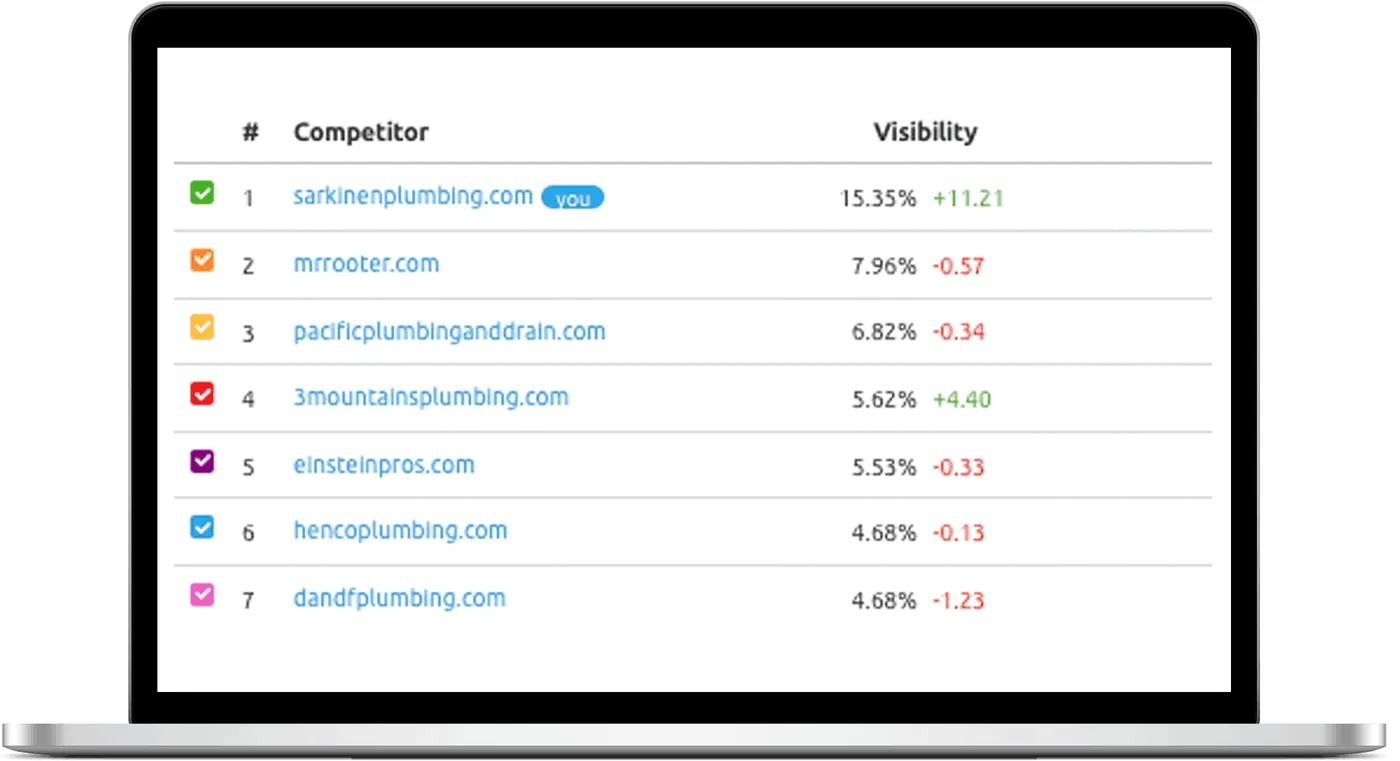
 Plumbing
Sarkinen Plumbing
2Xleads
on the same budget
- search visibility
- 3.75X
- search visibility
- ads conversion rate
- 27.37%
- ads conversion rate
SEO in San Diego, California
San Diego service businesses get Google profile, page and listing work planned by a co-founder, then a monthly report that counts calls and leads.
 Google PartnerView our Partners listing
5.0on Google · read our reviews
Google PartnerView our Partners listing
5.0on Google · read our reviews
Businesses
we’ve worked with
Businesses we’ve worked with
San Diego SEO, start to finish
Lithium Marketing builds the local search presence that San Diego plumbers, electricians, pest control companies and other service businesses need to win calls from Google. When we checked “plumber san diego”, the Map Pack came first on the page. Its three businesses carried 301, 6,000 and 1,400 Google reviews, and the 301-review business held its place in that row beside the one with 6,000, which shows a company doesn’t need thousands of reviews to appear there. So the work starts with your Google Business Profile and the reviews behind it.
Covering San Diego from one address is hard. The city lies on approximately 200 deep canyons and hills separating its mesas, creating gaps between otherwise proximate neighborhoods, so two parts of the city that sit close together on a map can still be split by a canyon. Distance from the searcher is one of the factors Google uses to fill the Map Pack, so pages written for each part of the city you serve are how you reach customers on the far side of those canyons through the organic results.
Trade searches naming San Diego
Google sees about 2,900 searches a month for “pest control san diego” and about 2,400 for “electrician san diego”. Demand at that level justifies a separate page for each service you want more of, such as termite work apart from rodent control, or panel upgrades apart from EV charger installs. Google can then match each search to the page that answers it, and the visitor lands on the job they came looking for.
BBB, Facebook, Thumbtack and Yelp also made the top 10 for “plumber san diego”, and Google showed a People Also Ask box of customer questions on the same page when we checked. A customer who meets you on Thumbtack and then searches your name should find the same phone number, hours and services on your website, and your service pages should answer those common questions in their first sentence.
| Search | Searches a month | Cost per click |
|---|---|---|
| seo agency san diego | 1,900 | $12.31 |
| seo company san diego | 1,900 | $12.31 |
| seo san diego | 1,300 | $26.58 |
| seo services san diego | 720 | not reported |
Source: Google Ads keyword data, average monthly U.S. searches. "Under 10" = below Google’s reporting floor.
Source: one Google results page for “plumber san diego”, as Google showed it to a searcher located in San Diego. Search ad counts exclude sponsored local listings. Results shift by searcher and day.
Communities and service areas
The City of San Diego recognizes 52 Community Planning Areas and more than 100 identified neighborhoods, so one “San Diego” service-area page leaves most of the city unnamed. Group your pages by community instead: one for the beach and coastal communities of La Jolla, Pacific Beach, Mission Beach and Ocean Beach, another for Clairemont, Kearny Mesa and Tierrasanta north of Mission Valley, each written around the jobs you take there.
The city’s southern edge is easy to miss. San Ysidro and Otay Mesa sit next to the border with Mexico and are physically separated from the rest of the city by the cities of National City and Chula Vista. If you take jobs there, give them a page and add them to your Google Business Profile service area, so customers near the border can see that your coverage reaches them.
Sources: U.S. Census Bureau 2025 population estimates, ACS 2020–2024 and 2023 County Business Patterns.
San Diego County’s trades
The chart counts 1,072 plumbing, heating and air-conditioning contractors in San Diego County, with 958 electrical contractors close behind. A profile that lists only “Plumber” or “Electrician” looks like hundreds of others, so name the specific jobs you want, such as tankless water heater installs or whole-home rewiring, on the profile and on pages of their own.
Roofing is a much smaller field on the chart, at 253 roofing contractors countywide, yet “roofing company san diego” still draws about 1,300 searches a month. For a roofer, that argues for splitting repair, replacement and inspections into separate pages and going after each of those searches by name.
County Business Patterns
Trade and home service businesses in San Diego County
Establishments by industry, 2023
Source: U.S. Census Bureau, 2023 County Business Patterns (NAICS establishment counts).
The SEO work
The early months go to fixing and filling in; links come once there are pages worth pointing them at.
We fix indexing problems, slow templates and duplicate pages so Google can read and rank every service page you have.
We set the right primary and secondary categories, list every service, add job photos and give your office a one-tap link for requesting reviews.
Each service you want more of gets its own page, and so does each part of San Diego or nearby city where you take work, written to answer what customers ask Google.
We bring your name, phone and hours into line on BBB, Thumbtack, Yelp and other directories, then point new links at the service pages that produce the most calls.
What every SEO retainer includes
The same eight parts go into every SEO retainer, wherever the business is.
Proof from the Portland area
Sarkinen Plumbing works in the Portland, Oregon area, not San Diego, and its card reflects a new website Lithium built for it plus the SEO and Google Ads Lithium ran alongside it. Beside it, Marc Rickabaugh of Rickabaugh Construction describes the website update and SEO help his company got from Lithium.
Plumbing2Xleads
on the same budget
“We used the team at Lithium Marketing to update our website and increase our SEO. We couldn't have been happier with the results! We receive compliments about our updated website on a regular basis!”
 Marc RickabaughRickabaugh Construction
Past the city line
Before you add a nearby city to your service area, open its SEO page: El Cajon, Chula Vista, Escondido, Carlsbad, Oceanside and Temecula each list the searches that name them, which shows where a dedicated page on your site would have demand behind it. The California link covers every other city.
Published price
$1,300–$3,000
per month
Typical local SEO retainer, scoped against what a lead is worth to you, with AI search optimization included.
FAQ

Still curious?
Call (503) 766-5964 or email [email protected].
Most local retainers land between $1,300 and $3,000 a month. We scope the figure against what a new customer is worth to your business and how far behind your site, profile and links are today. A company that needs pages and links built from scratch for high-ticket work pays more each month than one with a solid site and a half-finished profile.
Expect it in stages. The first month usually shows technical fixes taking hold. Map Pack and long-tail positions typically need 60 to 90 days, because new pages have to be indexed and your profile has to earn trust. The revenue effect usually builds from month four onward, and your report counts calls and leads the whole way, so a slow stretch is visible early.
Six months to start, then month to month. Local rankings need about that long to show what the work can do, so the first term is six months; from then on you can stop with 30 days’ notice. Every page, profile update and listing built along the way stays with your business if you leave.
It can be, if the numbers work. A two- or three-person company usually needs fewer pages and links than a multi-crew operation, so it sits toward the lower end of the range. The question to settle first is whether a few extra jobs a month cover that cost, and a co-founder works through that math with you before you sign anything.
Yes, AI search readiness is part of every SEO retainer. No AI Overview showed for “plumber san diego” when we checked, but that can change, and what helps there is the same work that wins People Also Ask spots: answer-first pages, schema and business facts that match everywhere. No one can promise an AI mention, and we won’t.
Free action plan
List the services that pay best and the parts of San Diego where you want more of them, plus your web address. On a short video call, a co-founder checks your Google profile and pages against those searches and lays out the first three fixes.
What we’ll cover
2000 NE 42nd Ave Ste D Unit 2370, Portland, OR 97213
Prefer to pick a time? Book a 30-minute call with DJ