

Table of Contents
- How Google’s Verification Process Transformed Into an Anti-Fraud Defense System
- The “Trust-First” Protocol: Establishing Legitimacy Before Touching Google
- Data Entry, Category Selection, and the New Rules of Submission
- The Perfect Verification Video: What Google’s AI Looks For (And What Triggers Rejection)
- When Verification Stalls: Technical Pitfalls and Recovery Strategies
- Key Takeaways
The era of quick Google Business Profile (GBP) verification is over. By 2026, what was once a simple postcard verification has evolved into a sophisticated, AI-driven validation process designed to combat the flood of fake, AI-generated business listings. For legitimate businesses, this shift represents both a significant challenge and a competitive advantage—profiles that successfully navigate these stringent requirements gain a powerful moat against less-prepared competitors. Today’s verification landscape operates on a “Trust-First” model, where Google cross-references your business data against government databases, utility records, and the broader Knowledge Graph before even permitting verification to begin. Industry data reveals that new account suspensions have risen by nearly 40% year-over-year, with many legitimate businesses caught in the crossfire simply due to minor data inconsistencies or incomplete digital footprints. This comprehensive guide walks you through the exact 2026 standards for GBP approval, detailing the necessary digital ecosystem, technical requirements, and operational protocols needed to successfully launch and verify your profile. Whether you’re a service-area business working from home or a brick-and-mortar location, understanding these requirements is critical—especially when 78% of local mobile searches lead to an offline purchase, making GBP visibility a non-negotiable component of local business success.
How Google’s Verification Process Transformed Into an Anti-Fraud Defense System
To appreciate the rigor of 2026’s verification standards, businesses must understand how Google evolved from reactive spam management to proactive fraud prevention.
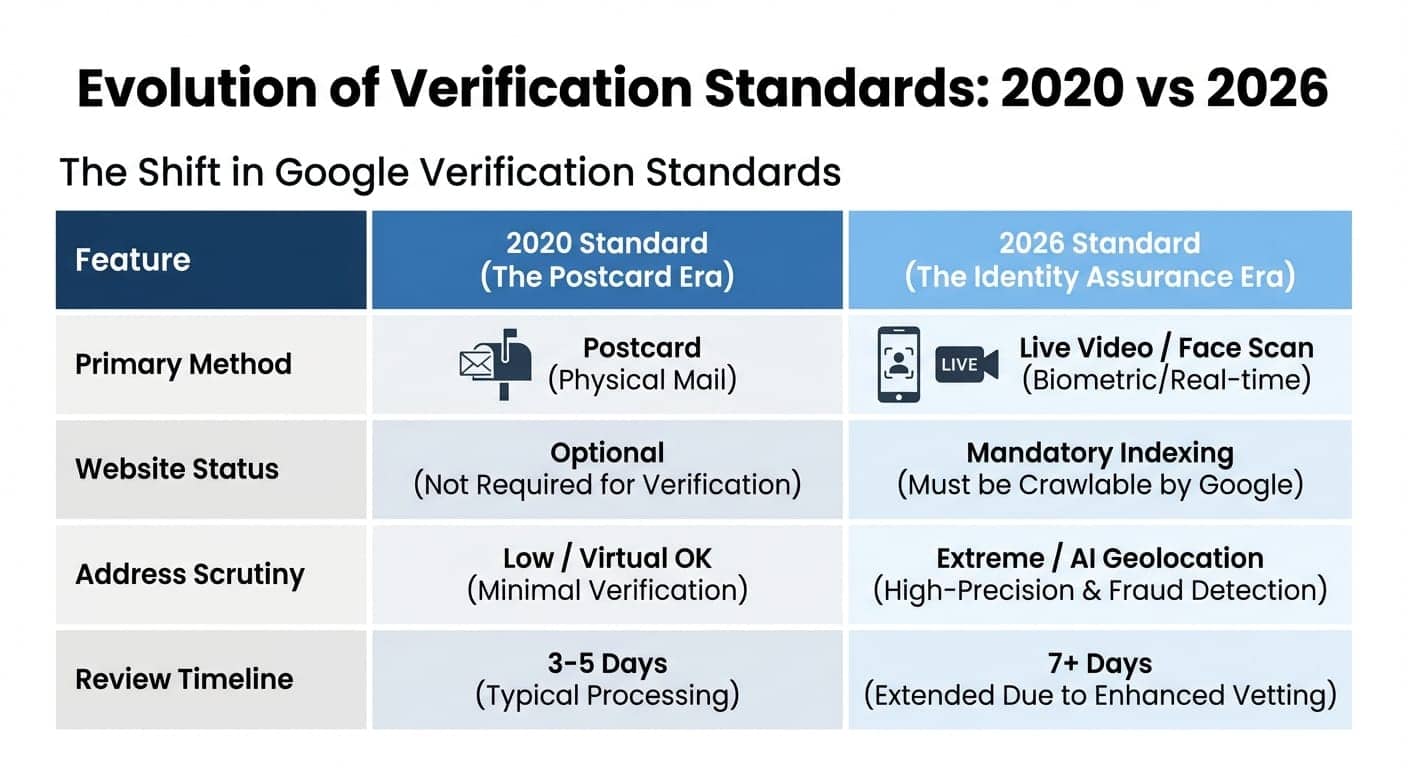
The Postcard Era (2015-2020)
During this period, verification relied heavily on physical mailers sent to business addresses. This system, while straightforward, became a playground for abuse. Bad actors exploited PO boxes and residential addresses to create thousands of “lead-gen” listings, flooding local search results with fake businesses designed solely to capture and sell customer inquiries. The postcard method had no mechanism to verify actual business operations—only that someone could receive mail at a given address.
The Video Transition (2021-2024)
Recognizing the limitations of physical mail verification, Google introduced video verification to combat virtual office abuse. This shift dramatically increased suspension rates, particularly for categories historically plagued by spam operations: locksmiths, garage door repair companies, HVAC services, and personal injury lawyers. Business owners were now required to provide visual proof of their operations, marking the beginning of Google’s “show, don’t tell” verification philosophy.
The Identity Assurance Era (2026)
Today’s verification process represents a quantum leap in sophistication. Google now integrates cross-platform data validation, querying Secretary of State filings, utility records, and Knowledge Graph entities before permitting verification to even begin. The algorithm operates as a forensic investigator, piecing together digital breadcrumbs to confirm that a business entity genuinely exists and operates as claimed.
The “Guilty Until Proven Innocent” Algorithm
New profiles—particularly in service industries—are treated with heightened skepticism. The burden of proof rests entirely on the business owner to establish legitimacy rather than simply claiming existence. This represents a fundamental philosophical shift: Google assumes profiles are fraudulent until proven otherwise, especially in categories with historical spam problems. The cost of failure in this environment is substantial. With suspension rates climbing and manual review queues extending verification timelines to seven or more days, businesses cannot afford to approach GBP creation casually. The stakes are too high—local search visibility directly translates to revenue, and businesses locked out of Google’s local ecosystem essentially don’t exist to the 78% of consumers who use mobile searches to find local services.
The “Trust-First” Protocol: Establishing Legitimacy Before Touching Google
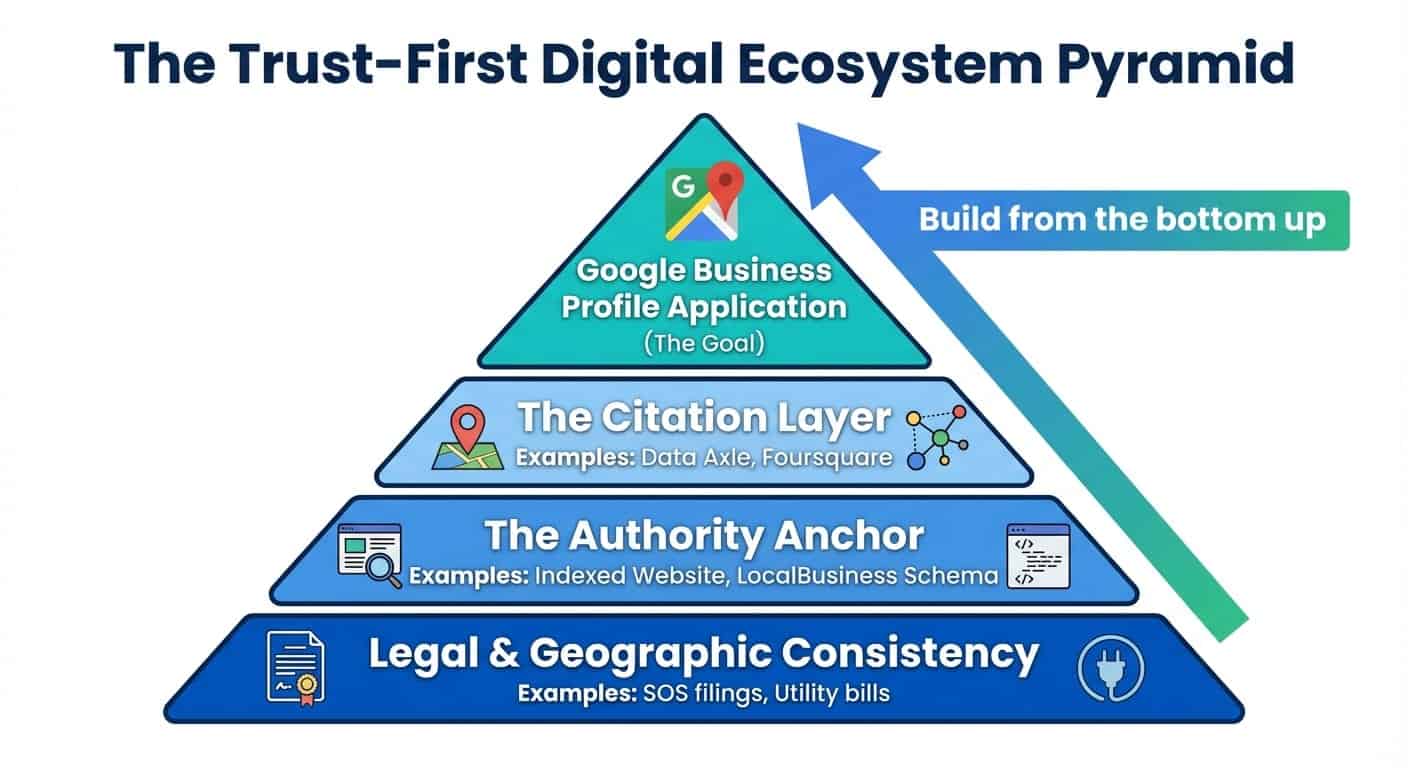
The most critical mistake businesses make in 2026 is attempting to create a GBP as their first digital step. Google’s AI demands a verifiable digital footprint exists before you approach their platform. Think of it as establishing a credit history—you can’t get a loan without first building creditworthiness through existing financial relationships.
Legal and Geographic Consistency: The Foundation Layer
Your GBP business name must exactly match your Secretary of State filing or registered DBA. This isn’t a suggestion—it’s a strict requirement enforced through automated cross-referencing with government databases. “Lithium Marketing LLC” in your state registration must appear identically on your GBP listing. Adding keywords like “Lithium Marketing – Best SEO Services in Chicago” will trigger immediate red flags. For Service Area Businesses using home addresses, precision becomes even more critical. The address you provide must match utility bills or bank statements exactly. Discrepancies as minor as “Suite B” versus “Unit B” or “Street” versus “St.” can trigger “Deceptive Content” suspensions. Google’s algorithm doesn’t interpret—it matches character-by-character against third-party databases.
The Website as Authority Anchor
A published, indexed website is now mandatory for verification. Google’s crawlers visit your provided URL to validate that your business category and service offerings align with your GBP claims. A website that exists but hasn’t been indexed by Google Search provides zero trust signal—it’s invisible to the validation algorithm. Implementing LocalBusiness Schema (structured data from Schema.org) on your homepage is vital. This code speaks directly to Google’s bot in a language it explicitly understands, defining your organization’s name, address, phone number, and operating hours in machine-readable format. Think of schema markup as providing Google with a standardized form rather than asking it to interpret free-text descriptions.
The Citation Foundation Layer
Before applying for a GBP, your business data should exist on high-authority data aggregators. Submit business information to the “Big Three” aggregators: Data Axle, Foursquare, and Neustar/Localeze before creating your Google profile. This establishes a “consensus of data” that Google can cross-reference during validation. While citations have fluctuated in their direct impact on local search rankings over the years, research confirms they remain a fundamental “pass/fail” factor for verification validity. Google’s algorithm looks for data consistency across the web—if your NAP (Name, Address, Phone) information appears identically across multiple authoritative sources, it signals legitimacy. Conversely, if your business only exists on Google and nowhere else on the internet, it triggers spam filters designed to catch AI-generated fake listings.
Data Entry, Category Selection, and the New Rules of Submission
Once your digital ecosystem is established, profile creation follows a strict order of operations where precision determines approval or suspension.
Business Name Precision: No Keywords Allowed
Use only your legal business name as it appears on government documents—no keyword stuffing, no descriptive additions, no location qualifiers. This rule is non-negotiable and one of the most common suspension triggers. Correct: “Lithium Marketing”
Violation: “Lithium Marketing – Best SEO Agency in Chicago” The temptation to add keywords is understandable—business owners naturally want to maximize visibility. However, Google considers this manipulative and treats it as spam. Your business name field is for identification only; optimization happens through categories, descriptions, and posts.
Phone Number Selection: Avoid VoIP Red Flags
While not explicitly prohibited, VoIP numbers (Google Voice, Skype, etc.) raise red flags in Google’s spam detection systems. The algorithm associates “burner” numbers with fraudulent operations that frequently cycle through disposable phone lines to evade detection. Preferred options include hardline local area code numbers or mobile lines registered to the business owner. If you must use a VoIP number due to business model constraints (fully remote team, call forwarding requirements), ensure it’s from a reputable provider with a consistent usage history rather than a freshly generated number.
Strategic Category Selection: Start Simple
Choose one primary category that matches your website’s H1 tag and most accurately describes your core service. This alignment between website content and GBP category selection helps Google’s algorithm confirm consistency across touchpoints. Add secondary categories only after verification to reduce complexity during the review process. Google’s manual reviewers scrutinize new profiles carefully, and excessive category selection on a brand-new listing can appear suspicious—as if you’re trying to rank for everything rather than genuinely operating across multiple service areas.
The Service Area Overreach Trap
For service businesses, selecting excessively large service areas triggers manual review. Google’s algorithm applies what local SEO experts call “The 2-Hour Rule”—limit service areas to a radius drivable in approximately two hours. Selecting “Entire United States” or multiple states when you’re a solo plumber operating from a home address often results in immediate “Deceptive Content” suspension. This restriction exists because Google prioritizes local relevance. A business legitimately serving a 200-mile radius should have the infrastructure to support that scope—multiple vehicles, field technicians, regional offices. A single-person operation claiming to serve half the country triggers obvious fraud signals.
The IP Address Flag: Location Matters During Creation
Google analyzes device geolocation during profile creation. Creating a Chicago business profile while using a Miami IP address signals fraud—it suggests you’re a spam operation creating profiles for locations you don’t actually operate in.
The Perfect Verification Video: What Google’s AI Looks For (And What Triggers Rejection)
By 2026, video verification is the standard for 95% of new profiles. The “postcard” option is now reserved primarily for large, established brands with immense existing authority—think national chains with decades of presence and overwhelming digital footprints.
Why Video Replaced Postcards
Traditional mail verification became ineffective against sophisticated spam operations using mail forwarding services and virtual offices. Bad actors could receive postcards at addresses they never physically occupied, creating the illusion of legitimacy without actual presence. Video verification requires “proof of management”—demonstrating legitimate access and operations that fake listings cannot replicate. You must show not just that a building exists, but that you have the right to operate a business there.
The Perfect Verification Video Script
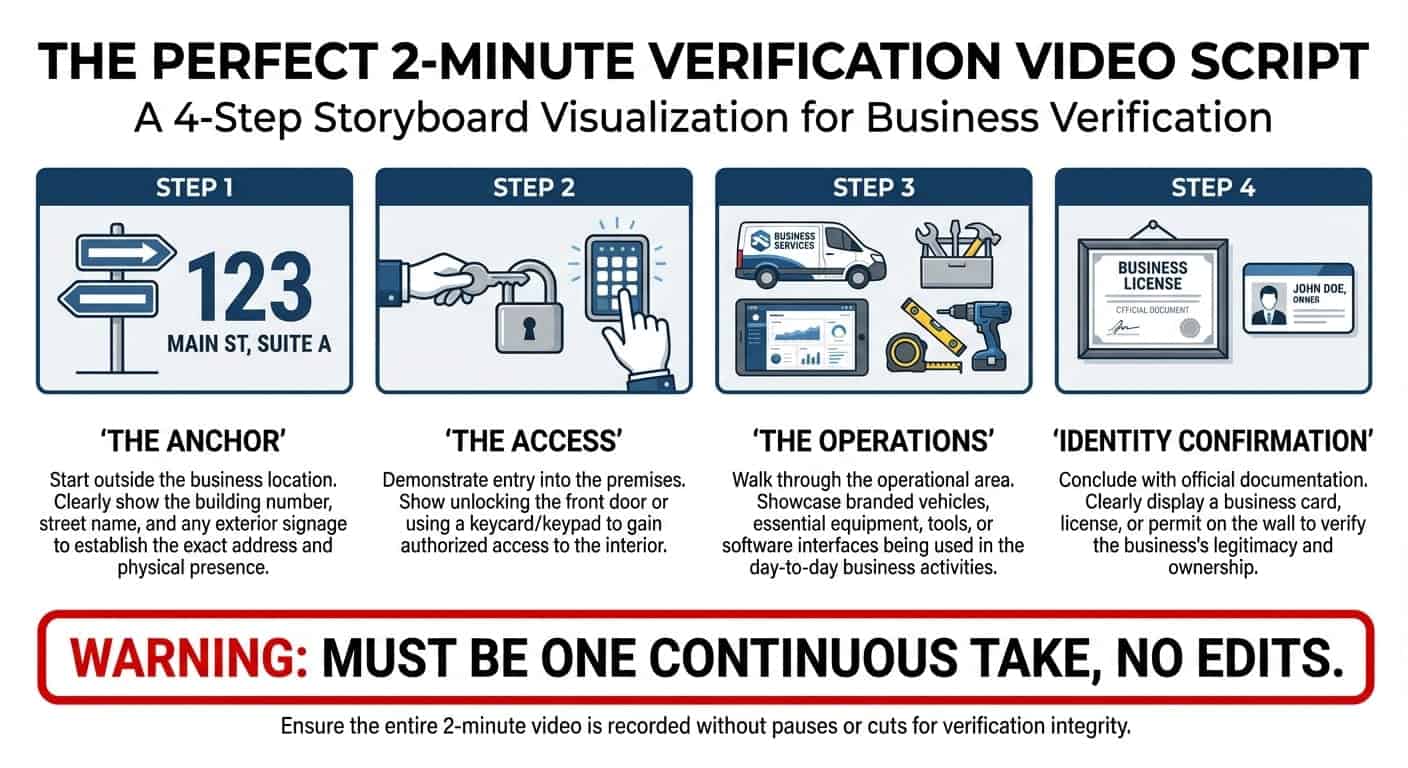
Record in one continuous take, under two minutes total. Google’s reviewers prefer unedited footage—multiple cuts or edits can raise suspicion that you’re concealing something or piecing together footage from different locations.
Step 1: The Anchor (15-20 seconds)
Start outside your location. Clearly show the street sign and building number in frame simultaneously. This establishes geographic legitimacy and allows the reviewer to confirm the address matches your GBP listing. Walk toward the building while keeping signage visible.
Step 2: The Access (20-30 seconds)
Walk to the entrance and unlock the door with a key or enter an access code. This critical step demonstrates “right of entry,” distinguishing business owners from customers or trespassers. Simply filming a building lobby without demonstrating access is a primary rejection trigger—anyone can walk into a publicly accessible building.
Step 3: The Operations (60-90 seconds)
Show branded equipment, software interfaces, business licenses displayed on walls, inventory storage areas, or branded vehicles. The goal is proving active business operations occur at this location. For Service Area Businesses verifying at home:
Film the branded service vehicle with clear company signage and vehicle wrap. Show tool storage areas, equipment staging zones, or your home office setup with marketing materials and business signage visible. Demonstrate the operational hub where customer service, dispatching, or administrative work occurs. The key is proving this isn’t just a residential property—it’s a functioning business headquarters.
Step 4: The Identity Confirmation (10-15 seconds)
Briefly speak your business name and verification request to camera. While not explicitly required, some reviewers appreciate this verbal confirmation as additional validation.
Common Video Rejection Triggers
Understanding what causes rejection is as important as knowing what to include:
- Filming from outside only without demonstrating access. This is the most common rejection cause. Showing a building exterior proves nothing about your relationship to that location.
- Poor lighting making addresses or branding unreadable. If the reviewer can’t clearly verify the address matches your listing or see your business branding, they must reject the submission.
- Multiple cuts or edits. Continuous footage provides confidence that you’re not manipulating what’s shown. Heavy editing suggests you might be concealing red flags.
- No visible proof of business operations or branding. Generic office spaces or residential areas without business equipment, signage, or operational proof raise fraud concerns.
- Virtual office or co-working space addresses. Google maintains comprehensive databases of known virtual office providers and co-working facilities. Using these addresses results in automatic rejection—Google knows you’re not genuinely operating from this location.
SAB-Specific Nuances
Home-based service businesses face additional scrutiny because residential addresses have historically been abused for spam operations. To overcome this skepticism, demonstrate professional infrastructure:
- Branded service vehicles with clear company signage
- Professional equipment storage areas showing inventory
- Dedicated workspaces with business signage and marketing materials
- Dispatch or customer service setups indicating active operations
Avoid filming residential clutter or personal spaces that don’t support business operations. The reviewer needs to see a professional operation, not someone working from their couch.
When Verification Stalls: Technical Pitfalls and Recovery Strategies
Even legitimate businesses with proper preparation can encounter verification delays or suspensions. Understanding common technical triggers helps prevent and resolve these issues.
The “Pending” Status Trap
Profiles stuck in pending status for weeks typically indicate data mismatch flags or manual review triggers. Google’s algorithm may be cross-referencing your data against third-party databases and finding inconsistencies that require human review to resolve. Resolution Strategy: Compare your GBP data against Secretary of State filings, utility bills, and website information character-by-character. Even minor variations—”Inc.” versus “Incorporated,” “Street” versus “St.”—can cause validation failures. Update all external citations to match your exact GBP formatting before resubmitting.
Data Mismatch Resolution
Google’s validation algorithm queries multiple databases simultaneously. When it finds conflicting information across sources, it flags the profile for manual review or automatic suspension. Common mismatches include:
- Business name variations across Secretary of State filings, website, and GBP
- Address formatting differences (Suite vs. Ste., Street vs. St.)
- Phone number inconsistencies across citations
- Category misalignment between website content and GBP selection
The solution requires creating absolute consistency across all digital properties before attempting verification. This means auditing and updating every citation, directory listing, and reference to ensure identical NAP formatting everywhere.
The Virtual Office Death Sentence
A digital consultant attempted verification using a Regus virtual office address to appear more professional than using a home address. The result was immediate suspension. Google maintains comprehensive databases of co-working spaces and virtual office providers—addresses associated with these services trigger automatic rejections. The resolution required profile deletion and recreation using the consultant’s legitimate home address, properly configured as a Service Area Business with the address hidden from public display. The second attempt succeeded via home office video demonstration, showing professional workspace setup and business operations. This case study illustrates a critical principle: attempting to appear more legitimate often backfires. Google’s algorithm is sophisticated enough to detect virtual offices, and the attempt to use one signals deception even when intentions are innocent.
Category Suspension Recovery
High-risk categories like locksmiths, HVAC services, garage door repair, and legal services face elevated scrutiny due to historical spam problems in these industries. Success in these categories requires exceptional preparation. Successful Strategy Example: A garage door repair company faced the “high-risk” stigma. Their approach:
- Pre-registered their LLC 30 days before GBP application
- Obtained professional branded vehicle wraps
- Launched a localized content website and ensured Google indexation
- Conducted video verification showing the branded truck, tool inventory, and invoicing software
- Achieved verification in 48 hours
The combination of branded vehicle, pre-indexed website, and comprehensive operational demonstration allowed Google to cross-reference video evidence with digital claims, bypassing the usual manual review queue that plagues this category.
Escalation Protocols
When automated appeals fail, businesses must document their legitimacy comprehensively for human review. Gather and submit through Google Business Profile support:
- High-resolution photos of business licenses
- Utility bills showing business name and address match
- Secretary of State registration confirmation
- Website screenshots with matching NAP data
- Photos of physical location with visible business signage
- Branded vehicle photos if applicable
Include clear explanations of any discrepancies. For example, if your utility bill shows a slightly different address format than your GBP listing, explain this proactively rather than hoping reviewers won’t notice.
Key Takeaways
The 2026 landscape for Google Business Profile verification demands a fundamental shift from reactive “claim and verify” to proactive “establish and validate.” For businesses working with agencies like Lithium Marketing, understanding these requirements isn’t optional—it’s the difference between local search visibility and complete invisibility in an ecosystem where 78% of local mobile searches convert to offline purchases. The roadmap is clear: establish legal consistency, build a verifiable digital footprint through indexed websites and citation networks, execute precise data entry, and master video verification techniques that demonstrate legitimate business operations. While the barrier to entry has risen significantly, this creates a competitive advantage for businesses willing to invest in proper preparation. The “Trust-First” protocol may seem daunting, but it ultimately serves legitimate businesses by raising the bar for spam operations that previously flooded local search results. By following this comprehensive 2026 roadmap—from pre-launch ecosystem building through verification execution and suspension prevention—businesses can secure their Google Business Profile efficiently while building a foundation of digital authority that extends far beyond local search rankings. The businesses that succeed in 2026’s GBP landscape won’t be those that try to game the system, but those that build genuine, verifiable digital ecosystems worthy of Google’s trust.
Ready to Establish a Bulletproof Google Business Profile?
Navigate 2026’s rigorous verification standards with expert guidance through every step of the process.
References
- BrightLocal. (2024). Local Search Industry Survey & Verification Trends. https://www.brightlocal.com/research/local-search-industry-survey/
- Google Business Profile Help. (2024). Guidelines for representing your business on Google. https://support.google.com/business/answer/3038177?hl=en
- Moz. (2023). The Impact of Local Citations on Rankings and Trust. https://moz.com/learn/seo/local-citations
- Schema.org. (2024). Organization and LocalBusiness Schema Markup. https://schema.org/LocalBusiness
- Search Engine Journal. (2024). Local SEO Statistics: Key Takeaways for Business Owners. https://www.searchenginejournal.com/local-seo-statistics/
- Search Engine Land. (2024). How Google’s Local Algorithm Has Changed. https://searchengineland.com/library/local-search/local-search-ranking-factors
- Semrush. (2024). Entity SEO: The Definitive Guide. https://www.semrush.com/blog/entity-seo/
- Sterling Sky. (2024). The State of Google Business Profile Suspensions. https://www.sterlingsky.ca/google-business-profile-suspensions/
- Whitespark. (2023). Local Search Ranking Factors Survey. https://whitespark.ca/local-search-ranking-factors/