
 Commercial glass
Town & Country Glass
13Xorganic traffic
145 to 1,849 visits a month
- top-3 rankings, up from 1
- 109
- top-3 rankings, up from 1
- Google Ads conversion rate
- 29.9%
- Google Ads conversion rate
Web design in Oregon City, Oregon
Oregon City contractors get a website that sells with photos of their own jobs, takes calls in one tap and stays in their name.
 Google PartnerView our Partners listing
5.0on Google · read our reviews
Google PartnerView our Partners listing
5.0on Google · read our reviews
Businesses
we’ve worked with
Businesses we’ve worked with
What you get
A website from Lithium Marketing has one job for an Oregon City contractor: turn the person reading it into a phone call or an estimate request. Your next customer might live in one of the 40.8% of Oregon City homes built before 1980 or in one of the 12.9% built in 2010 or later, and either way they want proof you have worked on a house like theirs, so we sort your gallery by the age of the home and the kind of job.
With a median home value of $555,800 in Oregon City, a remodel, a new roof or a panel upgrade is a big decision for the owner, so your service pages put reviews, photos of finished work and your license number right beside the phone number.
From search to your site
SEO and ads bring a customer to your website, and the site decides whether they call. In Oregon City, an average click on “garage door repair oregon city” costs $61.44, and paying that for a visitor who meets a slow page or a buried phone number wastes it. So every Lithium site is tested for speed on a phone and keeps the call button in view on every screen.
On Google’s page for “plumber oregon city”, the Map Pack came first. A tap on your listing’s website link should open the service page for your main job, with the phone number and reviews at the top, so the customer who chose you from the pack doesn’t land on a generic home page and start over.
| Search | Searches a month | Cost per click |
|---|---|---|
| web design oregon city | 10 | not reported |
| web designer oregon city | under 10 | not reported |
| website design oregon city | under 10 | not reported |
Source: Google Ads keyword data, average monthly U.S. searches. "Under 10" = below Google’s reporting floor.
Source: one Google results page for “plumber oregon city”, as Google showed it to a searcher located in Oregon City. Search ad counts exclude sponsored local listings. Results shift by searcher and day.
Oregon City homes and storefronts
Not every Oregon City job is a house. The Two Rivers neighborhood, the lowest part of town, is primarily commercial and includes downtown. If you take commercial work there, give it its own gallery and service page, so a property manager doesn’t have to dig through kitchen remodels to find a storefront job like theirs.
On the residential side, 65.3% of Oregon City’s occupied homes are owner-occupied. Homeowners are the main audience, then: write your service pages to them, and add a short section for the landlords and property managers who handle the rentals.
Sources: U.S. Census Bureau 2025 population estimates, ACS 2020–2024 and 2023 County Business Patterns.
Trades in the county
Clackamas County has 215 landscaping services and 109 excavation and site preparation contractors. Their work changes how a property looks, so their sites should open with before-and-after photos grouped by job type, and a short form that asks for the address and the project.
Painting contractors, 116 of them in the county, sell work a customer can see from the street. A painter’s site should show exteriors by neighborhood and interiors by room, each with the colors and finish used, so a homeowner can picture the result on their own house.
County Business Patterns
Trade and home service businesses in Clackamas County
Establishments by industry, 2023
Source: U.S. Census Bureau, 2023 County Business Patterns (NAICS establishment counts).
From kickoff to launch
Nothing goes live until you have signed off on the pages, the copy and the design.
We map one page per service and per area you want work from, and sort your photos into the galleries each page needs.
Our team writes every page from a call with you, and the designs come to you on a phone-sized screen first for approval.
We tune the build to Core Web Vitals targets, with the main content loading in under 2.5 seconds, and wire GA4 and call tracking so each lead shows its source.
Each old URL with traffic points to its new page at launch, and a private Loom video shows your team how to change text and photos.
What every Lithium website includes
The same eight parts go into every website build, wherever the business is.
Proof from Portland
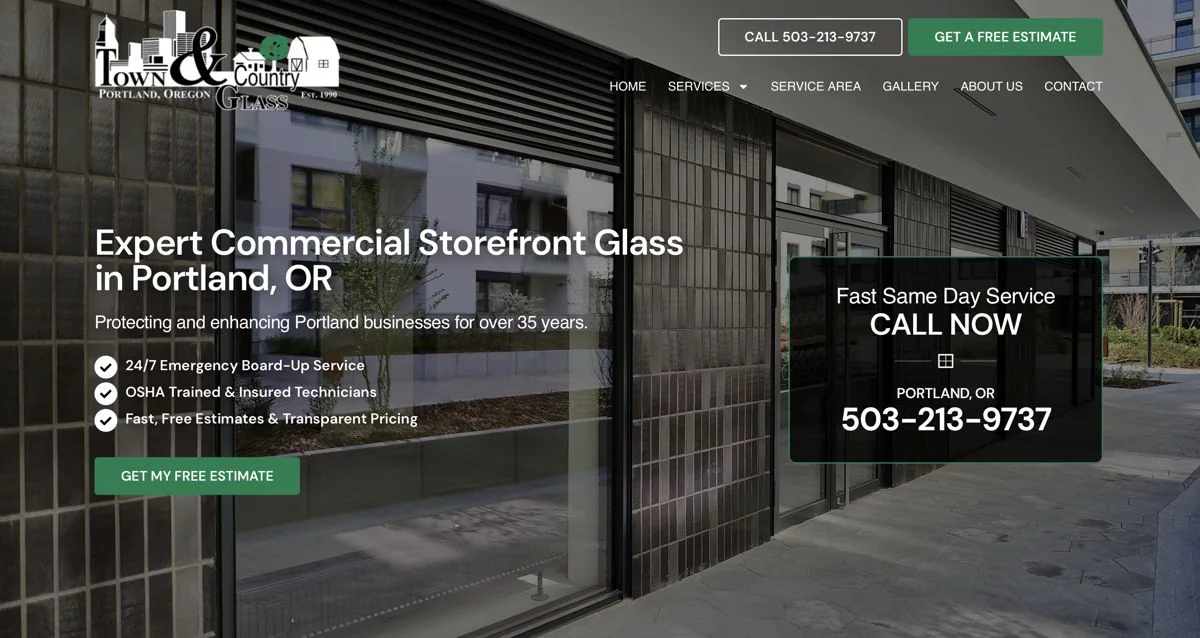
Our closest website case sits in Portland, part of Oregon City’s own metro. Town & Country Glass does commercial glass work, and Lithium gave it SEO, Google Ads and a new website at once; the card shows what the three did together. Marc Rickabaugh, whose company Rickabaugh Construction had Lithium update its website and SEO, gives his view in the quote.
Commercial glass13Xorganic traffic
145 to 1,849 visits a month
“We used the team at Lithium Marketing to update our website and increase our SEO. We couldn't have been happier with the results! We receive compliments about our updated website on a regular basis!”
 Marc RickabaughRickabaugh Construction
Nearby cities
Housing changes from one neighboring city to the next, and so do the projects your gallery should lead with. Compare West Linn, Lake Oswego, Happy Valley, Wilsonville, Tualatin and Tigard on their web design pages below, or open the Oregon page to find another city.
Published price
$5,000
typical project
Larger sites get a fixed proposal after a 30-minute discovery call. Six to nine weeks from kickoff to launch. You own the domain, hosting account, WordPress install and content.
FAQ

Still curious?
Call (503) 766-5964 or email [email protected].
It covers the site most service businesses need: service pages, area pages, a project gallery, forms and call tracking. Size is what moves the price. If you need a large project archive or many more pages, we price that bigger build up front, and you approve it before any work begins.
You own it. The domain, hosting and WordPress install are set up in your name, along with every page and photo, so the site keeps running if you stop working with Lithium. Optional hosting and maintenance is available if you would like us to handle updates.
Usually six to nine weeks from kickoff to launch. The biggest variable is how quickly photos and feedback come back, so sending your job photos and service list in the first week keeps the build on schedule.
Photos of finished jobs, a few for each service if you have them, your full service list, the cities and neighborhoods you work in and access to your current domain. We write all the copy, so there is nothing for you to draft.
It is built to. Every page gets its own title, description and schema for search, and the design leaves room for ad landing pages later without a rebuild, so the site can grow into both channels.
Free action plan
Tell us what you have now, whether that is an old site, a Facebook page or nothing at all, and attach a few photos of finished jobs. A co-founder will review them with you on a short video call and map out the pages your site needs.
What we’ll cover
2000 NE 42nd Ave Ste D Unit 2370, Portland, OR 97213
Prefer to pick a time? Book a 30-minute call with DJ