
 Plumbing
Sarkinen Plumbing
2Xleads
on the same budget
- search visibility
- 3.75X
- search visibility
- ads conversion rate
- 27.37%
- ads conversion rate
SEO for San Antonio contractors
Lithium builds the service pages, Google profile and directory listings San Antonio customers check, then shows you each month how many calls they bring.

 Google PartnerView our Partners listing
5.0on Google · read our reviews
Google PartnerView our Partners listing
5.0on Google · read our reviews
Businesses
we’ve worked with
Businesses we’ve worked with
San Antonio SEO in brief
Local SEO at Lithium Marketing starts with the listing San Antonio customers see first: your Google Business Profile. A search for “plumber san antonio” opened with the Map Pack when we checked, which puts three businesses in front of the customer before any website appears. That is why the profile, its reviews and the service pages behind it get built up together, for plumbers, roofers, electricians, pest control companies and other trades.
Customers here search by trade and city name, about 4,400 times a month for “pest control san antonio” and 1,900 for “electrician san antonio”. Searches that size each deserve their own page aimed at a San Antonio customer, naming the jobs you do and showing proof from finished work, so Google has a clear match for the search.
The results page
In that Map Pack, the three plumbers had 224, 87 and 324 Google reviews. Reviews matter, but the listing with 87 still appeared alongside two with far more, so the work covers the whole profile: the right primary category, every service you offer, photos from real jobs and a habit of asking every customer for a review once the job is done.
Angi, Facebook and Yelp also ranked on the first page, and Google showed a People also ask box of quick answers. Your name, phone and services should read the same on those directories as on your site, and your service pages should answer cost and timing questions in plain sentences that Google can pull into that box.
| Search | Searches a month | Cost per click |
|---|---|---|
| seo san antonio | 720 | $39.97 |
| seo company san antonio | 590 | not reported |
| seo services san antonio | 590 | not reported |
| seo agency san antonio | 170 | $37.26 |
Source: Google Ads keyword data, average monthly U.S. searches. "Under 10" = below Google’s reporting floor.
Source: one Google results page for “plumber san antonio”, as Google showed it to a searcher located in San Antonio. Search ad counts exclude sponsored local listings. Results shift by searcher and day.
Parts of the city
The city takes in upscale North Central neighborhoods such as Stone Oak, Rogers Ranch and Inwood, and West Side neighborhoods including Prospect Hill, Westwood and Collins Garden. An area page for each part of San Antonio you cover, naming its neighborhoods and showing jobs done there, gives Google a page to match when someone searches from that side of town and shows the customer you already work nearby.
Local pests belong on your pages too. The Eastern Subterranean Termite is a common structural pest here, and the invasive Formosan termite has spread into the greater San Antonio area. If you treat termites, or repair the damage they leave, a separate page for each one gives Google a clear match and gives the homeowner a straight answer.
Sources: U.S. Census Bureau 2025 population estimates, ACS 2020–2024 and 2023 County Business Patterns.
Trade counts
Plumbing, heating and air-conditioning is the largest group on the Bexar County chart, with 523 contractors. When that many companies could answer the same search, the one whose page names the exact job, such as AC repair, water heater replacement or drain cleaning, gives Google and the customer the closest match.
Bexar County lists 124 roofing contractors, and “roofing company san antonio” draws about 2,400 searches a month. For a roofer, that search volume supports separate pages for repairs, full replacements and leak calls, each backed by reviews, which gives Google more ways to match you than one general roofing page.
County Business Patterns
Trade and home service businesses in Bexar County
Establishments by industry, 2023
Source: U.S. Census Bureau, 2023 County Business Patterns (NAICS establishment counts).
The monthly work
The site gets repaired before we write anything new, and the reporting starts in week one.
We start with speed, mobile layout, indexing and internal links, since Google has to read a page quickly and fully before it can rank it.
We set the right categories, list each service, mark your service area and add real job photos, then give you a short text template that asks for a review after every job.
One page for each job you want more of, and area pages for the parts of San Antonio and nearby cities where you take work, each answering cost and timing questions.
We correct your business details on Angi, Yelp, Facebook and the data aggregators, then build links that point at the service pages bringing in calls.
What every SEO retainer includes
The same eight parts go into every SEO retainer, wherever the business is.
From the Portland area
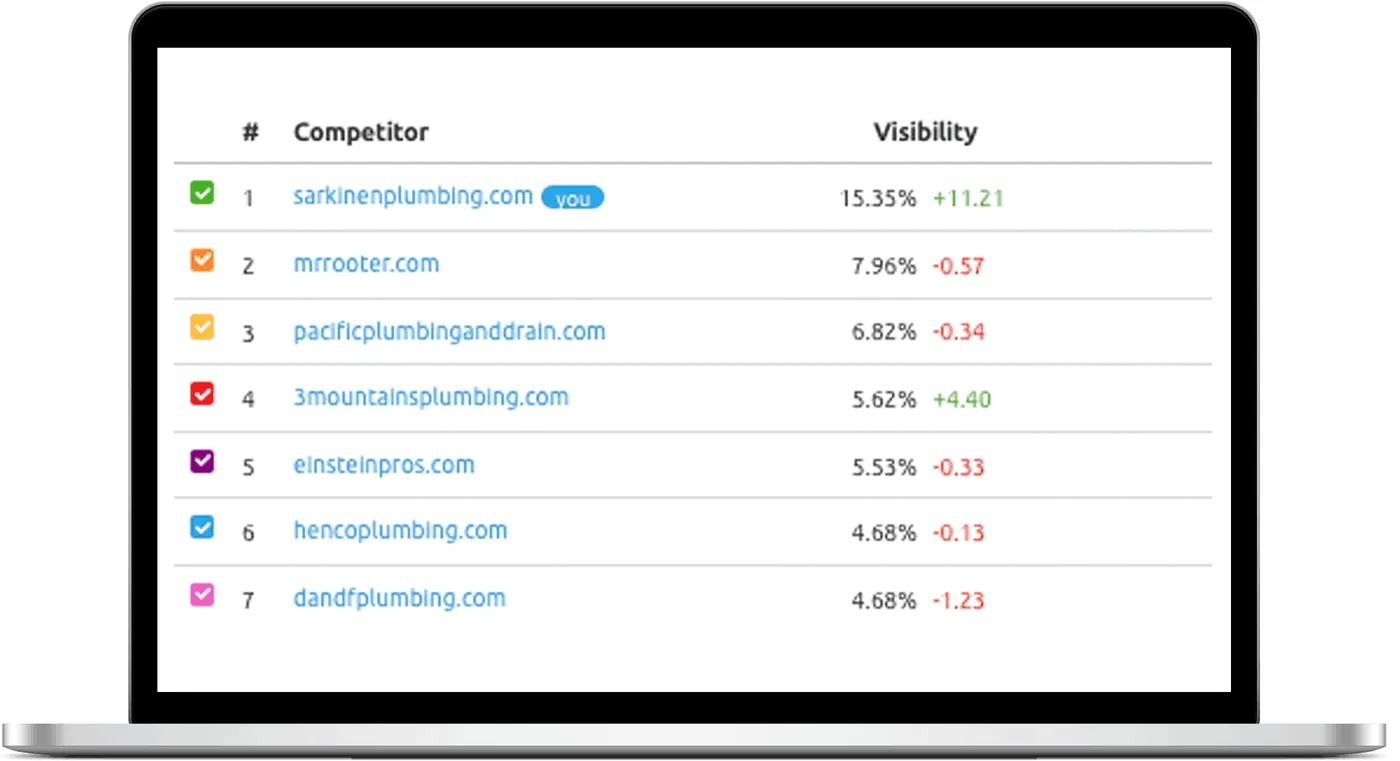
The case on the card is Sarkinen Plumbing, a plumber in the Portland area. Its SEO ran together with a new website and Google Ads from Lithium, so the numbers reflect all three. In the quote, Drake Snodgrass of Drake’s 7 Dees, a landscaping and garden center business, credits Lithium with moving his company onto Google’s first page of organic results.
Plumbing2Xleads
on the same budget
“Lithium has moved us to page 1 in Google search organically. Prior to working with them we spent a huge part of our marketing budget on paid search. Website redesign was a great experience.”
 Drake SnodgrassDrake’s 7 Dees
Nearby cities
If you take jobs in New Braunfels, Austin, Round Rock, Georgetown, Killeen or Corpus Christi, open that city’s SEO page below to see how many people there search for your kind of work, then decide whether it earns an area page on your site. Every other Texas city is on the state page.
Published price
$1,300–$3,000
per month
Typical local SEO retainer, scoped against what a lead is worth to you, with AI search optimization included.
It comes down to the number of pages, links and profile updates it takes to move you. A one-trade company with a sound website and a fair number of reviews sits near $1,300 a month. A plumbing and HVAC shop that wants to show across San Antonio and Bexar County, starting from a thin site, needs more each month and lands closer to $3,000.
The technical repairs usually show movement within about 30 days. Map Pack positions and longer, more specific searches usually take 60 to 90 days, and the effect on revenue builds from around the fourth month. Calls are tracked from week one, so the monthly numbers show which way things are heading long before then.
No. We guarantee the work, not a ranking. Google alone sets the Map Pack order; what we control is getting your profile, pages and listings right on schedule, and each month you see which searches moved and what calls followed.
It can compete across the city through two kinds of work. Your Google Business Profile can hide your address and list a service area, though the Map Pack still favors businesses near the person searching. For the rest of the city, area pages on your website compete in the organic results, which is why we write one for each part of San Antonio you serve.
Access to your website, Google Business Profile and Search Console, the list of services you want more of and the parts of San Antonio you cover. Photos from finished jobs help both the profile and the pages. We do the writing and the technical work, and you approve each page before it goes live.
Free action plan
Send us your site and a short list of the jobs you most want. On a short video call, a co-founder walks through where you show up for those jobs across San Antonio, in the Map Pack and below it, and what we would change in the first month.
What we’ll cover
2000 NE 42nd Ave Ste D Unit 2370, Portland, OR 97213
Prefer to pick a time? Book a 30-minute call with DJ